



Skip to content
  • Facebook
  • X
  • Linkedin
  • WhatsApp
  • YouTube
  • Associate Journalism
  • About Us
  • Privacy Policy
  • 033-46046046
  • editor@artifex.news
Artifex.News

Artifex.News

Stay Connected. Stay Informed.

  • Breaking News
  • World
  • Nation
  • Sports
  • Business
  • Science
  • Entertainment
  • Lifestyle
  • Toggle search form
  • SMAT 2025-26 | Himmat’s last-ball six helps Delhi edge Tamil Nadu
    SMAT 2025-26 | Himmat’s last-ball six helps Delhi edge Tamil Nadu Sports
  • Ukraine says it foiled a Russian spy agency plot to assassinate President Zelensky
    Ukraine says it foiled a Russian spy agency plot to assassinate President Zelensky World
  • Russia says captured three more east Ukrainian villages
    Russia says captured three more east Ukrainian villages World
  • Schoolteacher Stabbed By Student In Classroom In France
    Schoolteacher Stabbed By Student In Classroom In France World
  • 156.7 Kmph Sensation Gets Maiden India Call-Up For T20Is vs Bangladesh
    156.7 Kmph Sensation Gets Maiden India Call-Up For T20Is vs Bangladesh Sports
  • Access Denied Sports
  • Only 3,833 out of 57,566 schools in T.N. have dedicated special educators, shows Rajya Sabha reply
    Only 3,833 out of 57,566 schools in T.N. have dedicated special educators, shows Rajya Sabha reply Nation
  • Asian Games: Pugilist Parveen Hooda Punches Her Way Into Women’s 57kg Quarterfinals
    Asian Games: Pugilist Parveen Hooda Punches Her Way Into Women’s 57kg Quarterfinals Sports
What is downblending, the process at the heart of Trump’s Iran agreement?

What is downblending, the process at the heart of Trump’s Iran agreement?

Posted on June 19, 2026 By admin


In the memorandum of understanding signed by the U.S. and Iran to end the war, Tehran has pledged never to develop a nuclear bomb in return for U.S. sanctions relief and access to a $300 billion development fund. Beyond that commitment, the MoU offers few details on how the U.S. and Iran intend to solve the nuclear dispute.

Iran still possesses hundreds of kilograms of highly enriched uranium and retains the technical capacity to produce more. While the modalities of a final agreement are to be negotiated in the second phase of talks, the MoU states that both sides have agreed to take steps to downblend Iran’s uranium stockpile. U.S. President Donald Trump said last week that the U.S. would “go and get” Iran’s highly enriched uranium “at some point” and “dilute” (downblend) it either in America or in Iran.

Paragraph 8 of the MoU states: “The Islamic Republic of Iran reaffirms that it shall not procure or develop nuclear weapons… The two parties also agreed to resolve the disposition of stockpiled enriched material pursuant to a mechanism… with the minimum methodology to be down-blending on site under the supervision of the International Atomic Energy Agency.”

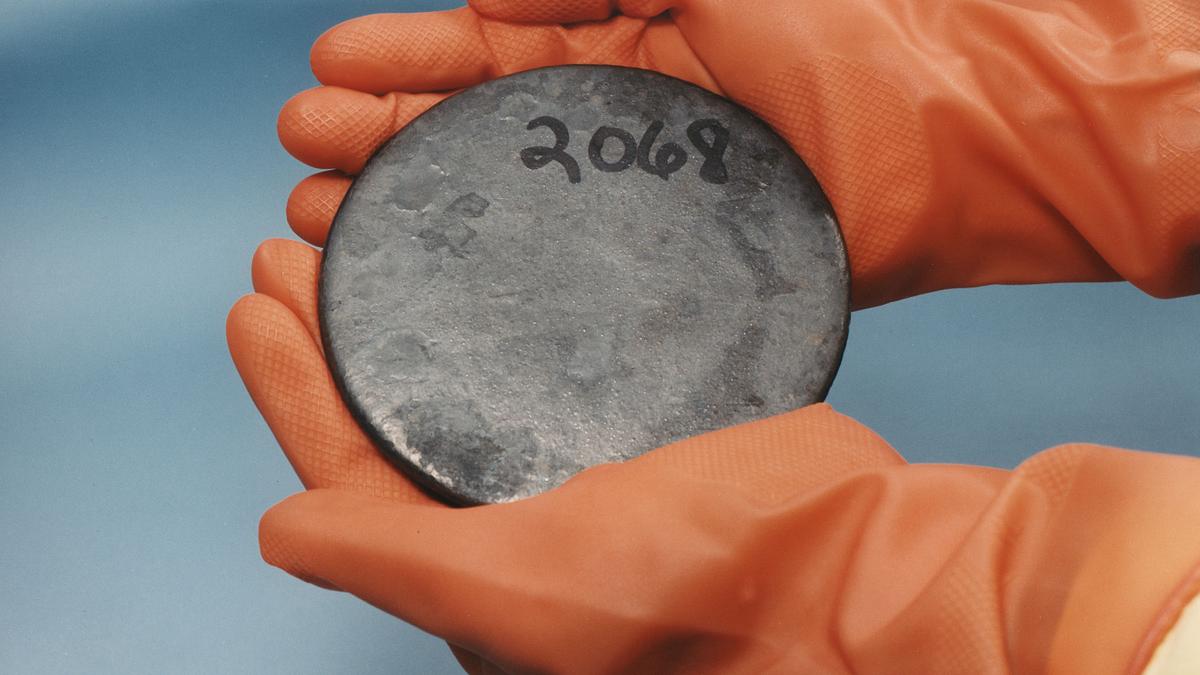
Downblending is a technology used to make uranium less pure. It is difficult to purify uranium, and highly pure uranium can be used to make nuclear bombs. So downblending removes the amount of uranium-235 available to make a bomb and increases the time required to do so. This duration, called the breakout time, is a cornerstone of modern nuclear non-proliferation.

Thus, the international community’s trust in Iran’s promise to not pursue a nuclear weapon depends on how well it implements downblending in the coming months, among other factors.

Uranium in nature consists mainly of two isotopes: uranium-238 and uranium-235. Of these, only uranium-235 is fissile, meaning it can sustain a nuclear chain reaction. However, the natural concentration of uranium-235 in uranium is only 0.72%. The remaining 99.28% is uranium-238. Purification means enriching the concentration of uranium-235 to higher levels.

Downblending is the opposite of enrichment. Here, enriched uranium is mixed with depleted (opposite of enriched) or natural uranium to produce uranium with less than 5% uranium-235. E.g. the 2015 Iran deal allowed Iran to enrich uranium up to 3.67%. Uranium of this purity can be used in some simple reactors to produce electricity but not to make a bomb.

The enriched uranium feedstock is usually stored as the compound uranium hexafluoride (UF6), which is a solid at room temperature. In the first step, the steel cylinders containing UF6 are placed in an industrial oven called an autoclave and heated to 80-110° C, turning the compound to gas. Gases are easier to mix than solids.

Second, another source of uranium called the blendstock is prepared. It can have 0.7% uranium-235 (natural uranium), 0.2-0.3% (depleted uranium), 1% uranium-235 (slightly enriched) or a different level. The level is based on need. For instance, downblending 90% enriched uranium to 5% will need a larger quantity of depleted uranium than natural uranium. The blendstock is also gaseous.

The enriched feedstock and the blendstock are pumped into a junction called a blending tee. The main challenge here is mass flow control: to achieve a target enrichment, the ratio of the two gases must be perfect. If too much feedstock gets in, the final gas will be too high in uranium-235.

Engineers use thermal mass flow meters, which determine the masses by measuring the heat transfer characteristics of the flowing gases. Then automated values adjust the flow. To ensure the gases mix, the blending tee uses internal mixers, called baffles, to create turbulence.

When the mixed gas exits the blending tee, it passes through an online enrichment monitor (OLEM). The OLEM uses sodium iodide to sense the amount of gamma rays emitted by the gas. Uranium-235 has an energy signature at 186 keV (around 3 × 10^-14 joules). OLEM tracks the intensity of gamma rays with this signature. If it exceeds an agreed-upon limit, the system will trigger failsafe valves that shut off the entire flow. This is done to keep the facility from producing more of the non-compliant material.

In fact, the facility is also fit with cameras housed in tamper-proof casings and which record 24/7.

The gas is then solidified by cooling it in a product cylinder.

This is not the last step, however. The downblended uranium still exists as UF6 — which is also the feedstock for the process that enriches uranium. Since the purpose of downblending is to increase the amount of effort needed to make a bomb, the UF6 is finally moved to a reconversion plant, where the gas reacts with steam and hydrogen. The reaction replaces the fluorine atoms with oxygen, producing uranium dioxide (UO2), a dark powder.

The uranium in UO2 can’t be enriched directly. It has to be converted to UF6 first in a conversion plant. The emissions from such a plant can be detected by satellites and on ground inspections.

The very last step is IAEA verification. IAEA inspectors collect a small physical sample of the UO2 powder and ship it to their laboratory in Seibersdorf, Austria, where thermal ionisation mass spectrometry is used to confirm the level of uranium-235 to four decimal places. Second, the IAEA applies seals on the cylinders that can’t be tampered without leaving back signs.

While the crux of downblending is the physical mixing, downblending the process includes the control systems so that it can provide verifiable proof that the uranium has indeed become less pure. And that in turn is why the U.S.-Iran memorandum will rest as much on diplomatic assurances as on the technical implementation.

Published – June 19, 2026 09:14 am IST



Source link

Science

Post navigation

Previous Post: Pawar replaces Patil as Mumbai chief selector, Salvi retained as head coach
Next Post: JD Vance slams Israeli officials who criticised U.S.-Iran deal, deepening rift between allies

Related Posts

  • Scientists in Chile question if Antarctica has hit a point of no return
    Scientists in Chile question if Antarctica has hit a point of no return Science
  • The Science Quiz | Cholesterol
    The Science Quiz | Cholesterol Science
  • A community for cosmic curiosity
    A community for cosmic curiosity Science
  • Japan weather bureau says 90% chance of El Nino ending by May
    Japan weather bureau says 90% chance of El Nino ending by May Science
  • How scientists are using menstrual blood to treat osteoarthritis
    How scientists are using menstrual blood to treat osteoarthritis Science
  • Indian team discovers rare ‘bow and arrow’ radio galaxy two billion light years from Earth
    Indian team discovers rare ‘bow and arrow’ radio galaxy two billion light years from Earth Science

More Related Articles

What is Theremin? What is Theremin? Science
Puzzling spider web decorations revealed to boost prey detection Puzzling spider web decorations revealed to boost prey detection Science
Models struggled to predict the 2026 monsoon’s rapid changes Models struggled to predict the 2026 monsoon’s rapid changes Science
Artemis II | Mission moon Artemis II | Mission moon Science
Sun bears appear so human-like they are mistaken for people in suits – experts explain Sun bears appear so human-like they are mistaken for people in suits – experts explain Science
PRIYA trial links teen B12 intake to long-term health in babies PRIYA trial links teen B12 intake to long-term health in babies Science
SiteLock

Archives

  • September 2026
  • August 2026
  • July 2026
  • June 2026
  • May 2026
  • April 2026
  • March 2026
  • February 2026
  • January 2026
  • December 2025
  • November 2025
  • October 2025
  • September 2025
  • August 2025
  • July 2025
  • June 2025
  • May 2025
  • April 2025
  • March 2025
  • February 2025
  • January 2025
  • December 2024
  • November 2024
  • October 2024
  • September 2024
  • August 2024
  • July 2024
  • June 2024
  • May 2024
  • April 2024
  • March 2024
  • February 2024
  • January 2024
  • December 2023
  • November 2023
  • October 2023
  • September 2023
  • August 2023
  • July 2023
  • June 2023
  • May 2023
  • April 2023
  • March 2023
  • February 2023
  • January 2023
  • December 2022
  • November 2022
  • October 2022
  • September 2022
  • August 2022
  • July 2022
  • June 2022
  • May 2022

Categories

  • Business
  • Nation
  • Science
  • Sports
  • World

Recent Posts

  • Saudi Arabia confirms Yemen’s Houthi rebels tried to attack its capital with ballistic missile
  • Martin recovers from early setback to win Austrian sprint and retake championship lead
  • Arsenal thrashed by Brighton, sorry Spurs lose again
  • Shamli Police book six over alleged ‘misleading’ social media posts on Ayush Malik High Court proceedings
  • What is the India-Pakistan conflict at sea about? | Explained

Recent Comments

  1. AlvinNet on UP Teacher Who Asked Students To Slap Muslim Classmate
  2. AlvinNet on UP Teacher Who Asked Students To Slap Muslim Classmate
  3. Jamesslits on UP Teacher Who Asked Students To Slap Muslim Classmate
  4. MichaelClear on UP Teacher Who Asked Students To Slap Muslim Classmate
  5. Jamesslits on UP Teacher Who Asked Students To Slap Muslim Classmate
  • India fully withdraws soldiers from Maldives: Presidential spokesperson
    India fully withdraws soldiers from Maldives: Presidential spokesperson World
  • Access Denied World
  • Indian-origin woman sentenced to two years jail over Covid business loan fraud in U.K.
    Indian-origin woman sentenced to two years jail over Covid business loan fraud in U.K. World
  • Real Madrid Miss Another Chance To Overtake Barcelona, Play Out 3-3 Draw vs Rayo Vallecano
    Real Madrid Miss Another Chance To Overtake Barcelona, Play Out 3-3 Draw vs Rayo Vallecano Sports
  • New Role For Ramesh Bidhuri, Who Abused Danish Ali, Is “Reward For Hate”
    New Role For Ramesh Bidhuri, Who Abused Danish Ali, Is “Reward For Hate” Nation
  • Newly-Elected Pak PM Thanks PM Modi For Felicitating Him On His Re-Election
    Newly-Elected Pak PM Thanks PM Modi For Felicitating Him On His Re-Election World
  • Ganesh Chaturthi 2023 Greetings, Messages, Wishes, SMS, WhatsApp Status And More
    Ganesh Chaturthi 2023 Greetings, Messages, Wishes, SMS, WhatsApp Status And More Nation
  • Access Denied
    Access Denied Nation

Editor-in-Chief:
Mohammad Ariff,
MSW, MAJMC, BSW, DTL, CTS, CNM, CCR, CAL, RSL, ASOC.
editor@artifex.news

Associate Editors:
1. Zenellis R. Tuba,
zenelis@artifex.news
2. Haris Daniyel
daniyel@artifex.news

Photograher:
Rohan Das
rohan@artifex.news

Artifex.News offers Online Paid Internships to college students from India and Abroad. Interns will get a PRESS CARD and other online offers.
Send your CV (Subjectline: Paid Internship) to internship@artifex.news

Links:
Associate Journalism
About Us
Privacy Policy

News Links:
Breaking News
World
Nation
Sports
Business
Entertainment
Lifestyle

Registered Office:
72/A, Elliot Road, Kolkata - 700016
Tel: 033-22277777, 033-22172217
Email: office@artifex.news

Editorial Office / News Desk:
No. 13, Mezzanine Floor, Esplanade Metro Rail Station,
12 J. L. Nehru Road, Kolkata - 700069.
(Entry from Gate No. 5)
Tel: 033-46011099, 033-46046046
Email: editor@artifex.news

Copyright © 2023 Artifex.News Newsportal designed by Artifex Infotech.