


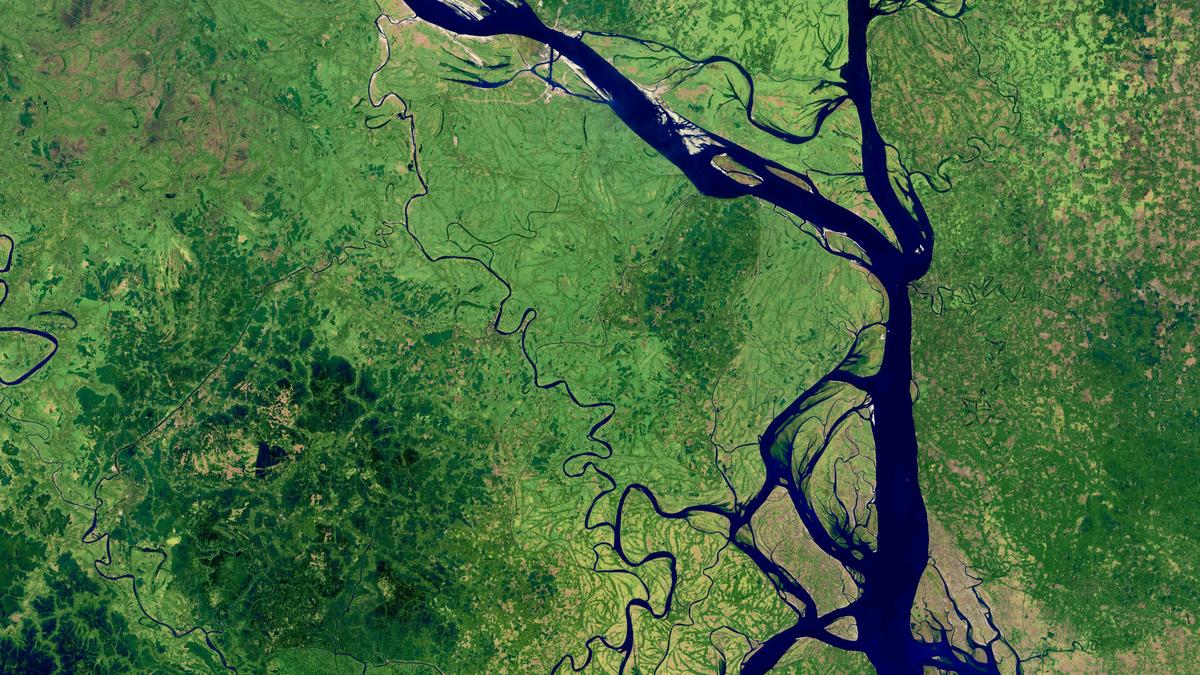
Bangladesh recently approved the construction of the Padma barrage. The barrage is intended to control the Padma river, which is the name of the Ganga in Bangladesh, and abate the country’s seasonal water scarcity.
The 2.1-km-long structure will store 2,900 million cu. m of water to serve 6.5 crore people across southwestern and northern Bangladesh. It is estimated to cost Tk 50,443 crore (Rs 39,170 crore) over seven years.
The Padma barrage will lie just 180 km downstream of the Farakka barrage in West Bengal — and what Bangladesh has increasingly viewed as an impediment. The Farakka barrage is one of India’s largest with a feeder canal and was built to divert water from the Ganga to the Bhagirathi-Hoogly and thus flush the Kolkata Port.
Under the 1996 Ganges Water Treaty, Bangladesh will receive half the water from the Farakka barrage when the flow is under 70,000 cusecs. But during the dry season between March and May, each country has to receive at least 35,000 cusecs of water in three alternating 10-day periods.
Treaties past and future
A 2019 review by an international team of experts in Water Policy found that there were “repeated occurrences of low flow at Farakka during the drier years in the post-Treaty period,” including in 1997, 2008, 2010 and 2016. They concluded that the 1996 Treaty couldn’t account for rising unpredictability in the flows.
The agreement is set to expire in December 2026. Both New Delhi and Dhaka have said negotiations to extend it are underway.
But Dhaka has also said the Farakka barrage is responsible for the country’s periodic water scarcity. To add to the resulting anxiety, several river-sharing agreements between India and Bangladesh remain unsigned, including the Teesta River Treaty.
An illustration showing the Ganga and Brahmaputra basins in South Asia.
| Photo Credit:
Pfly (CC BY-SA)
According to S. Janakarajan, president of the South Asia Consortium for Interdisciplinary Water Resources Studies, “All transboundary water issues centre around the lack of timely flow of water,” implying that the barrage will be a way for the lower riparian state to exert some control over its water resources.
But this equity will come at a sizeable environmental cost. Bangladesh is already very drought-prone, ranking third in the World Resources Institute Aqueduct drought-risk ranking.
Effects of Farakka barrage
Dhaka’s concerns over the Farakka barrage are not unfounded. Diverting the Ganga’s waters altered the river’s character and ecology in Bangladesh. About a third of Bangladesh relies on the Ganga basin, mostly to irrigate crops. By redirecting the river and reducing downward flow, the Farakka has dried up several of Bangladesh’s rivers. The result is reduced groundwater levels, fewer waterways for navigation, increased salinity, riverbank erosion and reduced freshwater flows to the Sundarbans.
“A substantial part of Bangladesh is under a low elevation coastal zone,” Mr. Janakarajan said, meaning the land is less than 10 m above sea level.
“In the near future, sea-level rise will lead to the disappearance of 17% of the territory of Bangladesh,” researchers wrote in the Journal of Marine Science and Engineering in 2022. This, they added, will “create 20 million refugees, and 220,000 km2 of land will be submerged following a projected sea-level rise of 1500 mm to take place within 150 years.”
Groundwater overextraction isn’t helping. Bangladesh drew around 520 litres of groundwater per person per day in 2008 (the latest year for which the U.N. FAO Aquastat database provides national figures for withdrawals by source), which is not particularly high — but the country’s dependence on groundwater is a matter of concern.
Because the Farakka barrage also reduces the flow in the Padma, the Padma is less able to transport silt, which sinks to the riverbed and piles up. When the monsoons arrive, then, the river overflows quickly and floods.
Keeping the sediment flowing is also crucial to maintain the ecosystems and the livelihoods that depend on it.
For example, the Sundarbans region hosts the world’s largest contiguous mangrove forest and relies on water from the Ganga, Brahmaputra, and Meghna rivers. Mr. Janakarajan said less sediment and freshwater flowing from these barrages will cause the water in the Sundarbans to become saline whereas the ecosystem requires the water to be brackish, which is less salty.
These changes will lead to fewer fish, affecting the lives and livelihoods of fisherfolk in the area.

Fondness for concrete
South Asia is currently on a dam-building spree. There are more than 160 hydroelectric power projects underway in South Asia and more than 700 planned hydropower plants have been georeferenced in the Indus-Ganga-Brahmaputra region, per a 2023 review in Water. China is also building what will be the world’s largest dam over the upper course of the Brahmaputra, just before the river enters India. In response, India initiated a Rs 6.4 lakh crore hydroelectric power project, including building over 200 dams in its Northeast.
Dams — of which barrages are a type — are generally designed to operate for a century. Climate change is breaking this guarantee.
The Farakka barrage across the Ganga river in West Bengal.
| Photo Credit:
Project website
To ensure barrages don’t overflow under heavy bursts of rain, for instance, engineers have to drain water from behind a barrage via canals to other areas, Omair Ahmad, former South Asia managing editor at Dialogue Earth. However, this will require building extensive water diversion infrastructure, which would likely be made of cement.
“Creating greater pondage here in a cement thing means water is not going into your groundwater. It cannot. It is robbing a much larger area around that barrage of the regular flow of water that would seep in from a river basin,” Mr. Ahmad said.
Given the bevy of adverse environmental consequences, experts say building another barrage is not the most rational choice. In fact, they have already said much of South Asia’s obsession with building big dams is something of a colonial hangover.
“We think big projects will actually manage [water] despite historical evidence that they do not,” Mr. Ahmad said. “It is rare for big projects to be able to manage this because ecosystems are a bit too complex.”
Mr. Ahmad and Mr. Janakarajan also suggested that instead of one large barrage, Bangladesh should consider building a series of smaller check-dams, which don’t dramatically alter a river’s flow.
But this has the downside of requiring cross-country planning and maintenance. The Padma barrage on the other hand will be ‘confined’ to one specific area.

Water and neighbourhood
“Water sharing is always going to be a political issue,” Sreeradha Datta, an international affairs professor at O.P. Jindal Global University, said. “The more we try to tame the river, the more we fall into other issues [with] long-term consequences which we cannot see now. But in the immediate context, it looks beneficial, and we are always pandering to the constituency.”
The long-term consequences also evolve. After the Pahalgam attack in 2025, India suspended the Indus Water Treaty with Pakistan. Experts have said India engages in one-on-one diplomacy with its neighbours, in part to project a dominant stance but also to keep relations separate. Still, India’s reaction may be on Dhaka’s mind as it heads into the 1996 Treaty talks while New Delhi steps up its rhetoric on “illegal” migrants.
China looms as well. According to a report in The Daily Star, Bangladeshi officials have said the government will build the Padma barrage with its own money. Experts, however, say the country lacks the engineering resources for a project of this scale and likely has help from China, which is already involved in other infrastructure projects in the area.
“China is a non-resident South Asian,” Prof. Datta said. Working on a project so close to the border along with India’s scepticism towards Bangladesh’s new Tarique Rahman administration could make India uncomfortable, she added.
During his 2016 trip to Dhaka, China President Xi Jinping said the Chinese and the Bangladeshi people “drink water from the same river”.
“China gets to be seen more and more as a dominant water manager in South Asia, as it has already become in the Mekong,” Mr. Ahmad said. “India becomes a less relevant actor within its own neighbourhood.”
For all these concerns, however, India has not directly commented on the Padma Barrage. Bangladesh has said its relationship with India depends on what they agree about sharing the Ganga’s waters. Delhi has said all river-sharing issues will be handled within the existing bilateral framework. The treaty’s renewal process is underway.
sonikka.l@thehindu.co.in