



Skip to content
  • Facebook
  • X
  • Linkedin
  • WhatsApp
  • YouTube
  • Associate Journalism
  • About Us
  • Privacy Policy
  • 033-46046046
  • editor@artifex.news
Artifex.News

Artifex.News

Stay Connected. Stay Informed.

  • Breaking News
  • World
  • Nation
  • Sports
  • Business
  • Science
  • Entertainment
  • Lifestyle
  • Toggle search form
  • World Heritage Site Sanchi In Madhya Pradesh Is India’s First Solar City
    World Heritage Site Sanchi In Madhya Pradesh Is India’s First Solar City Nation
  • India’s T20 World Cup Jersey Price Revealed. Delhi-Goa Flight Tickets Cost Less
    India’s T20 World Cup Jersey Price Revealed. Delhi-Goa Flight Tickets Cost Less Sports
  • Access Denied Sports
  • Doctor, 5 Workers Killed In Jammu And Kashmir Terror Attack
    Doctor, 5 Workers Killed In Jammu And Kashmir Terror Attack Nation
  • Pope blames weapons industry for Russia-Ukraine war and ‘martyrdom’ of Ukrainian people
    Pope blames weapons industry for Russia-Ukraine war and ‘martyrdom’ of Ukrainian people World
  • 18 security personnel, 23 terrorists killed in Pakistan’s restive Balochistan
    18 security personnel, 23 terrorists killed in Pakistan’s restive Balochistan World
  • Finger In Ice Cream Belongs To Factory Staff? Big Update In Mumbai Shocker
    Finger In Ice Cream Belongs To Factory Staff? Big Update In Mumbai Shocker Nation
  • U.S. CDC recommends broad use of updated COVID-19 vaccines
    U.S. CDC recommends broad use of updated COVID-19 vaccines World
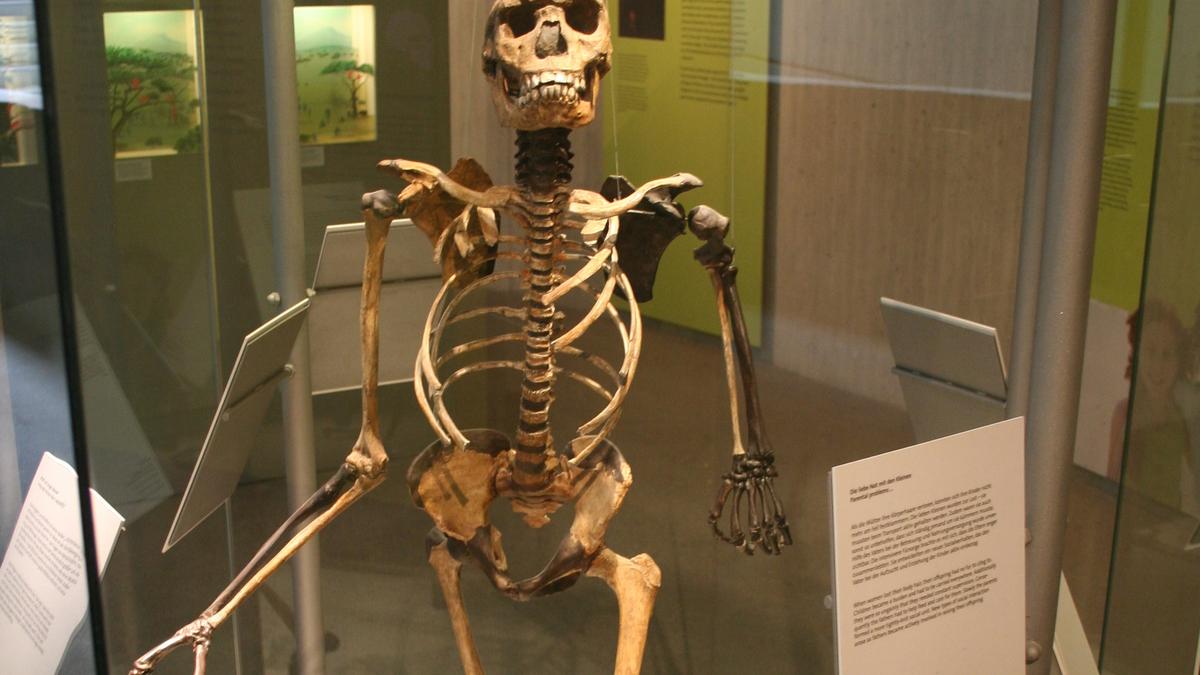
Homo erectus fossil yields secrets long thought to be beyond genetics

Homo erectus fossil yields secrets long thought to be beyond genetics

Posted on June 7, 2026 By admin


For much of modern history, human evolution was thought to progress in linear fashion, with one species replacing another, one by one. The famous ‘ape turning to human’ cartoon illustrating a stooped primate gradually straightening into a modern man essentially captures this idea.

That picture began to change in the second half of the 19th century when scientists started to unearth human-like fossils. At the time, scientists used geological clues such as the depth at which a fossil was found and the rock layers surrounding it to determine the age of fossils. This method could establish which fossils were older or younger than others but did not reveal precise dates.

The timeline suggested an intriguing possibility, however. It appeared that these different kinds of humans had not followed one another in succession but had lived alongside each other. Radiometric dating techniques later confirmed this idea: multiple human species had coexisted on the earth at various points.

Series of surprises

In 2003, the Human Genome Project announced the first high-quality sequence of the human genome. Human beings finally possessed the secret to their own identity — the reason(s) they were unique. That sense of identity proved to be short-lived.

In 2010, scientists published the genome of the Neanderthals, our closest extinct relatives. When they compared Neanderthal DNA with the genomes of living people, they uncovered a remarkable result. Most humans alive today carry around 1-2% Neanderthal DNA in their own genomes. In Africans, this percentage is slightly lower, but even their DNA is 0.3-0.5% Neanderthal.

The surprises did not end there. In 2012, scientists sequenced the genome of Denisovans, another human lineage, finding that some present-day populations, particularly in Oceania and parts of Southeast Asia, had 3-6% Denisovan DNA.

That we carry DNA fragments from two other members of the genus Homo raised the possibility that we may also harbour genetic material from other extinct human species. But in the 14 years since the Denisovan genome was published, no new genome from any other extinct human relative has been uncovered.

DNA after death

The difficulty lies in the nature of DNA itself. The moment an organism dies, its DNA begins to break down. Enzymes released from dying cells cut DNA into small pieces. Microbes and fungi invade the remains and further degrade the genetic material. Water and oxygen promote chemical reactions that further damage DNA. Then there are temperature fluctuations, solar radiation, and UV damage. Over a few tens of millennia, the DNA is reduced to a few small pieces.

To recover DNA from these ancient humans, scientists need to be very lucky. The specimen must have been exposed to cold, dry, and stable environments such as permafrost, frozen sediments, or the inside of a deep cave. This is very rare — and why only a small fraction of fossils contain usable DNA.

One such species whose DNA sequence has evaded us for a long time is Homo erectus, the species estimated to have originated over 2 million years ago and thought to be one of the first human relatives to spread widely across Africa, Europe, and Asia.

Acid etching

A recent study published in Nature has provided the first molecular sequences from Homo erectus fossils from China. Rather than attempting to recover DNA directly, the researchers extracted proteins preserved within the enamel of six Homo erectus teeth dated to around 400,000 years ago. Because proteins are the products of the DNA, their sequences can reveal portions of the underlying genetic information, providing a rare, albeit narrow, view into the genome of an extinct human species.

The method used to recover the genetic information is notable. Usually, recovering ancient DNA or proteins requires scientists to grind up part of a fossil, so museum curators are reluctant to permit such analyses, especially when there is no guarantee that usable genetic material will be recovered.

To overcome this problem, the researchers used acid etching, a technique where a small area of the tooth enamel is briefly exposed to a dilute acid solution, which dissolves microscopic amounts of tooth enamel and releases the proteins trapped within it. The fossil is left largely intact. Since tooth enamel is a highly mineralised tissue, it can trap and protect proteins for a long time.

The researchers proceeded to successfully recover enamel proteins from five male and one female Homo erectus individuals. When they compared the protein sequences with those of modern humans, Neanderthals, and Denisovans, they made two interesting discoveries.

First, all six Homo erectus individuals had a protein variant that has never been found in any other known species in the genus Homo. Second, they carried another variant present in Denisovans. This suggests populations related to these Chinese Homo erectus may have interbred with Denisovans in East Asia.

Shared story

However, because the results come from only the enamel proteins and not the entire genome, they are not conclusive. It was long known that the Denisovan genome contains DNA from a much older species of the human lineage. While this study points to Homo erectus as a possible candidate, it does not prove it.

Nevertheless, the study represents an advance far beyond the information it has generated, which by itself is tiny. This is the first effort to recover meaningful molecular data from Homo erectus fossils, long thought to be beyond the reach of genetics.

Though Neanderthals, Denisovans, and others have vanished from the earth, traces of their existence endure within our DNA. The more we look, the more we find that the story of humans is not only ours: it is theirs as well.

Arun Panchapakesan is an assistant professor at the Y.R. Gaitonde Centre for AIDS Research and Education, Chennai.

Published – June 08, 2026 07:30 am IST



Source link

Science

Post navigation

Previous Post: Hyderabad man shot dead during pizza delivery in Philadelphia
Next Post: Mcap of 7 of top-10 most valued firms erodes by ₹1.25 lakh cr; Reliance takes biggest hit

Related Posts

  • What is geospatial intelligence? A geographer explains the powerful melding of maps and data
    What is geospatial intelligence? A geographer explains the powerful melding of maps and data Science
  • The Science Quiz: Rovers on the moon and Mars
    The Science Quiz: Rovers on the moon and Mars Science
  • Consumption of ultra-processed and fast foods leading cause of diabetes in India, reveals new study
    Consumption of ultra-processed and fast foods leading cause of diabetes in India, reveals new study Science
  • How did the Baltimore bridge disaster happen? | Explained
    How did the Baltimore bridge disaster happen? | Explained Science
  • How quantum algorithms solve problems that classical computers can’t
    How quantum algorithms solve problems that classical computers can’t Science
  • Study suggests ancient Indian scholars knew mineral acids centuries before Europeans
    Study suggests ancient Indian scholars knew mineral acids centuries before Europeans Science

More Related Articles

Why did Anthropic’s Claude Cowork plugins spook markets? | The Hindu Explains Why did Anthropic’s Claude Cowork plugins spook markets? | The Hindu Explains Science
Food systems largest violators of planetary limits: 2025 EAT-Lancet Commission Food systems largest violators of planetary limits: 2025 EAT-Lancet Commission Science
ISRO | Mission possible – The Hindu ISRO | Mission possible – The Hindu Science
How small can a liquid be? How small can a liquid be? Science
How can a quantum computer prove that it is superior? How can a quantum computer prove that it is superior? Science
The Science Quiz | The lives of hormones The Science Quiz | The lives of hormones Science
SiteLock

Archives

  • June 2026
  • May 2026
  • April 2026
  • March 2026
  • February 2026
  • January 2026
  • December 2025
  • November 2025
  • October 2025
  • September 2025
  • August 2025
  • July 2025
  • June 2025
  • May 2025
  • April 2025
  • March 2025
  • February 2025
  • January 2025
  • December 2024
  • November 2024
  • October 2024
  • September 2024
  • August 2024
  • July 2024
  • June 2024
  • May 2024
  • April 2024
  • March 2024
  • February 2024
  • January 2024
  • December 2023
  • November 2023
  • October 2023
  • September 2023
  • August 2023
  • July 2023
  • June 2023
  • May 2023
  • April 2023
  • March 2023
  • February 2023
  • January 2023
  • December 2022
  • November 2022
  • October 2022
  • September 2022
  • August 2022
  • July 2022
  • June 2022
  • May 2022

Categories

  • Business
  • Nation
  • Science
  • Sports
  • World

Recent Posts

  • Bharathiraja passes away | Tributes pour in for Tamil cinema’s transformative voice
  • Bharathiraja, ace film director, passes away
  • Pakistan carries out new deadly strikes on Afghanistan: government officials
  • FIFA 2026 | A World Cup like no other
  • West Asia war LIVE: U.S. military says ‘completed’ strikes against Iran; ‘will leave no attack or threat unanswered’, says Iran

Recent Comments

  1. DarrylSnigo on UP Teacher Who Asked Students To Slap Muslim Classmate
  2. JamesRot on UP Teacher Who Asked Students To Slap Muslim Classmate
  3. JulesMex on UP Teacher Who Asked Students To Slap Muslim Classmate
  4. FrancisSkida on UP Teacher Who Asked Students To Slap Muslim Classmate
  5. Jerryrek on UP Teacher Who Asked Students To Slap Muslim Classmate
  • Access Denied
    Access Denied Nation
  • “Raebareli, Amethi Not Just Constituencies, But Our Karmabhoomi”: Rahul Gandhi
    “Raebareli, Amethi Not Just Constituencies, But Our Karmabhoomi”: Rahul Gandhi Nation
  • Shubman Gill and Sai Sudharsan showed you can succeed in T20 playing traditional cricket | IPL Show
    Shubman Gill and Sai Sudharsan showed you can succeed in T20 playing traditional cricket | IPL Show Sports
  • U.K., France, Germany back direct Ukraine-Russia talks
    U.K., France, Germany back direct Ukraine-Russia talks World
  • Taiwan reports Chinese military incursions into Air Defence Identification Zone
    Taiwan reports Chinese military incursions into Air Defence Identification Zone World
  • How Trump’s H-1B fee threatens India’s IT firms and Big Tech business models
    How Trump’s H-1B fee threatens India’s IT firms and Big Tech business models World
  • Colombian Wonderkid Jhon Duran Extends Aston Villa Contract Till 2030
    Colombian Wonderkid Jhon Duran Extends Aston Villa Contract Till 2030 Sports
  • Frequent GPS interference, including ‘spoofing’, near India’s border with Pakistan, Myanmar
    Frequent GPS interference, including ‘spoofing’, near India’s border with Pakistan, Myanmar World

Editor-in-Chief:
Mohammad Ariff,
MSW, MAJMC, BSW, DTL, CTS, CNM, CCR, CAL, RSL, ASOC.
editor@artifex.news

Associate Editors:
1. Zenellis R. Tuba,
zenelis@artifex.news
2. Haris Daniyel
daniyel@artifex.news

Photograher:
Rohan Das
rohan@artifex.news

Artifex.News offers Online Paid Internships to college students from India and Abroad. Interns will get a PRESS CARD and other online offers.
Send your CV (Subjectline: Paid Internship) to internship@artifex.news

Links:
Associate Journalism
About Us
Privacy Policy

News Links:
Breaking News
World
Nation
Sports
Business
Entertainment
Lifestyle

Registered Office:
72/A, Elliot Road, Kolkata - 700016
Tel: 033-22277777, 033-22172217
Email: office@artifex.news

Editorial Office / News Desk:
No. 13, Mezzanine Floor, Esplanade Metro Rail Station,
12 J. L. Nehru Road, Kolkata - 700069.
(Entry from Gate No. 5)
Tel: 033-46011099, 033-46046046
Email: editor@artifex.news

Copyright © 2023 Artifex.News Newsportal designed by Artifex Infotech.