

Skip to content
  • Facebook
  • X
  • Linkedin
  • WhatsApp
  • YouTube
  • Associate Journalism
  • About Us
  • Privacy Policy
  • 033-46046046
  • editor@artifex.news
Artifex.News

Artifex.News

Stay Connected. Stay Informed.

  • Breaking News
  • World
  • Nation
  • Sports
  • Business
  • Science
  • Entertainment
  • Lifestyle
  • Toggle search form
  • Access Denied World
  • Access Denied Business
  • Access Denied
    Access Denied Nation
  • Access Denied World
  • Access Denied Business
  • SMAT | Baroda makes short work of Gujarat; Abhishek’s all-round show floors Pondicherry
    SMAT | Baroda makes short work of Gujarat; Abhishek’s all-round show floors Pondicherry Sports
  • Ten new MLCs sworn in at Maharashtra Vidhan Bhavan
    Ten new MLCs sworn in at Maharashtra Vidhan Bhavan Nation
  • IPL 2026 | After Jaiswal storm, RR bowlers take over
    IPL 2026 | After Jaiswal storm, RR bowlers take over Sports
CCMB scientists identify rare gene behind Indian girl’s red hair

CCMB scientists identify rare gene behind Indian girl’s red hair

Posted on May 29, 2026 By admin


Indians typically have black hair, with grey appearing as a natural part of ageing. But red hair? The colour more commonly associated with Europeans has now been identified in a rare case in India, intriguing scientists at the CSIR-Centre for Cellular and Molecular Biology (CCMB) in Hyderabad.

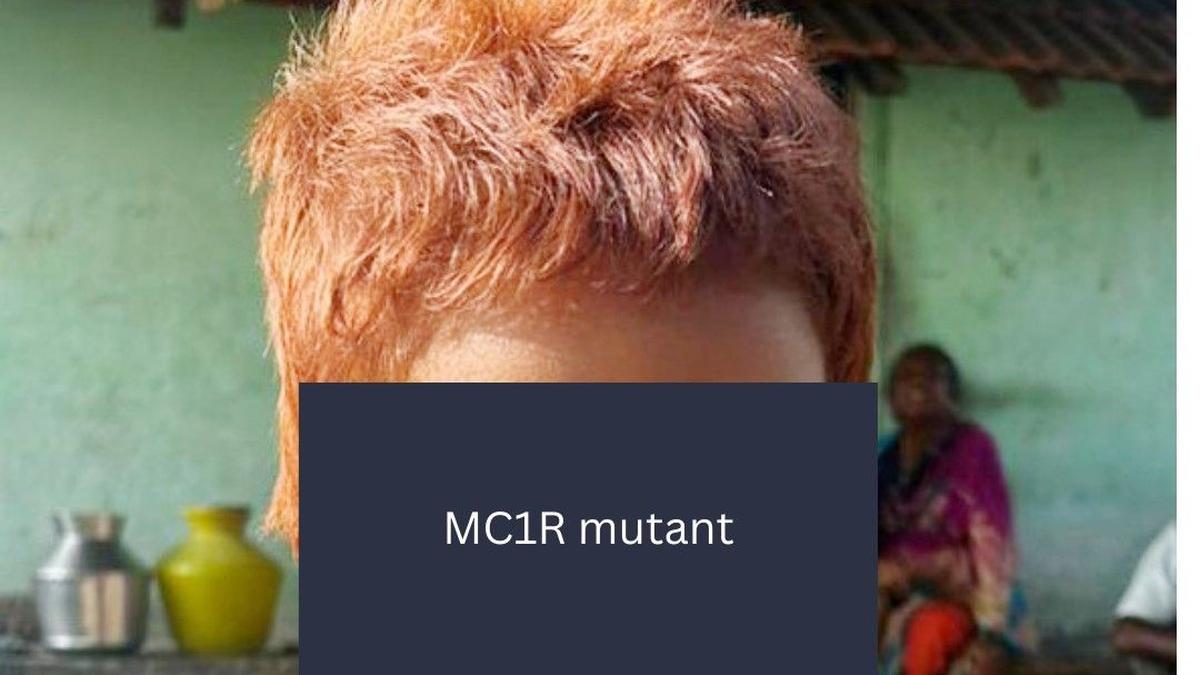
Their study was prompted by a striking case of a five-year-old Indian girl with red hair on her scalp, eyebrows and body, while retaining dark eyes — an extremely rare phenotype. From this, researchers have provided fresh insight into the country’s complex genetic landscape by uncovering the role of the MC1R gene (melanocortin 1 receptor), a key regulator of skin and hair pigmentation.

MC1R gene determines the type of melanin produced in the body ‘eumelanin’, which gives dark brown or black colour, or pheomelanin, which results in red or yellow hues. Using genome sequencing, researchers identified a rare MC1R variant (c.872C>A) in the child.

“The child had inherited two copies of this mutation, one from each parent, indicating an autosomal recessive pattern. Her parents, who carried only one copy each, had typical dark hair. This ultra-rare variant disrupts the function of the MC1R protein, leading to red hair,” said senior scientist K. Thangaraj.

To understand how widespread such variations might be, the researchers analysed over 11,000 individuals from 91 populations across India. Drawing on data from the GenomeIndia Consortium and additional lab samples, the study identified 21 novel or ultra-rare MC1R variants, revealing an unexpected depth of genetic diversity. Lab experiments and zebrafish models showed that some of these variants impair gene function, affecting pigmentation patterns.

The team including Deepak K. Kashyap, Srashti J. Agrawal, Meenakshisundaram Karthikeyan, Disha Biradar, Eerapagula Ramesh, Krithika Subramanian, Lomous Kumar, UrgyanChorol, Audditiya Bandopadhyay, A. Vasanthakumar, Nagarjuna Pasupuleti, Tamilselvan Jayavelu, Ajay K. Mahato, Periyasamy Govindaraj, Gyaneshwer Chaubey, Bratati Kahali and Vivek T. Natarajan, also examined another variant, c.-226A>T (rs3212363), which is linked to lighter skin pigmentation in certain populations.

Its distribution varies sharply, found at high levels in the Bodh population of Ladakh, but is much lower among Dravidian tribal groups in South India. Communities in northern and northeastern India, which typically have lighter skin tones, show a higher frequency of this variant. However, scientists emphasise that skin colour is influenced by multiple genes, including SLC24A5 and SLC45A2, and cannot be attributed to MC1R alone.

India has a wide range of skin tones, from light to dark. Southern populations, particularly Dravidian-speaking groups, generally have darker complexions. In contrast, northern populations, largely Indo-European speakers, tend to have lighter skin, reflecting skin colour genetic links to Central Asia, the Middle East and Europe. People in the Himalayan and northeastern regions, including Tibeto-Burman communities, also show relatively lighter skin, influenced by skin colour mutation, which is widespread in East Asian populations.

“India’s vast range of skin tones reflects its complex genetic ancestry, shaped by migration, admixture, environment and social practices such as endogamy or marriages within the caste,” said Mr. Thangaraj. The findings also have clinical relevance, as variants in the MC1R gene are linked to a higher risk of skin cancers, including melanoma.

Published – May 29, 2026 07:36 pm IST


Source link

Science Tags:CCMB hyderabad, indian dark hair, indian girl red hair mystery, indian hair colour rare gene

Post navigation

Previous Post: Centre should adhere to Constitutional spirit in the appointment of nominated legislators, urges former MP

Related Posts

  • COVID-19: anosmia as a marker for susceptible brain damage
    COVID-19: anosmia as a marker for susceptible brain damage Science
  • Study uncovers surprising new ‘spatial grammar’ of gene expression
    Study uncovers surprising new ‘spatial grammar’ of gene expression Science
  • Can India eliminate malaria by 2030? | Explained
    Can India eliminate malaria by 2030? | Explained Science
  • Gaganyaan: ISRO all geared up for first test flight
    Gaganyaan: ISRO all geared up for first test flight Science
  • Cosmic ‘speed camera’ reveals staggering speed of neutron star jets
    Cosmic ‘speed camera’ reveals staggering speed of neutron star jets Science
  • Cell sizes, clumping finally explain how animals form sharp patterns
    Cell sizes, clumping finally explain how animals form sharp patterns Science

More Related Articles

Webb telescope confirms the universe is expanding at an unexpected rate Webb telescope confirms the universe is expanding at an unexpected rate Science
India’s fossil fuel capacity grows 2.44% in FY24; non fossil-fuel rises 11%: Government data India’s fossil fuel capacity grows 2.44% in FY24; non fossil-fuel rises 11%: Government data Science
X chromosome revival in older women ups autoimmune disease risk X chromosome revival in older women ups autoimmune disease risk Science
Experts clash over HALEU-Th fuel for Indian nuclear reactors Experts clash over HALEU-Th fuel for Indian nuclear reactors Science
Chandrayaan-3 | Centre asks universities to organise special assemblies to watch Moon landing Chandrayaan-3 | Centre asks universities to organise special assemblies to watch Moon landing Science
What would it take to turn Mars into a life-friendly planet like the earth? What would it take to turn Mars into a life-friendly planet like the earth? Science
SiteLock

Archives

  • May 2026
  • April 2026
  • March 2026
  • February 2026
  • January 2026
  • December 2025
  • November 2025
  • October 2025
  • September 2025
  • August 2025
  • July 2025
  • June 2025
  • May 2025
  • April 2025
  • March 2025
  • February 2025
  • January 2025
  • December 2024
  • November 2024
  • October 2024
  • September 2024
  • August 2024
  • July 2024
  • June 2024
  • May 2024
  • April 2024
  • March 2024
  • February 2024
  • January 2024
  • December 2023
  • November 2023
  • October 2023
  • September 2023
  • August 2023
  • July 2023
  • June 2023
  • May 2023
  • April 2023
  • March 2023
  • February 2023
  • January 2023
  • December 2022
  • November 2022
  • October 2022
  • September 2022
  • August 2022
  • July 2022
  • June 2022
  • May 2022

Categories

  • Business
  • Nation
  • Science
  • Sports
  • World

Recent Posts

  • CCMB scientists identify rare gene behind Indian girl’s red hair
  • Centre should adhere to Constitutional spirit in the appointment of nominated legislators, urges former MP
  • YSRCP seeks CBI probe into DSC ‘irregularities’, demands Lokesh’s dismissal
  • Norway Chess Magnus Carlsen R Praggnanandhaa Wesley So Vincent Keymer Bibisara Assaubayeva
  • A.P. govt. sanctions ₹99.19 crore for Project SARTHI in Vizag

Recent Comments

  1. KennethBek on UP Teacher Who Asked Students To Slap Muslim Classmate
  2. Bradleyrox on UP Teacher Who Asked Students To Slap Muslim Classmate
  3. Charlesmaw on UP Teacher Who Asked Students To Slap Muslim Classmate
  4. RobertBum on UP Teacher Who Asked Students To Slap Muslim Classmate
  5. Williambuh on UP Teacher Who Asked Students To Slap Muslim Classmate
  • Major Search Op In J&K To Trace Accused In Ganderbal, Gulmarg Terror Attacks
    Major Search Op In J&K To Trace Accused In Ganderbal, Gulmarg Terror Attacks Nation
  • Access Denied Sports
  • Access Denied
    Access Denied Nation
  • Access Denied
    Access Denied Nation
  • Russia Jails US-Russian Journalist Alsu Kurmasheva For Over 6 Years
    Russia Jails US-Russian Journalist Alsu Kurmasheva For Over 6 Years World
  • Congress’ Vinesh Phogat On Exit Polls
    Congress’ Vinesh Phogat On Exit Polls Nation
  • It’s Ridiculous That People Would Not Play For India For Whatever Reason: Anand Amritraj
    It’s Ridiculous That People Would Not Play For India For Whatever Reason: Anand Amritraj Sports
  • Access Denied
    Access Denied Nation

Editor-in-Chief:
Mohammad Ariff,
MSW, MAJMC, BSW, DTL, CTS, CNM, CCR, CAL, RSL, ASOC.
editor@artifex.news

Associate Editors:
1. Zenellis R. Tuba,
zenelis@artifex.news
2. Haris Daniyel
daniyel@artifex.news

Photograher:
Rohan Das
rohan@artifex.news

Artifex.News offers Online Paid Internships to college students from India and Abroad. Interns will get a PRESS CARD and other online offers.
Send your CV (Subjectline: Paid Internship) to internship@artifex.news

Links:
Associate Journalism
About Us
Privacy Policy

News Links:
Breaking News
World
Nation
Sports
Business
Entertainment
Lifestyle

Registered Office:
72/A, Elliot Road, Kolkata - 700016
Tel: 033-22277777, 033-22172217
Email: office@artifex.news

Editorial Office / News Desk:
No. 13, Mezzanine Floor, Esplanade Metro Rail Station,
12 J. L. Nehru Road, Kolkata - 700069.
(Entry from Gate No. 5)
Tel: 033-46011099, 033-46046046
Email: editor@artifex.news

Copyright © 2023 Artifex.News Newsportal designed by Artifex Infotech.