

Skip to content
  • Facebook
  • X
  • Linkedin
  • WhatsApp
  • YouTube
  • Associate Journalism
  • About Us
  • Privacy Policy
  • 033-46046046
  • editor@artifex.news
Artifex.News

Artifex.News

Stay Connected. Stay Informed.

  • Breaking News
  • World
  • Nation
  • Sports
  • Business
  • Science
  • Entertainment
  • Lifestyle
  • Toggle search form
  • Rajapaksas’ party decides against backing Ranil in presidential election
    Rajapaksas’ party decides against backing Ranil in presidential election World
  • Quality of active TB case finding suboptimal nationally: study
    Quality of active TB case finding suboptimal nationally: study Science
  • Access Denied
    Access Denied Nation
  • Access Denied
    Access Denied Nation
  • Access Denied
    Access Denied Nation
  • Access Denied
    Access Denied Nation
  • Kotak Mahindra Bank introduces premium service for affluent customers
    Kotak Mahindra Bank introduces premium service for affluent customers Business
  • Ajinkya Rahane Or Venkatesh Iyer? Kolkata Knight Riders CEO’s Brutally Honest Verdict On IPL Captaincy
    Ajinkya Rahane Or Venkatesh Iyer? Kolkata Knight Riders CEO’s Brutally Honest Verdict On IPL Captaincy Sports
Dog brains shrank significantly by 5,000 years ago, thanks to humans

Dog brains shrank significantly by 5,000 years ago, thanks to humans

Posted on May 23, 2026 By admin


Domestic dogs have significantly smaller brains than their wolf ancestors. Researchers have long known that dogs’ brains shrank in the past, but when has been a mystery. Some theories also argue that strict aesthetic standards and intensive, selective modern breeding over the last 200 years could have been the cause.

In a new study, researchers from Europe have suggested that canines’ brains had already shrunk by at least 5,000 years ago — and possibly due to human interference.

During the Upper Pleistocene period, around 35,000 years ago, and long before humans started settled agriculture, dogs and wolves had similar brain sizes. This was around when humans and dogs began to interact more often. But by the Late Neolithic period, around 5,000 years ago, by when agricultural societies had become widespread, dogs living in Western European settlements had brains nearly 46% smaller than those of wolves at the same time, the researchers reported on April 29 in Royal Society Open Science.

They noticed this shrinkage in the remains of dogs in a Middle/Late Neolithic site in Chalain in France.

This study provides “new evidence” for the evolutionary reduction in the brain size of dogs that correlates with their domestication, Ian Kuijt, a zooarcheologist at the University of Notre Dame in Indiana, who was not involved in the research, said.

“It is fascinating to see the overall trajectory, even if this is a very small sample,” he added.

Virtual endocasts

To trace how dog brains evolved, Thomas Cucchi, a bioarchaeologist at the French National Centre for Scientific Research (CNRS), Paris, and his colleagues and peers analysed the skulls of 185 modern and 22 prehistoric wolf and dog specimens. The specimens included two dog-like animals from about 35,000 and 15,000 years ago, and Late Neolithic wolves and dogs from about 5,000 to 4,500 years ago.

The researchers used this data to create virtual endocasts — models of the space inside the skull where the brain once sat. Even though, the brain decomposes rapidly after death, the skull’s inner cavity preserves an imprint of the brain’s size and general shape, so the endocast served as a proxy for the brain, Eniko Kubinyi, a biologist at Eotvos Lorand University in Hungary and another author of the study, said.

Using the volume of these endocasts and the skull size, the team could track how brain size, relative to body size, changed at different points of time.

The endocranial volume of the so-called ‘protodogs’ from the Pleistocene didn’t indicate the smaller brain seen in later dogs. This, the researchers said, could mean they were still more wolflike than doglike.

One specimen from a cave site called Goyet in Belgium had a slightly larger brain volume than that of contemporary wolves. Dr. Cucchi said this might be due to increased human interaction at the beginning of the domestication process that posed new cognitive challenges.

Disproportionate drop

As humans transitioned from hunter-gatherers to a settled lifestyle around 5,000 years ago, dogs in Western European farming settlements adapted as well, becoming widely domesticated as a result.

Dogs face pressure to evolve from predators, foraging, and mating but domestication relaxes all of them. The high energy cost of neural tissues combined with the lower cognitive demands of a captive environment results in smaller brains in domesticated animals.

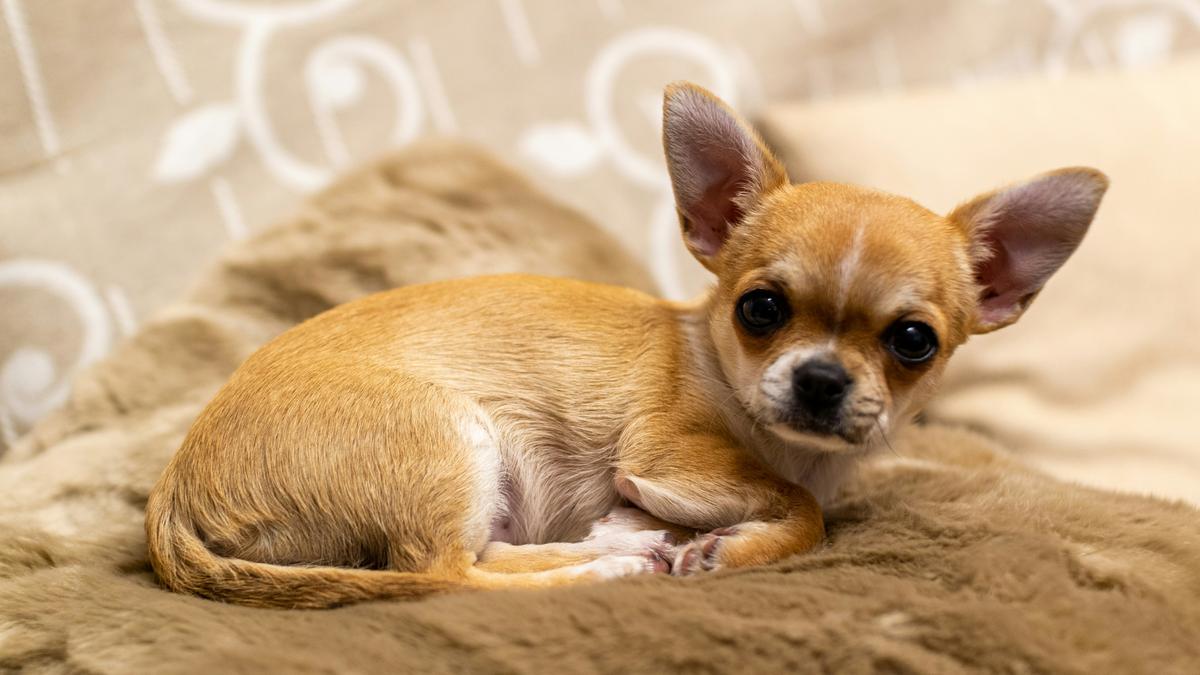
That said, the researchers found that dogs’ brains shrunk disproportionate to the drop in their body sizes — so much so that their brains were as big as those of Chihuahuas and pugs today. The researchers did note that the samples from Chalain alone were based on eight to ten dogs, meaning the findings from here alone can’t be generalised.

Previous studies have suggested that when brain size drops drastically, brain regions are reorganised. Often, this means a smaller cortical brain — which is responsible for learning, self-control, and cognitive ability — and a larger subcortical brain, which is involved in controlling emotions, Dr. Cucchi said.

Extrapolating from neuroanatomical research and studies of modern breeds, the researchers also suggested that the reorganisation resulted in dogs that were likely less trainable but more anxious, fearful, and prone to barking. Since small-brained dogs are more temperamental and wary of everything, they could have served the purpose of alerting humans to unusual activities nearby, Dr. Cucci said by way of one example of a role they could have played.

Dr. Kuijt noted that dog skulls and mandibles had also been found in refuse pits, meaning they were likely used as food as well.

A dingo story

“The link with changing temperaments serving as an alarm system is an intriguing speculation, but of course inferring behaviours from the archaeological and palaeontological records is challenging,” Michael Buckley, a bioarchaeologist at the University of Manchester and who was not involved in the study, said.

The study also examined dingoes, the East Asian dogs introduced to Australia and which returned to the wild at least 3,300 years ago. They have since been living largely independent of humans. Despite this long separation, dingoes’ brain volumes are between the smallest and largest-brained modern dogs, and larger than village dogs of comparable skull size.

According to experts, this suggests living as a free-ranging apex predator and facing the cognitive demands of hunting and survival without human support may have exerted some positive selection pressure favouring larger brains.

However, dingoes haven’t regained the brain size seen in wolves.

Even though dingoes could grow a larger brain, Dr. Kubinyi said, “brain tissue is metabolically very costly [to maintain], so brain size is unlikely to increase without strong selection pressure.”

Since dingoes do not rely on cooperative hunting against large and dangerous prey the way wolves do, “it seems that dingoes do not need a larger brain for their survival,” she added.

Jay Kakade is a freelance science writer.

Published – May 27, 2026 07:30 am IST


Source link

Science

Post navigation

Previous Post: GVMC launches ‘Operation Clean Sweep’ to tackle city waste issues
Next Post: Whole body scans: why investors love them but doctors hate them

Related Posts

  • NASA conducts successful rehearsal of Artemis 2 lunar launch
    NASA conducts successful rehearsal of Artemis 2 lunar launch Science
  • Sustainability science for FMCGs – The Hindu
    Sustainability science for FMCGs – The Hindu Science
  • ‘Think before you throw’: This event will teach you how to use scraps in your kitchen for zero waste cooking
    ‘Think before you throw’: This event will teach you how to use scraps in your kitchen for zero waste cooking Science
  • Sawalkote hydropower project on Chenab gets fresh environmental clearance
    Sawalkote hydropower project on Chenab gets fresh environmental clearance Science
  • Is it okay for an Indian scientist to have taken Jeffrey Epstein’s money?
    Is it okay for an Indian scientist to have taken Jeffrey Epstein’s money? Science
  • India’s space economy has potential to reach  billion by 2033 with about 8% global share
    India’s space economy has potential to reach $44 billion by 2033 with about 8% global share Science

More Related Articles

Chandrayaan 4 and 5 design complete; 70 satellites likely to be launched in 5 years: ISRO chief Chandrayaan 4 and 5 design complete; 70 satellites likely to be launched in 5 years: ISRO chief Science
The afterglow of an explosive collision between giant planets may have been detected in a far-off star system The afterglow of an explosive collision between giant planets may have been detected in a far-off star system Science
Queensland positions itself as a strategic partner in India-Australia biotech collaboration at BioAsia 2026 Queensland positions itself as a strategic partner in India-Australia biotech collaboration at BioAsia 2026 Science
India aims to send astronaut to the moon by 2040 India aims to send astronaut to the moon by 2040 Science
Chandrayaan-4 to launch in 2027: Jitendra Singh Chandrayaan-4 to launch in 2027: Jitendra Singh Science
NZ treaty may allow people to sue on ‘behalf of whales’ NZ treaty may allow people to sue on ‘behalf of whales’ Science
SiteLock

Archives

  • May 2026
  • April 2026
  • March 2026
  • February 2026
  • January 2026
  • December 2025
  • November 2025
  • October 2025
  • September 2025
  • August 2025
  • July 2025
  • June 2025
  • May 2025
  • April 2025
  • March 2025
  • February 2025
  • January 2025
  • December 2024
  • November 2024
  • October 2024
  • September 2024
  • August 2024
  • July 2024
  • June 2024
  • May 2024
  • April 2024
  • March 2024
  • February 2024
  • January 2024
  • December 2023
  • November 2023
  • October 2023
  • September 2023
  • August 2023
  • July 2023
  • June 2023
  • May 2023
  • April 2023
  • March 2023
  • February 2023
  • January 2023
  • December 2022
  • November 2022
  • October 2022
  • September 2022
  • August 2022
  • July 2022
  • June 2022
  • May 2022

Categories

  • Business
  • Nation
  • Science
  • Sports
  • World

Recent Posts

  • Karnataka CM Siddaramaiah resigns, but won’t budge from State politics
  • Thailand court acquits progressive political leader Thanathorn on charges of royal defamation
  • Four Indians in ICC’s all-female panel of match officials for Women’s T20WC
  • Vaibhav Sooryavanshi’s open-and-shut case for India T20I call-up
  • Indian national living illegally in U.S. held by Federal authorities for ‘assaulting man with baseball bat’

Recent Comments

  1. PatrickFek on UP Teacher Who Asked Students To Slap Muslim Classmate
  2. WesleyCow on UP Teacher Who Asked Students To Slap Muslim Classmate
  3. BradyNar on UP Teacher Who Asked Students To Slap Muslim Classmate
  4. EdwardRouct on UP Teacher Who Asked Students To Slap Muslim Classmate
  5. Georgelaf on UP Teacher Who Asked Students To Slap Muslim Classmate
  • PV Sindhu, Kidambi Srikanth, Lakshya Sen Progress To Second Round Of Swiss Open
    PV Sindhu, Kidambi Srikanth, Lakshya Sen Progress To Second Round Of Swiss Open Sports
  • Scientists search for a female partner for world’s ‘loneliest’ plant
    Scientists search for a female partner for world’s ‘loneliest’ plant Science
  • Access Denied Sports
  • Wholesale price inflation rises to three-month high of 0.53% in March
    Wholesale price inflation rises to three-month high of 0.53% in March Business
  • Gautam Gambhir’s Act From KKR Bench Triggers Plethora Of Questions. Watch
    Gautam Gambhir’s Act From KKR Bench Triggers Plethora Of Questions. Watch Sports
  • UAE Expands Visa-On-Arrival Facility For Indians From 6 More Countries
    UAE Expands Visa-On-Arrival Facility For Indians From 6 More Countries World
  • Access Denied Business
  • Access Denied Sports

Editor-in-Chief:
Mohammad Ariff,
MSW, MAJMC, BSW, DTL, CTS, CNM, CCR, CAL, RSL, ASOC.
editor@artifex.news

Associate Editors:
1. Zenellis R. Tuba,
zenelis@artifex.news
2. Haris Daniyel
daniyel@artifex.news

Photograher:
Rohan Das
rohan@artifex.news

Artifex.News offers Online Paid Internships to college students from India and Abroad. Interns will get a PRESS CARD and other online offers.
Send your CV (Subjectline: Paid Internship) to internship@artifex.news

Links:
Associate Journalism
About Us
Privacy Policy

News Links:
Breaking News
World
Nation
Sports
Business
Entertainment
Lifestyle

Registered Office:
72/A, Elliot Road, Kolkata - 700016
Tel: 033-22277777, 033-22172217
Email: office@artifex.news

Editorial Office / News Desk:
No. 13, Mezzanine Floor, Esplanade Metro Rail Station,
12 J. L. Nehru Road, Kolkata - 700069.
(Entry from Gate No. 5)
Tel: 033-46011099, 033-46046046
Email: editor@artifex.news

Copyright © 2023 Artifex.News Newsportal designed by Artifex Infotech.