






People from Bengaluru should not be allowed to complain about their weather turning hot. The other day, as a namma friend called to express disappointment over their daytime temperatures reaching as high as 33 degrees, I wondered in what Awadhi words should I inform her about the pleasant 42 degrees here in Kanpur. The baked earth, the breezily burning air and the blindingly bright sunny afternoons are clearly things she would not be missing.
Even while you drink a glass of nimbu paani to cool yourself, have you ever wondered: what does a ‘degree’ really mean? By that I don’t mean your qualifications, but just the temperature. Also have you ever thought how does one even measure it?
Units of temperature
The standard unit of temperature is called Celsius, named after Swedish physicist Anders Celsius who designed some of the early thermometers. But there is a fundamental catch with measuring temperature. While we can feel anxiously hot or depressingly cold depending on the weather or global news, one challenge in measuring temperature is defining the zero for it. After all, unlike the number of gas cylinders or valid ID cards – can you really count them on your fingers, and say when you have ‘zero’?
To define this zero – we use one of our common day magical materials – water. So, how does water help decide this? To proceed, we need to understand what temperature really is.
Temperature is a way of estimating how hot something is. Now when we heat a material, what we are really doing is making the atoms and molecules of that material more and more restless. They shake more and more vigorously as we pump in energy. Similarly when we cool something we make the atoms more sluggish, that is, we take away their energy. Not very different from us. So can we really continue to heat or cool something as long as we want?
Turns out the answer is no. For a while, the material may decide to get heated or cooled, but at some point it may decide to completely change its character. This is called a phase transition. You see this everyday. When water is kept in a refrigerator, it would first start cooling and appear as – just colder water.
But at some point, it won’t cool as a liquid – but will start turning into ice, which as we know is a solid. This “temperature” at which water turns to ice was named ‘zero’ degree Celsius. Similarly, when water is heated, it gets hotter and hotter until it starts boiling and turning into vapour. After this particular “temperature” after which the water cannot get hot anymore – was named ‘100’ degrees Celsius.
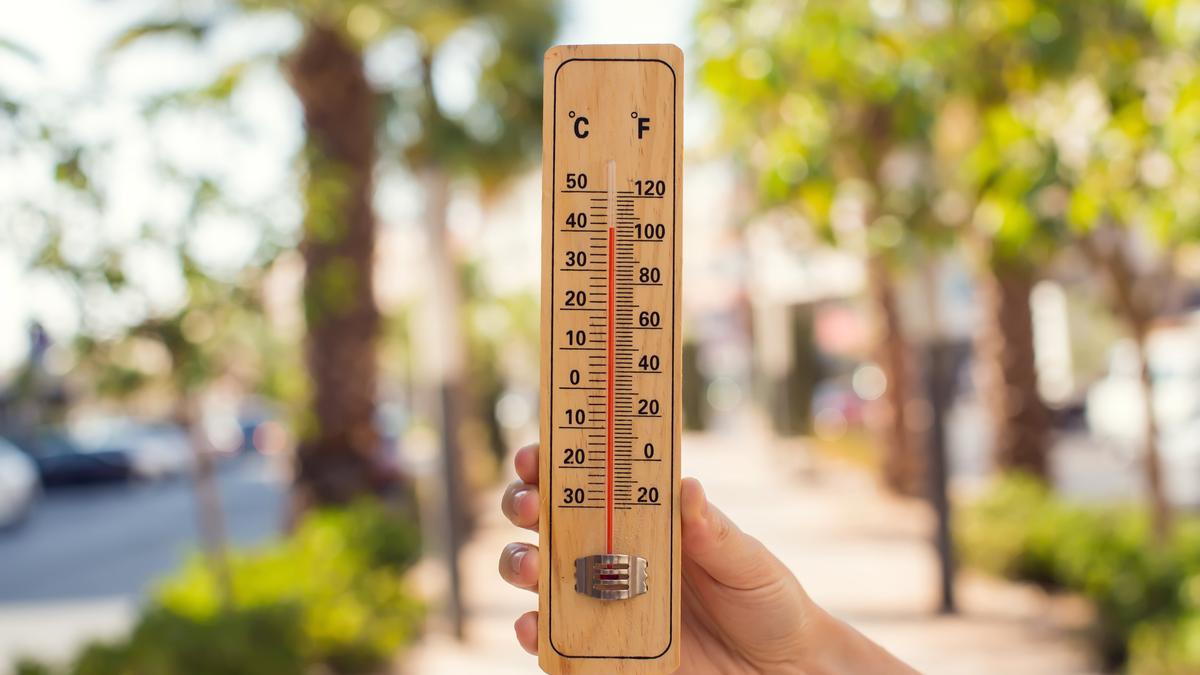
Therefore the zero and 100 of temperature was marked and divided into a hundred divisions so that we can measure everything else in these units. It is on this scale that our body temperature is 37 degrees Celsius. There is another popular scale — Fahrenheit, where zero and 100 is marked using a different protocol. On that scale our body temperature is supposed to be 98.6 degrees Fahrenheit. In 1948 physicists finally decided to use Celsius as a standard unit.
Now that we have defined zero and 100 of temperature, the next question is how do we measure it? Here comes another magical material —mercury, no — not the planet.
Mercury thermometers
Mercury is a metal, like iron or aluminium, i.e., which conducts current and shines, but unlike our metallic utensils or spoons, it is in a liquid state. Now most metals expand a bit when heated. This is because the atoms within the materials tend to get away from each other when they are hot. But one of the most amazing properties of mercury is that it expands only as much as it is heated. Think of it like a rod whose length changes depending on how hot it is. So we have found the measurement trick.
The idea is simple: put mercury in a glass bulb attached to a tube. Keep the bulb in a bucket of ice. See the level of mercury in the tube and mark it as zero. Now put the same bulb in boiling hot water. Mercury will expand and the level will rise in the tube. Mark that new level as 100. Use your favourite scale to equally divide the distance between the two marks into 100 divisions. And you have a thermometer. Now you can put this thermometer in your favourite soup, or soil, or your mouth to measure how much the mercury expands to tell you what the temperature is!
In fact, this is how regular thermometers used to look until a few years ago, when phones were still non-smart. Most of the school going students today may not have seen these thermometers. They could easily break for no good fault of ours and would lead to a huge hue and cry from the adults nearby.
But in any case, mercury thermometers, then, could be found in every household. But as the quantity of greenhouse gases, global temperatures, homes, gadgets, and governments changed – our thermometers changed too.
Digital thermometers
So to measure temperature, one basically needs a material which changes its behavior depending on how hot something is, and whose change of behavior can be measured accurately. After all, measuring something correctly is fundamental to all of science. This branch of physics which specialises in the principles behind measurements is called metrology.
With advances in condensed matter physics — the physics of materials — physicists created a new class of materials called semiconductors in the 1950s. Semiconductors are neither metals (i.e. conductors) like aluminum or copper, nor insulators (i.e. things which do not conduct current) like glass or wood. Hence the prefix “semi”. They conduct a small amount of current, but the amount of current they carry can increase if the temperature rises.
This is because semiconductors have a rather interesting arrangement of atoms and electrons.
In metals, electrons move freely from atom to atom, like a soup – so they can easily conduct electricity whenever a battery is attached. In insulators, the electrons are tightly bound to the atoms. So even when a battery is put – they refuse to budge. In semiconductors, electrons are loosely bound to the atoms. They mostly stay close to atoms, but when the atoms become agitated due to heat, they shake off these electrons. These “free” electrons can now move and create an electrical current.
Now when a battery is attached to a semiconductor and if the temperature rises, the atoms shake more vigorously and more electrons are made free. So the hotter the surrounding is, more current will be generated and if we can measure that current we can find what the temperature is!
This is what happens in a digital thermometer which you find in your homes now – with 70 years of technological progress, humans have perfected the art of measuring changes in currents and voltages.
Absolute zero and cold atoms
Now, even while water turns to ice at zero degree celsius – the atoms in the ice are still shaking, though more slowly. Now if we continue to take away their energy even further, is there a point where it can essentially have “no” energy? What temperature would that mean?
That temperature is now defined as the Absolute zero – in another unit called Kelvin (K): the scientific unit of measuring temperatures. In terms of Celsius, this means -273 degrees Celsius.
When temperatures fall to just a few Kelvins, they become even harder to measure. We cannot use our mercury or semiconductors to measure them, since the properties of these thermometers themselves would change completely.
In fact, even atoms themselves become very funny at these temperatures and we need to use the whole power of quantum mechanics to understand them. Study of such atoms at ultra-low temperatures is cold-atomic physics.
Bose and his condensate
Atoms, in general, can be considered as one of the two types of personalities. One: ‘fermions’ type, where they do not like to stay together in one room. And another: ‘bosons’ where they like to all stay together whenever given a chance. ‘Bosons’ is named after Satyendra Nath Bose, an Indian physicist. In 1924, he first theoretically predicted the statistical behaviour of these ‘bosons’.
Many cold atoms are bosonic in nature and when they reach temperatures very close to zero Kelvin they form an exotic phase of matter called the Bose-Einstein Condensate (BEC), named after Bose and Albert Einstein. In 2001, three U.S. scientists Eric A. Cornell, Wolfgang Ketterle and Carl E. Wieman were awarded the Nobel Prize in Physics for achieving the BEC in experiments at a temperature of 20 nanoKelvins (nK). 1 nK is 0.000000001 Kelvin, just slightly above Absolute zero.
So, the next time when the heat bothers you, whether in Bangalore or Kanpur, and you call a friend to complain about the rising temperatures – don’t forget to express gratitude to the long, illustrious line of thermometers that have accurately measured temperatures for you.
(Adhip Agarwala is an Assistant Professor of Physics at IIT Kanpur)