


Skip to content
  • Facebook
  • X
  • Linkedin
  • WhatsApp
  • YouTube
  • Associate Journalism
  • About Us
  • Privacy Policy
  • 033-46046046
  • editor@artifex.news
Artifex.News

Artifex.News

Stay Connected. Stay Informed.

  • Breaking News
  • World
  • Nation
  • Sports
  • Business
  • Science
  • Entertainment
  • Lifestyle
  • Toggle search form
  • CEO On New Noida Airport
    CEO On New Noida Airport Nation
  • Israeli forces kill man in West Bank camp: Palestinian Ministry
    Israeli forces kill man in West Bank camp: Palestinian Ministry World
  • Access Denied World
  • “On Certain Days They Will Have…”: India Batting Coach’s Blunt Take On Pakistan Pacers
    “On Certain Days They Will Have…”: India Batting Coach’s Blunt Take On Pakistan Pacers Sports
  • Access Denied
    Access Denied Nation
  • Adani Power to acquire 24% stake in JPVL, thermal assets for ₹4,194 crore
    Adani Power to acquire 24% stake in JPVL, thermal assets for ₹4,194 crore Business
  • Israel Vows To Hit Hezbollah After Rocket Kills 12 On Football Field
    Israel Vows To Hit Hezbollah After Rocket Kills 12 On Football Field World
  • Access Denied Sports
How does the Gaganyaan’s life-support system operate?

How does the Gaganyaan’s life-support system operate?

Posted on May 21, 2026 By admin


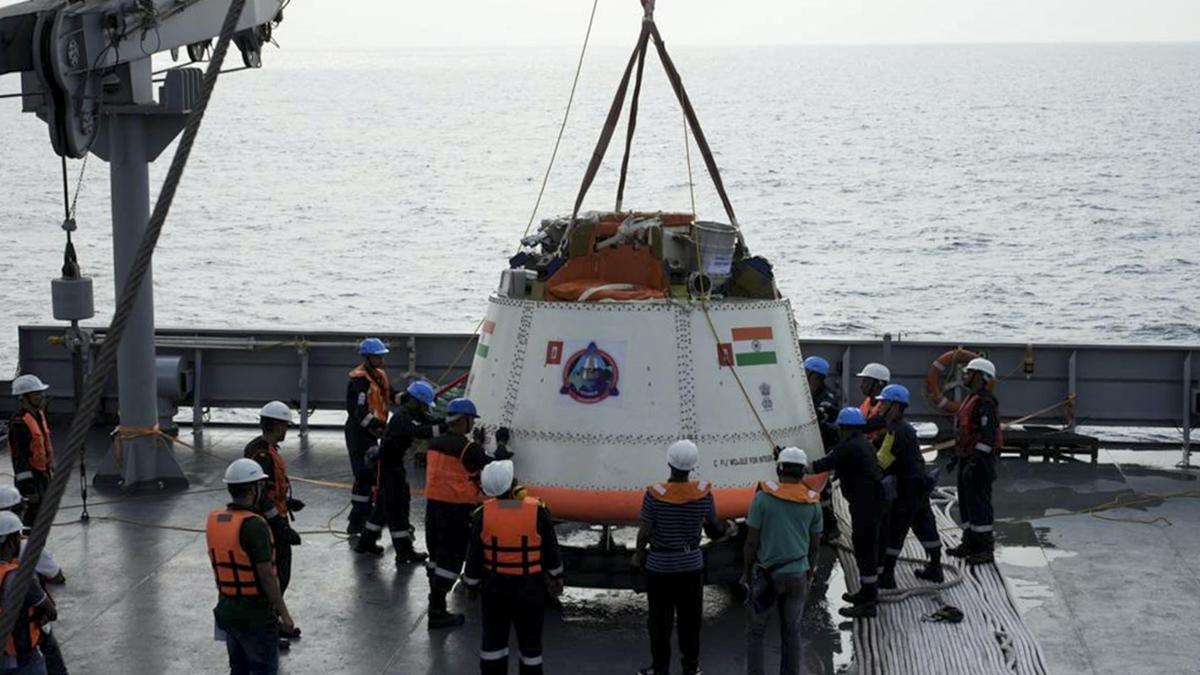
ISRO successfully conducted the Second Integrated Air Drop Test (IADT-02) for Gaganyaan, India’s first human spaceflight mission, on April 15, 2026.
| Photo Credit: PTI

The Environmental Control and Life Support System (ECLSS) replicates the earth’s atmosphere in earth orbit by managing air, water, temperature, and waste. In short-term space missions, all supplies are carried from the earth and waste is stored for disposal later. Long-duration missions recycle the waste back into useful resources like breathable air and clean water.

What is air revitalisation?

Carbon dioxide is removed from the earth’s atmosphere by photosynthesis and by dissolving in the oceans. In Gaganyaan (the Indian Space Research Organisation mission to place a small crew of Indian astronauts in a 400 km orbit around the earth), astronauts’ exhalation will increase the cabin’s carbon dioxide content and has to be artificially removed. Elevated levels of carbon dioxide can lead to hypercapnia, causing symptoms such as headaches, dizziness, and impaired cognitive function.

A healthy adult normally exhales around 1 kg of carbon dioxide per day, though this amount increases significantly with physical exertion. The air revitalisation system (ARS) provides fresh air, removes carbon dioxide, and filters trace contaminants or odours that would otherwise accumulate in the cabin. For short missions, oxygen is supplied from high-pressure gas bottles. According to standards, a healthy crew member needs 0.84 kg of oxygen per day to support metabolic functions.

Carbon dioxide is removed using lithium hydroxide canisters. Each canister has activated charcoal that absorbs any odours in the cabin air. A spent canister is replaced by the crew with a fresh one typically every 20-24 hours. In a microgravity environment lacking natural convection, small fans in the ECLSS are the circulatory system that prevents lethal carbon dioxide and hazardous oxygen pockets from lingering.

How are pressure, temperature and humidity controlled?

The Gaganyaan crew module is designed to maintain a comfortable environment with a temperature of 20-26°C and relative humidity between 30% and 70% to ensure crew comfort and equipment safety. The moisture released through the crews’ breath and sweat are the main sources of humidity in the cabin.

Low humidity in the crew cabin can lead to dry skin, irritated eyes, and higher risk of static electricity discharge that could damage electronics. High humidity promotes microbial growth and causes condensation that may lead to short-circuits or corrosion.

Heat in the crew module is primarily generated by the metabolic body heat of the astronauts (100 to 150 W per crew) and continuously operating onboard electronics and avionics. An active cooling system is used to regulate temperature. Heat is removed by circulating the air through heat exchangers, which will expel the heat into space. The humidity is managed by condensing units that collect water to prevent fogging and short-circuits.

The pressure is held at 101.3 kPa. To mimic the earth’s sea-level conditions, the pressure control system uses electronic sensors and safety valves to balance the air and oxygen levels.

Where does water come from?

The primary challenge in space is water doesn’t ‘pour’ but forms floating globules that can cause short-circuits in electronics or pose a hazard if inhaled accidentally. So water must be mechanically forced from storage using pressurised bladders to avoid gas-liquid mixing.

In Gaganyaan, the crew relies on supply of potable water stored in specially designed pouches. They can be pressed to force water directly into the mouth.

How is waste managed?

In microgravity, liquid and solid waste do not “fall”, requiring suction-based airflow systems to pull waste away from the body and prevent it from floating around. These systems must also separate and stabilise waste to avoid microbial contamination and the buildup of toxic gases like ammonia.

In Gaganyaan, specialised faecal collection bags will be used and urine will be sucked through funnels. All waste will be chemically treated to neutralise odours and inhibit bacterial growth, then stored in sealed containers for disposal after return.

How are fires suppressed?

The lack of gravity allows fires to expand into a sphere that is harder to reach with traditional suppressants. In Gaganyaan, smoke detectors will sound an alarm to alert the crew. Fire extinguishers that create fine water mists can be used to put the fire out. A water mist effectively cools the fire and also scrubs toxic smoke particles.

Russia’s Soyuz has the option to depressurise the cabin as a last resort to extinguish the fire after the crew has worn a pressure suit.

(Unnikrishnan Nair S. is Former Director, VSSC and IIST; Founding Director, HSFC; and an expert in launch vehicle systems, orbital re-entry and human spaceflight technologies. He is currently working as Dr Sarabhai Professor at VSSC)

Published – May 22, 2026 08:00 am IST


Source link

Science Tags:gaganyaan, ISRO, Space mission, Spacecraft

Post navigation

Previous Post: IT-based skill training launched for inmates at Visakhapatnam Central Jail
Next Post: Pickup van overturns on ghat road, one injured

Related Posts

  • What are Milankovitch Cycles? – The Hindu
    What are Milankovitch Cycles? – The Hindu Science
  • What is an AI agent? The computer science of the next wave of AI tools
    What is an AI agent? The computer science of the next wave of AI tools Science
  • Caterpillars may sense threats using electric fields
    Caterpillars may sense threats using electric fields Science
  • An overlooked molecule could help solve the Venus water mystery
    An overlooked molecule could help solve the Venus water mystery Science
  • Racing to build a quantum computer in Hyderabad
    Racing to build a quantum computer in Hyderabad Science
  • Wasps are excellent predators of pests and can play a big role in controlling them: IISc professor
    Wasps are excellent predators of pests and can play a big role in controlling them: IISc professor Science

More Related Articles

Charles Richet and his Nobel-winning work on severe allergic reactions Charles Richet and his Nobel-winning work on severe allergic reactions Science
The virtues of the tomato, a healthy vegetable The virtues of the tomato, a healthy vegetable Science
Bird flu reaches mainland Antarctica for first time, scientists say Bird flu reaches mainland Antarctica for first time, scientists say Science
Rise and shine: morning sunlight and your wellbeing Rise and shine: morning sunlight and your wellbeing Science
What are weights in AI? What are weights in AI? Science
Climate change funding talks stuck ahead of COP29 summit Climate change funding talks stuck ahead of COP29 summit Science
SiteLock

Archives

  • May 2026
  • April 2026
  • March 2026
  • February 2026
  • January 2026
  • December 2025
  • November 2025
  • October 2025
  • September 2025
  • August 2025
  • July 2025
  • June 2025
  • May 2025
  • April 2025
  • March 2025
  • February 2025
  • January 2025
  • December 2024
  • November 2024
  • October 2024
  • September 2024
  • August 2024
  • July 2024
  • June 2024
  • May 2024
  • April 2024
  • March 2024
  • February 2024
  • January 2024
  • December 2023
  • November 2023
  • October 2023
  • September 2023
  • August 2023
  • July 2023
  • June 2023
  • May 2023
  • April 2023
  • March 2023
  • February 2023
  • January 2023
  • December 2022
  • November 2022
  • October 2022
  • September 2022
  • August 2022
  • July 2022
  • June 2022
  • May 2022

Categories

  • Business
  • Nation
  • Science
  • Sports
  • World

Recent Posts

  • Ahead of SIR, 75% of voters mapped with 2003 rolls in Jharkhand: CEO
  • Lens lift French Cup for the first time after beating Nice in final
  • Rain in parts of Delhi, strong winds bring respite from heat
  • UN nuclear non-proliferation talks fail
  • Trump weighs fresh Iran strikes, says report | LIVE

Recent Comments

  1. Rogershavy on UP Teacher Who Asked Students To Slap Muslim Classmate
  2. LeroyClins on UP Teacher Who Asked Students To Slap Muslim Classmate
  3. CyrusKikem on UP Teacher Who Asked Students To Slap Muslim Classmate
  4. Michaeldix on UP Teacher Who Asked Students To Slap Muslim Classmate
  5. RobertLet on UP Teacher Who Asked Students To Slap Muslim Classmate
  • Experts meet as final global plastic treaty talks near
    Experts meet as final global plastic treaty talks near Science
  • ISRO’s Aditya-L1 decodes how solar storms impact Earth’s magnetic field
    ISRO’s Aditya-L1 decodes how solar storms impact Earth’s magnetic field Science
  • India will look to dominate rivals in Asia Cup: Harmanpreet
    India will look to dominate rivals in Asia Cup: Harmanpreet Sports
  • Global Security Hotspots That Will Test Donald Trump’s Strategies In 2025
    Global Security Hotspots That Will Test Donald Trump’s Strategies In 2025 World
  • Access Denied
    Access Denied Nation
  • Access Denied Sports
  • Dalit Man Beaten To Death, Mother Stripped Over Daughter’s Sex Assault Complaint
    Dalit Man Beaten To Death, Mother Stripped Over Daughter’s Sex Assault Complaint Nation
  • Top China, U.S. diplomats to meet at SE Asia Foreign Minister talks
    Top China, U.S. diplomats to meet at SE Asia Foreign Minister talks World

Editor-in-Chief:
Mohammad Ariff,
MSW, MAJMC, BSW, DTL, CTS, CNM, CCR, CAL, RSL, ASOC.
editor@artifex.news

Associate Editors:
1. Zenellis R. Tuba,
zenelis@artifex.news
2. Haris Daniyel
daniyel@artifex.news

Photograher:
Rohan Das
rohan@artifex.news

Artifex.News offers Online Paid Internships to college students from India and Abroad. Interns will get a PRESS CARD and other online offers.
Send your CV (Subjectline: Paid Internship) to internship@artifex.news

Links:
Associate Journalism
About Us
Privacy Policy

News Links:
Breaking News
World
Nation
Sports
Business
Entertainment
Lifestyle

Registered Office:
72/A, Elliot Road, Kolkata - 700016
Tel: 033-22277777, 033-22172217
Email: office@artifex.news

Editorial Office / News Desk:
No. 13, Mezzanine Floor, Esplanade Metro Rail Station,
12 J. L. Nehru Road, Kolkata - 700069.
(Entry from Gate No. 5)
Tel: 033-46011099, 033-46046046
Email: editor@artifex.news

Copyright © 2023 Artifex.News Newsportal designed by Artifex Infotech.