



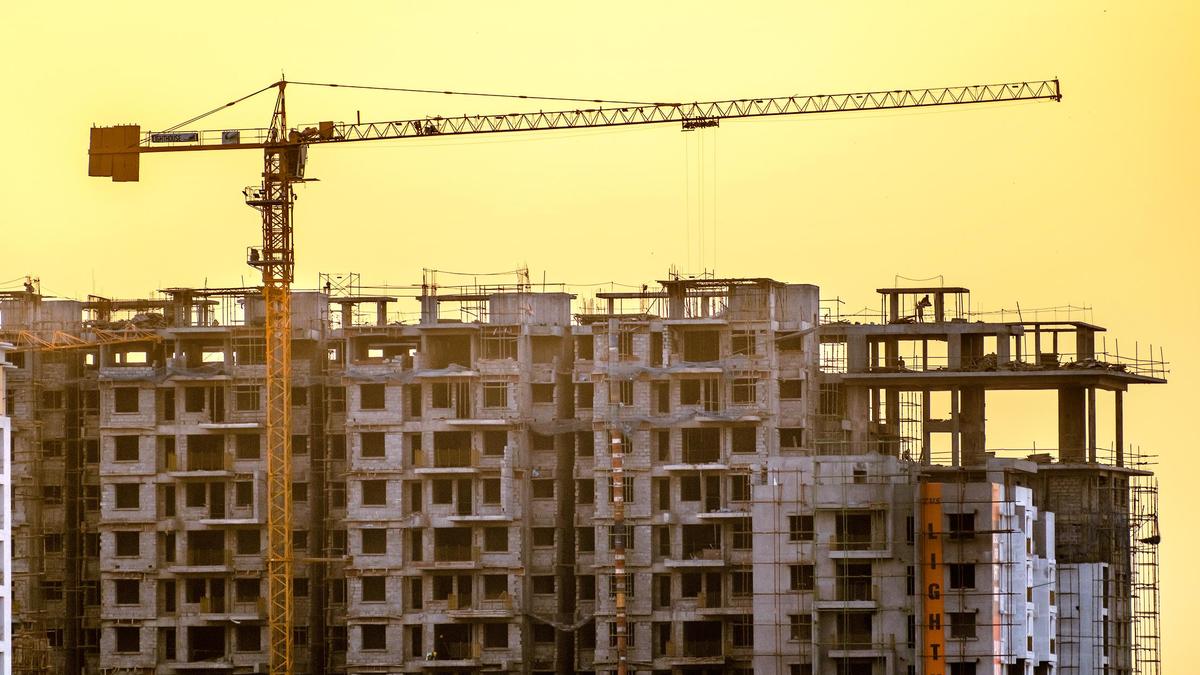
India is among the emerging economies powering an unprecedented expansion of the world’s building stock at a moment when the sector’s decarbonisation has slowed sharply, according to the 10th edition of the Global Status Report for Buildings and Construction (GSRBC), released on Tuesday (May 19, 2026) by the UN Environment Programme (UNEP) and the Global Alliance for Buildings and Construction (GlobalABC).
Global building floor area reached 273 billion square metres in 2024, growing 1.7% in a single year, “like adding two Delhis annually”, the report notes. While growth in Europe and China has slowed, it “remains robust in India and Southeast Asia”.
India’s construction sector itself grew at an annual rate of 11% between 2024 and 2025, reaching a valuation of around $210 billion, driven by strong public and private investment. Inflation in the construction sector in India ran at 5%–6%, the report notes, largely on account of labour shortages.
This expansion, however, sits uneasily alongside the sector’s climate trajectory. Buildings and construction now account for around 37% of global carbon emissions, nearly 50% of global material extraction — the largest of any sector — and 28% of global energy consumption.
Operational emissions from buildings rose 6.5% between 2015 and 2024, the report says, against a benchmark that required them to fall 31.6% over the same period to align with a 2050 net-zero pathway. The stagnation, it adds, stems primarily from rising operational emissions driven by expanding floor area, sluggish retrofitting, and persistent fossil fuel policy support.
“New construction continues to outpace decarbonisation, while renovation of existing buildings is far too slow. Fossil fuels still dominate heating, cooling, and cooking in many countries,” Martin Krause, Director of UNEP’s Climate Change Division, said in a statement. “The gap between current trajectories and the Paris Agreement goals persists — not because solutions are missing, but because they are not yet deployed at the speed and scale required.”
For an economy in India’s position, the report’s findings on embodied emissions — those locked into a building’s materials before it is occupied — are particularly consequential. Carbon emissions from cement, steel and aluminium used in buildings alone accounted for 9% of global emissions in 2024, holding stubbornly at around 2.1 gigatonnes for several years. The report describes embodied carbon as “a critical—and still under-addressed—climate challenge” and warns that with construction booming in Asia and Africa, “shifting now to low-carbon materials is essential to avoid locking in high emissions for decades. Rapid growth in countries like India shows why early action is critical to manage resource pressures sustainably”. It also notes that China is moving to bring steel, cement and aluminium into its emissions trading scheme.
The report nevertheless flags several Indian initiatives. India’s Energy Conservation and Sustainable Building Code 2024, administered by the Bureau of Energy Efficiency, strengthens efficiency requirements for commercial buildings with a connected load of 100 kW or more, targeting “20–50 per cent efficiency improvements over conventional construction”.
Rooftop solar is identified as a bright spot — India added 3.2 GW of rooftop capacity in 2024 and a further 4.9 GW in the first nine months of 2025, up sharply from 1.7 GW in 2023, on the back of the PM Surya Ghar scheme that provides households with subsidies and loans. The Indian Green Building Council has registered over 18,620 projects covering about 1.4 billion square metres, while GRIHA has registered 3,869 projects across 86.5 million square metres.
At the sub-national level, the report cites Odisha as an example of how GlobalABC-aligned roadmaps can drive “regulation reform, climate-responsive planning and regionally tailored mitigation strategies”. Globally, renewables met only 17% of buildings’ final energy demand in 2024 — far short of the 46% required by 2030.
As of January 2026, no country has submitted an updated NDC 3.0 (Nationally Determined Contributions) with what UNEP terms an “extensive” buildings-sector strategy — a benchmark requiring a “complete, comprehensive and coherent national strategy” for the built environment. The report calls on all G20 nations, India included, and at least 75 other countries to embed such strategies in their NDCs by 2030.
The investment gap is similarly large. Global investment in building energy efficiency reached $275 billion in 2024 — a 38% increase over 2015 levels — but an additional $3.6 trillion is needed cumulatively by 2030 to align with a net-zero pathway. The report frames this within the broader Belém Call for Action launched in November 2025, which “reiterated that climate change exacerbates the housing crisis” by raising construction and material costs, amplifying energy demands for cooling, and “widening affordability gaps for low-income households”.
Published – May 19, 2026 08:46 pm IST