





Does Jupiter have a “voice”?
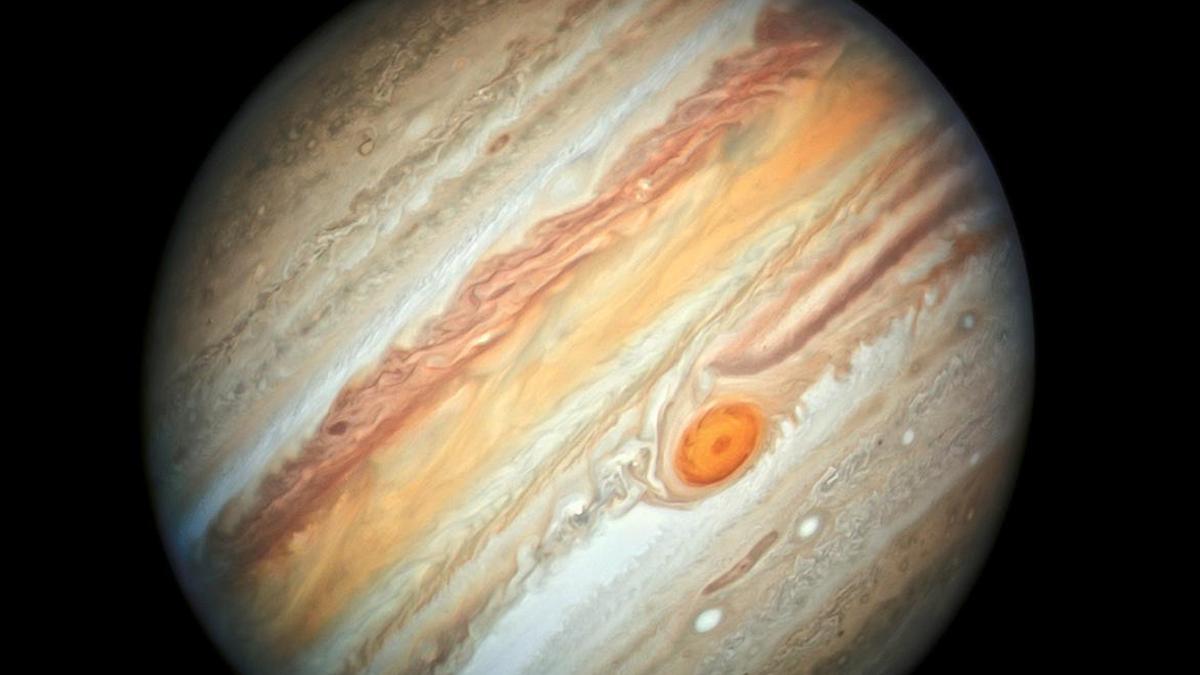
When we say discovery of Jupiter’s “voice”, it corresponds to the discovery that the planet Jupiter is a strong source of radio waves. This discovery was made in the 1950s by two scientists at the Carnegie Institution in Washington D.C. – Bernard F. Burke and Kenneth Linn Franklin – when the idea of using radio for astronomical research was still relatively new.
By the time Burke and Franklin got together for their work, astronomers were privy to the fact that several sources in the sky emitted radio waves. With receivers in the rural 96-acre Mills Cross field near Washington, the duo set out to map the northern sky using their radio antenna array.
In order to test how their array was working, they picked Crab Nebula – a supernova remnant and pulsar wind nebula – in the constellation of Taurus. The tests went well and with the passing weeks, they progressively changed the pointing direction towards the south.
When there were some aberrations that they couldn’t identify, they initially suspected terrestrial interference, probably from a passing vehicle. But by observing it more carefully over the nights that followed and noticing that it not only occurred around the same time period, but was also consistently occurring four minutes earlier each night, they realised it had to be a celestial object.
Once they had a few more months of data, they could rule out stars as the source of the radio emissions didn’t move like those that come from stars. This not only eliminated stars, but also nebula or galaxy as they all move across the sky at about the same rate.
Finding that the object that happened to be near Crab Nebula in the sky was Jupiter and checking its rate of movement to match with the data they had, the duo were able to zero in on Jupiter. On April 5-6, 1955, Burke and Franklin announced their discovery at a meeting of the American Astronomical Society. A lot of noise followed as it was the first ever noise to have been identified as coming from a specific planet.
How has it helped?
The detection of the first non-thermal radio noise from a planet provided astronomers and scientists a new tool for exploring the solar system. Immediately after the announcement, in fact, astronomers went back to their own existing data, to see if they had a match as well.
Australian radio astronomer Charles Alexander Shain was actually able to recognise Jovian radio bursts in his own data set. Looking back following the announcement in 1955, Shain found observations he had taken five years earlier to correspond to radio emissions from Jupiter. This meant that immediately after the discovery, there was already five years worth of data to begin work with. Another 70-plus years worth of data has since been added to this repository.
As far as Jupiter is concerned, the bursts of radio emissions served as the first evidence for a Jovian magnetic field. Most radio waves from Jupiter are polarised, implying that wherever these waves were originating from, there’s a magnetic field present.
The radio emissions observed by Burke and Franklin were in the form of noise bursts with peak intensities so great that Jupiter is the most prominent source in the sky at this wavelength, behind only the sun. These emissions are called decametre radiation, based on the characteristic wavelength.
Subsequent observations were at shorter wavelengths, revealing that the solar system’s biggest planet is also a source of steady radio emissions. These are called decimetre radiation, again, based on the characteristic wavelength.
Here’s more about the two men who made the discovery:
Burke’s baseline
Born in Brighton, Massachusetts, U.S. on June 7, 1928, Bernard F. Burke enjoyed maths from a rather young age. This didn’t surprise those around him as his mother Clare was a typist who worked with statistics and therefore came up with her own method to type complex maths formulae manually, and his father Vincent was the head of the maths department at a high school.
Interest for what lay beyond was also evident from an early age as he purchased a large piece of glass along with a friend at the age of 16 with the objective of grinding it into a telescope’s lens.
After graduating from high school, Burke received a full scholarship to study the violin. He turned it down and decided to study at the Massachusetts Institute of Technology (MIT). Studying physics and astrophysics, Burke received his PhD in 1953,
Following his PhD, Burke joined the Carnegie Institution of Washington’s Department of Terrestrial Magnetism (DTM) and it was during his time here that he co-discovered radio noise from Jupiter in 1955. He was at DTM for another decade, before heading back to MIT in 1965 as a professor of physics.
The blue horseshoe shape that circumscribes the red galaxy is the real prize in this image – an Einstein ring. This blue horseshoe is a distant galaxy that has been magnified and warped into a nearly complete ring by the strong gravitational pull of the massive foreground Luminous Red Galaxy.
| Photo Credit:
ESA/HUBBLE & NASA
Once in MIT, his work shifted, focussing on the detection of gravitational lensing and in the development of Very Long Baseline Interferometry (VLBI). In 1988, he discovered what is considered the first Einstein ring. A rare astronomical phenomenon predicted by theoretical physicist Albert Einstein’s theory of relativity, Einstein ring is the deformation of light in the form of a ring due to gravitational lensing around a massive cosmic object.
In addition to his own research, Burke was also well-respected as a professor, challenging students both on and off campus. He passed away on August 5, 2018, aged 90.
Facts about Franklin
Kenneth Linn Franklin was born in Alameda, California, U.S. on March 25, 1923. Franklin set his sights at the distance much earlier than most as one of his earliest memories was looking up at the moon and asking his mother what it was. He never got his answer then as his mother was blind. It left him seeking answers and explaining astronomical phenomena as best he could for a lifetime.
After earning his doctorate in astronomy from the University of California, Berkeley, Franklin joined DTM. Along with Burke, Franklin detected Jupiter’s “voice” in 1955 and went on to accept an astronomer’s position at the Hayden Planetarium the following year.
In addition to studying astronomical phenomena, Franklin became an expert communicating these as he had a talent for putting the right things in focus. This helped not just those around him, but also the journalists, who often quoted him. He provided astronomical information to The New York Times for years, including the hour of sunrise and sunset, and served as a consultant for Scientific American, and television networks NBC and CBS.
It wasn’t just the times on Earth that he was good at, as is evident from the fact that he invented a watch for moon walkers in 1970. With moon missions on the rise then, Franklin’s watch measured time on the moon based on lunations – a lunar month of 29.53 Earth days during which the moon completes a full cycle of phases. While the watch never really caught on, his methodology for calculating time there is very close to the solutions thought off in the current decade when interest in moon missions is again on the rise.
Apart from being a popular lecturer, Franklin also produced his own radio programme. He never missed a chance to encourage his students to analyse radio waves coming from Jupiter, striving to kindle curiosity as an educator. He passed away on June 18, 2007, aged 84.