
Skip to content
  • Facebook
  • X
  • Linkedin
  • WhatsApp
  • YouTube
  • Associate Journalism
  • About Us
  • Privacy Policy
  • 033-46046046
  • editor@artifex.news
Artifex.News

Artifex.News

Stay Connected. Stay Informed.

  • Breaking News
  • World
  • Nation
  • Sports
  • Business
  • Science
  • Entertainment
  • Lifestyle
  • Toggle search form
  • Access Denied World
  • Access Denied
    Access Denied Nation
  • Access Denied
    Access Denied Nation
  • Access Denied World
  • How New ‘Mountain Tank’ Will Enhance Army’s Combat Capabilities
    How New ‘Mountain Tank’ Will Enhance Army’s Combat Capabilities Nation
  • Access Denied Business
  • Uttarakhand Stays Order Suspending Production Of 14 Patanjali Drugs
    Uttarakhand Stays Order Suspending Production Of 14 Patanjali Drugs Nation
  • Keralam Home Minister asks Crime Branch to verify reports fugitive Sukumara Kurup is alive
    Keralam Home Minister asks Crime Branch to verify reports fugitive Sukumara Kurup is alive Nation
In snake genes, study finds they evolved 3x faster than other reptiles

In snake genes, study finds they evolved 3x faster than other reptiles

Posted on March 3, 2024 By admin


The sci-fi writer David Brin built his fictitious ‘Uplift Universe’ in a series of novels for two decades from 1980. In the series, a patron race uplifts species of a future universe to a higher order of life.

Something similar happened in the earth’s distant past when many species went through bursts of evolutionary innovation, taking giant leaps and incorporating extraordinary diversity in their population, while others were left behind.

Unexplained bursts of change

The question of how some species become capable of taking these quantum leaps has been an enduring mystery in evolutionary biology.

The popular Darwinian theory of evolution states that all organisms evolve through the process of natural selection. In other words, organisms inherit small changes over many generations and these changes collectively enhance the organism’s ability to compete, survive, and reproduce. However, the earth’s fossil records tell a more complex, in fact different story: in addition to a constant rate of transformation, organisms also evolved at different speeds and through varying degrees of complexity.

Our planet’s evolutionary history is dotted with numerous instances of such unexplained bursts of evolutionary changes, leading to the emergence of new species or the extinction of old ones.

A tree of snakes and lizards

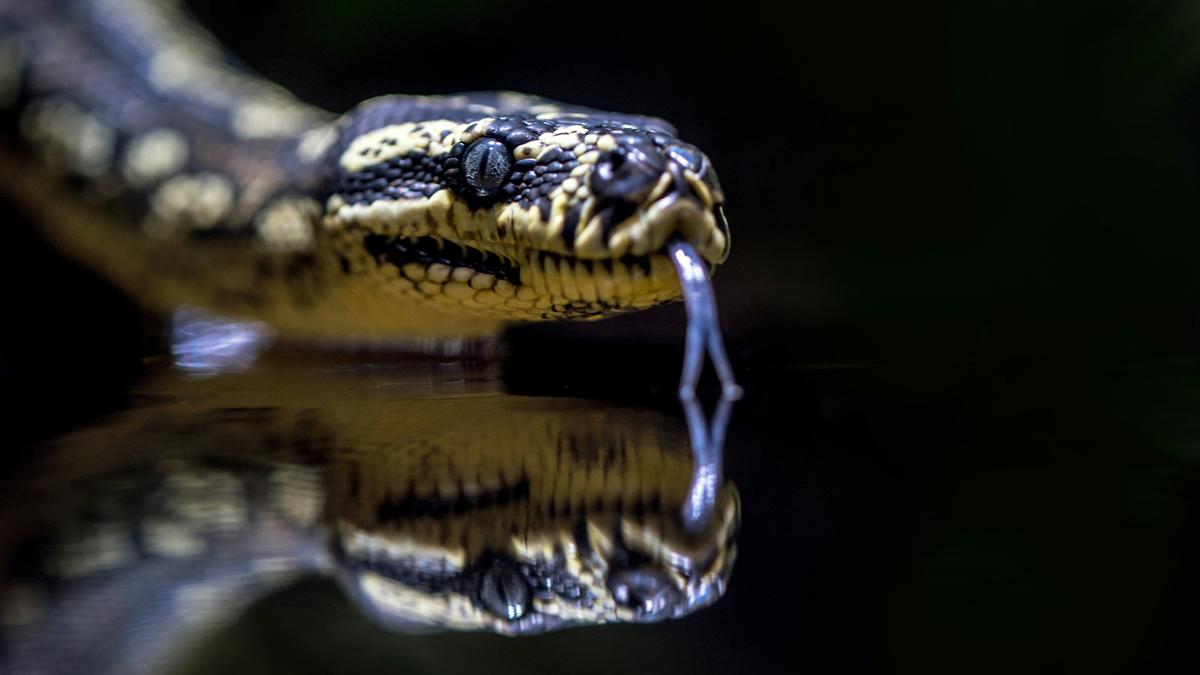
One such evolutionary explosion happened about 100-150 million years ago, when dinosaurs roamed the planet’s surface. An extraordinary evolutionary transformation happened at this time: the nondescript lizards lost their legs to become one of the most highly adapted predators in history, capturing almost every environmental niche on the planet. We know them today as snakes.

Through a series of remarkable adaptations, snakes acquired legless bodies that could slither across diverse terrains, developed complex chemical sensory systems to track prey, incorporated flexible jaws to swallow large animals, and evolved an assortment of attack mechanisms, including the production of lethal venoms.

In a study published on February 22 in the journal Science, an international team of scientists, led by researchers at the University of Michigan, worked together to unravel the genetic sequence of more than 1,018 snake and lizard species. The result was the largest and most comprehensive evolutionary tree of snakes and lizards. They analysed the genetic sequence data together with previous studies, and revealed that snakes have been evolving much faster than their reptilian cousins.

Specifically, the team estimated snakes evolved almost three-times faster than lizards and other reptiles, allowing them to take advantage of the new environmental niches that rapidly emerged after the extinction of the dinosaurs. 

A clock in the body’s molecules

DNA and protein sequences evolve at a relatively constant rate over time, irrespective of the organism. This allows scientists to use genetic differences between two species to estimate the time that has passed since these species last shared a common ancestor. This is then used to calculate the relative pace of evolution of the organism. In a way, genetic sequences serve as a molecular clock using which scientists can determine the ‘evolutionary distances’ between various organisms.

Along with snakes, many lizards also adapted to these rapid changes and developed snake-like traits, including losing their limbs and elongating their bodies. The Australian scincid lizard (Lerista), a member of the clade Squamata (which includes lizards and snakes), provides perhaps the best example of such evolution.

Lerista comprises more than 75 closely related species that display a wide variety of digit (finger) layout: from five digits to being entirely limbless. Such extraordinary malleability of limb-count in this lizard is the result of at least 10 independent evolutionary limb-reduction events over a few million years.

But while the lizards made desperate attempts to evolve, snakes easily outpaced them, leading to a burst of diversification. Researchers have attributed this surge to a phenomenon they call the “singularity of snakes”. This is akin to the Big Bang theory of cosmology, which postulates that our entire universe emerged from a singular event around 14 billion years ago. In the case of the evolution of snakes, the singularity emerged in a series of rapid changes in form and function, but which occurred so close together that they appeared to be a single, unified event on the evolutionary time-scale.

Availability of prey

The eventual result is that we have about 4,000 living species of snakes flourishing in a variety of geographical conditions. Today, snakes are terrestrial dwellers, tree-climbers, burrowers, swimmers, etc., sporting a bevy of hunting strategies and dietary preferences.

As part of the new study, scientists also painstakingly collected information about snakes’ dietary preferences by studying the stomach contents of more than 60,000 snakes and lizards, mostly from field observations and natural-history museum specimens. They found that snakes largely consumed small vertebrates while lizards preferred insects and invertebrates – meaning snakes specialised their food selection whereas lizards have tended to be non-specific.

However, the availability of prey alone is insufficient to explain snake diversity. The researchers also admitted the ultimate cause of the “singularity” remains hidden from view.

The Sonic hedgehog gene

The hallmark of a snake is the elegant manner in which it glides over land or water. Snakes can move this way thanks to their long spinal column and specially designed vertebrae. They have over 300 vertebrae versus about 65 in lizards and 33 in humans. Also, all three organisms have a backbone and almost the same genetic blueprint – yet varied body plans.

In a previous study of snake genomes, researchers were able to identify snake-specific changes in a vertebrate limb-enhancer of the Sonic hedgehog gene (named for the videogame character). This limb-enhancer sequence has also been found in primitive snakes, such as pythons and boa, but not in modern snakes. When they replaced the mouse-specific limb-enhancer gene with the snake-specific one in mice, the researchers observed severe limb reduction.

Scientists suspect such evolutionary bursts in some species may have happened multiple times, not just once, and are certain that understanding them is key to understanding the earth’s ecological future.

The authors are senior consultants at the Vishwanath Cancer Care Foundation and adjunct professors at Indian Institute of Technology, Kanpur.



Source link

Science Tags:evolutionary uplift, genetic sequencing, singularity of snakes

Post navigation

Previous Post: IPL 2024 Won’t Be MS Dhoni’s Last Season? Childhood Friend Drops Massive Update
Next Post: Relatives of Malaysia plane crash victims mark 10 years since disappearance

Related Posts

  • Faunal survey in Kerala’s Vazhachal adds 26 species to checklist of wildlife division in Western Ghats
    Faunal survey in Kerala’s Vazhachal adds 26 species to checklist of wildlife division in Western Ghats Science
  • IISc study shows that small chemical change can boost bioavailability of drug molecules
    IISc study shows that small chemical change can boost bioavailability of drug molecules Science
  • Australian weather bureau sees 50% chance of La Nina this year
    Australian weather bureau sees 50% chance of La Nina this year Science
  • We need more mega-science projects, says CERN Director-General
    We need more mega-science projects, says CERN Director-General Science
  • NASA climate satellite blasts off to survey oceans and atmosphere of a warming Earth
    NASA climate satellite blasts off to survey oceans and atmosphere of a warming Earth Science
  • Does 2022 H5N1 bind, replicate better in the respiratory tract?
    Does 2022 H5N1 bind, replicate better in the respiratory tract? Science

More Related Articles

Jeff Bezos’ Blue Origin launches massive New Glenn rocket on first test flight Jeff Bezos’ Blue Origin launches massive New Glenn rocket on first test flight Science
Where is ISRO heading – The Hindu Where is ISRO heading – The Hindu Science
In manifesto, scientists oppose ‘militarisation’ of quantum research In manifesto, scientists oppose ‘militarisation’ of quantum research Science
BRICS condemns EU carbon tax BRICS condemns EU carbon tax Science
The Science Quiz | Could you slow down? The Science Quiz | Could you slow down? Science
‘AI’s benefits to humanity are enormous, we need social mechanisms to deal with the problems it creates’ ‘AI’s benefits to humanity are enormous, we need social mechanisms to deal with the problems it creates’ Science
SiteLock

Archives

  • October 2026
  • September 2026
  • August 2026
  • July 2026
  • June 2026
  • May 2026
  • April 2026
  • March 2026
  • February 2026
  • January 2026
  • December 2025
  • November 2025
  • October 2025
  • September 2025
  • August 2025
  • July 2025
  • June 2025
  • May 2025
  • April 2025
  • March 2025
  • February 2025
  • January 2025
  • December 2024
  • November 2024
  • October 2024
  • September 2024
  • August 2024
  • July 2024
  • June 2024
  • May 2024
  • April 2024
  • March 2024
  • February 2024
  • January 2024
  • December 2023
  • November 2023
  • October 2023
  • September 2023
  • August 2023
  • July 2023
  • June 2023
  • May 2023
  • April 2023
  • March 2023
  • February 2023
  • January 2023
  • December 2022
  • November 2022
  • October 2022
  • September 2022
  • August 2022
  • July 2022
  • June 2022
  • May 2022

Categories

  • Business
  • Nation
  • Science
  • Sports
  • World

Recent Posts

  • Private bus operators to begin indefinite hunger strike on October 27
  • Yemen’s Houthis vow more attacks on Saudi airports, oil facilities after Aramco HQ hit
  • Ranji Trophy | Assam weathers Punjab’s push for an outright win
  • BJP party worker killed in Bengaluru as high-end car rams gas tanker near Devanahalli; three injured
  • Rupee rises 19 paise to close at 95.17 against U.S. dollar

Recent Comments

  1. RobertTes on UP Teacher Who Asked Students To Slap Muslim Classmate
  2. Manuelret on UP Teacher Who Asked Students To Slap Muslim Classmate
  3. RobertTes on UP Teacher Who Asked Students To Slap Muslim Classmate
  4. RobertTes on UP Teacher Who Asked Students To Slap Muslim Classmate
  5. BrentWes on UP Teacher Who Asked Students To Slap Muslim Classmate
  • Shivraj Singh Chouhan, Congress Chief Mallikarjun Kharge Engage In War Of Words
    Shivraj Singh Chouhan, Congress Chief Mallikarjun Kharge Engage In War Of Words Nation
  • Access Denied World
  • EPFO Reports Highest Ever Monthly Payroll Additions In July 2024
    EPFO Reports Highest Ever Monthly Payroll Additions In July 2024 Nation
  • FIFA World Cup 2026: Kylian Mbappé condemns Paraguayan senator over racist remarks after match
    FIFA World Cup 2026: Kylian Mbappé condemns Paraguayan senator over racist remarks after match Sports
  • Access Denied Sports
  • Access Denied Business
  • North Korea should build two warships a year in next five years, Kim says
    North Korea should build two warships a year in next five years, Kim says World
  • Will India’s Aditya L-1 Mission Throw Light On Solar Eclipse? ISRO Chief S Somanath Says…
    Will India’s Aditya L-1 Mission Throw Light On Solar Eclipse? ISRO Chief S Somanath Says… Nation

Editor-in-Chief:
Mohammad Ariff,
MSW, MAJMC, BSW, DTL, CTS, CNM, CCR, CAL, RSL, ASOC.
editor@artifex.news

Associate Editors:
1. Zenellis R. Tuba,
zenelis@artifex.news
2. Haris Daniyel
daniyel@artifex.news

Photograher:
Rohan Das
rohan@artifex.news

Associate Journalists
1. Subrata Paul - AN/2020/01
2. Quamruz Zaman - AN/2021/22
3. Ahmed Sha - AN/2021/035
4. Ajay Kumar Shaw - AN/2021/39
5. Tahqiqul Hoda - AN/2021/21

Artifex.News offers Online Paid Internships to college students from India and Abroad. Interns will get a PRESS CARD and other online offers.
Send your CV (Subjectline: Paid Internship) to internship@artifex.news

Links:
Associate Journalism
About Us
Privacy Policy

News Links:
Breaking News
World
Nation
Sports
Business
Entertainment
Lifestyle

Registered Office:
72/A, Elliot Road, Kolkata - 700016
Tel: 033-22277777, 033-22172217
Email: office@artifex.news

Editorial Office / News Desk:
No. 13, Mezzanine Floor, Esplanade Metro Rail Station,
12 J. L. Nehru Road, Kolkata - 700069.
(Entry from Gate No. 5)
Tel: 033-46011099, 033-46046046
Email: editor@artifex.news

Copyright © 2023 Artifex.News Newsportal designed by Artifex Infotech.