




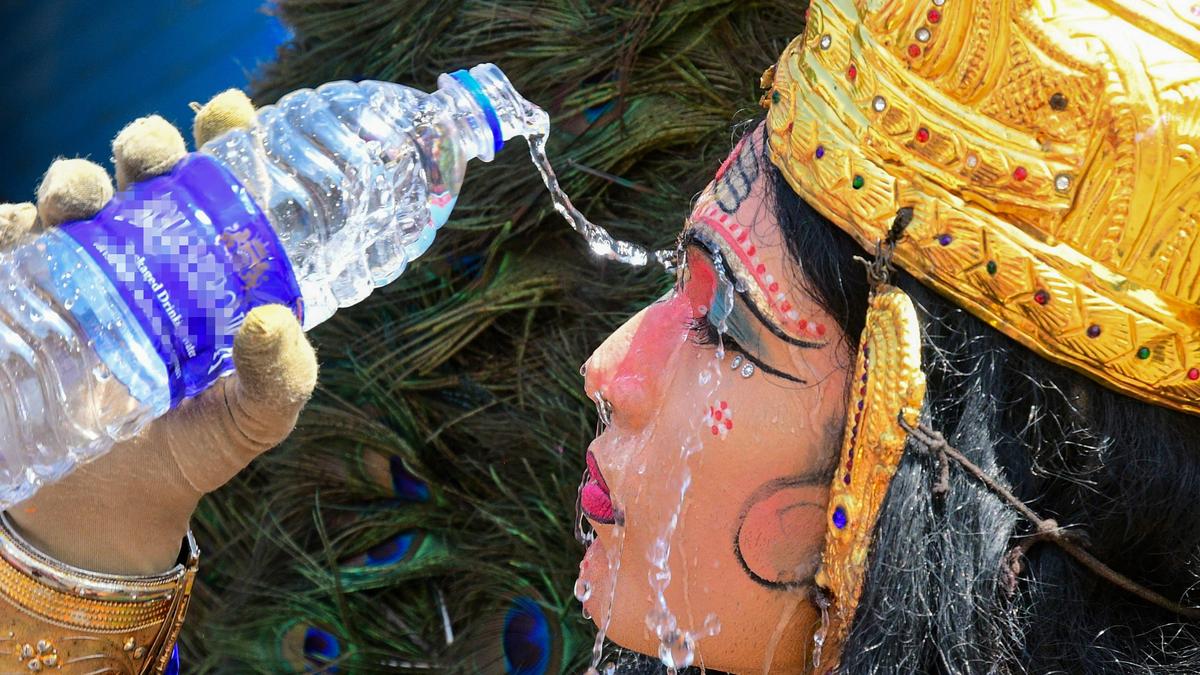
During the Tamil months of Chithirai and Vaikasi (April to June), temple festivals gather momentum across Tamil Nadu. On festival days, village squares and temple grounds slowly fill up even as the sun beats down mercilessly through the afternoon. By evening, performances of song, dance, drama, and ritual begin; people drop in, stay awhile, applaud, and move on, as the night wears on. For the artistes, though, the work starts hours before the first drumbeat and stretches well past the last act, and includes long spells of waiting, preparation, and travel before the performance itself.
A living archive
Tamil Nadu has a vast tradition of folk arts that span rituals, storytelling, music, and movement — from Koothu forms and Oppari lamentations to Parai drumming, Devarattam, Bommalattam (puppetry), and performances in front of the village deity. Many of these traditions are inseparable from temple festivals, agricultural cycles, and caste- and region-specific practices, and form part of a living cultural archive sustained often through oral transmission. In recent years, the State has sought to safeguard and promote these traditions through cultural festivals, documentation, and platforms that bring rural artistes to urban audiences. However, artistes face multiple pressures — among them is heat stress, an overlooked but increasingly felt challenge while performing under open skies.
The Kaniyan Koothu is an ancient folk performance tradition practised by members of the Kaniyan, a Scheduled Tribe community, in Tirunelveli district. Combining music, dance, singing, and narration, it is typically staged at temple festivals, particularly in rituals dedicated to the folk deity, Sudalai, where performers invoke the deity’s spirit through the recital.
Ganesha Moorthy, 45, from Vadakkankulam, describes his art form as an oral tradition passed down through generations. Performing largely across Tirunelveli, Tenkasi, Thoothukudi, and Kanniyakumari, in a troupe of seven to eight members, he said, “We sing the stories of Sivasudalai Maadan, Pechiamma, Karuppasamy, and also Sivapuranam, Empuranam, Kannagi Puranam, and so on.”
Made to wait
Their performances usually run through the night, from 9 p.m. to 4 a.m. “After the show, it takes an hour or so to pack our things up, and then we are usually made to wait for a couple of hours for payment, as the village head has some work. Sometimes, we are given tea,” Mr. Moorthy said, adding that the troupe typically arrives at venues well in advance during the day and spends hours waiting before the performance begins.
Hours spent waiting in open grounds, rehearsing under tin roofs, putting on and performing in heavy costumes are factors that are turning summer festivals into tests of endurance for folk artistes, who say rising heat is becoming another challenge layered onto the existing concerns such as shrinking patronage and dwindling audiences for folk arts.
About 74% of the people in Tamil Nadu are now living in areas where the air temperatures regularly hit over 35 degrees Celsius, according to a study released by the State Planning Commission (SPC) in 2025. Of the State’s 389 administrative blocks, 94 have experienced a ‘very high change’ in heat intensity from 1981 to 2023.
Living on the fringes: Many folk traditions are inseparable from temple festivals, agricultural cycles, and caste- and region-specific practices — forming part of a living cultural archive sustained largely via oral transmission.
| Photo Credit:
N. RAJESH
M. Chandrakumar, a resident of Kilnathur in Tiruvannamalai district, is an Oppari singer who has been performing for 30 years. While Oppari remains his primary art form, he trained in Periya Melam to supplement his income, as he says Oppari performances occur sporadically, typically following deaths in and around his village and often only for a few days each month. Despite three decades of experience, he says he may not be able to perform as long as the elders, from whom he learnt. “Around katthiri (the peak summer), it is not easy to perform without wearing slippers,” he adds.
In addition to the rising average daytime heat, nearly 70% of the districts in Tamil Nadu now have “very warm nights”, with temperatures between 26°C and 28°C. High night-time heat creates a cycle of thermal stress with no breaks, because it prevents the human body from shedding the heat accumulated during the day.
Lack of nocturnal relief
When minimum temperatures stay between 26°C and 28°C, the body’s natural cooling mechanisms are disrupted, leading to cumulative exhaustion, poor sleep quality, and increased cardiovascular strain. This lack of nocturnal relief is particularly dangerous for vulnerable groups such as the elderly and outdoor workers, as it significantly diminishes physical recovery and long-term productivity, the SPC study notes.
According to the study, the number of administrative blocks recording high night-time minimums has surged from just six blocks 20 years ago to 80 blocks today. Several artistes say many among them live with chronic conditions such as diabetes and hypertension, which may force them to step away from performance earlier than expected. While some take comfort in their children’s education as a safety net, it also means the younger generation is less likely to enter the arts, as many folk artistes themselves hope their children will move on to greener pastures. With senior performers retiring sooner and fewer successors stepping in, what does this mean for the future of folk traditions? Anitha Pottamkulam, Director-Culture, Dakshina Chitra, says that while factors such as migration have always affected the continuity of traditional art, climate change has worsened the situation. “They are dislocated. There is a loss of habitat and a loss of access to the materials and ecological resources they need to practise their craft. To that extent, climate and ecological change definitely adds to the existing challenges,” she says.
According to the United Nations Framework Convention on Climate Change (UNFCCC), traditional understandings of climate-related loss have largely centred on impacts that are measurable and monetisable, while non-economic losses — those not reducible to financial terms — remain significant yet under-recognised. Cultural heritage, in particular, has been largely absent from climate agreements and policy discussions, the UNFCCC notes. While heat affects everyone and all performances, its impact is not experienced uniformly. Human vulnerability to heat extends beyond physiological responses to include socio-economic factors such as income, access to healthcare, and housing conditions, the SPC study notes.
Little basic comfort
G. Sundarrajan of Poovulagin Nanbargal and a member of the Tamil Nadu Governing Council on Climate Change says folk artistes are frequently transported in cramped vans and rest at government schools, community halls, or in asbestos-roof shelters, leaving little scope for their bodies to thermoregulate. “When it comes to upper-caste arts, performances are often held in air-conditioned sabhas, but OBC and Dalit artistes usually perform in open rural spaces. Apart from differences in remuneration, there is a lack of basic comfort for the artistes,” he says.
For Shyamala and members of her Thirunangaiyar Kaali Aattam Kalai Kuzhu, an all-transwomen troupe from Cuddalore district, the discomforts are compounded. “We can’t even imagine using the restrooms at most places as they are all makeshift ones,” she says. As a result, they often avoid drinking too much water or even tea, even while wearing elaborate costumes and performing for long hours.
If performers face heat-related challenges, instrument makers — particularly those making thol karuvi or skin-based instruments — experience them even more acutely. P. Matheswaran, an Aadhi Melampractitioner from Salem district, describes enduring heat beyond performance hours. “The instrument we use is a thol karuvi. It holds the sruthi correctly only for a short period, so we have to keep heating it in a very specific way and for a set duration, not for too long, to get the right tone. During the summer months, it is a struggle to sit and hold the instrument, heating it over the fire,” he says.
Artistes spend long hours outdoors, performing through the night and then facing the morning heat, often without adequate time for their bodies to recover. “I started when I was a 10-year-old boy. In these 30 years, I can see how much things have changed. Our group has around 12 people. Many of them, including me, get exhausted more often now, or struggle to sleep properly after a show, even on nights when we don’t perform,” says Mr. Chandrakumar. During the off-season, he adds, they also take up daily wage labour, sometimes in neighbouring districts, to make ends meet. Ms. Pottamkulam says migration does not always sever tradition. “For example, Chennai has a very strong urban folk culture and this is really a product of people who have migrated from rural areas. Some performances are as grand as those in villages, though adapted to an urban scale. However, continuity depends on context. Certain forms, once removed from their original social and ecological milieu, struggle to survive,” she adds.
While government advisories urge people to remain indoors during peak morning heat, Mr. Sundarrajan points out that informal outdoor workers receive no compensation for lost workdays. Drawing a parallel with lean-period support extended to fisherfolk, he says vulnerable groups like folk artistes should also be considered a climate-vulnerable group and given compensation.
Systematic health check-ups
K. Manivasan, Additional Chief Secretary, Tourism, Culture and Religious Endowments Department, says the Tamil Nadu Folk Artistes Welfare Board, under the Department of Art and Culture, has over 50,000 registered members, many of whom have received financial assistance for education and marriage. However, he notes, two key areas require attention. The first is the need for systematic health check-ups and regular screening camps for artistes. “The Welfare Board will work with the Health Department for this,” he says. The second is ensuring that all artistes are covered under health insurance schemes. He adds efforts will also be made to enrol more artistes in the Board.
(This story is part of the Asian College of Journalism’s Climate Change Media Hub Mentorship Programme.)