



Skip to content
  • Facebook
  • X
  • Linkedin
  • WhatsApp
  • Associate Journalism
  • About Us
  • Privacy Policy
  • 033-46046046
  • editor@artifex.news
Artifex.News

Artifex.News

Stay Connected. Stay Informed.

  • Breaking News
  • World
  • Nation
  • Sports
  • Business
  • Science
  • Entertainment
  • Lifestyle
  • Toggle search form
  • Ishan Kishan’s Gym Session Video With Hardik Pandya Viral Amid Row Over Missing Domestic Cricket Tournaments Sports
  • Halving Food Waste Can Reduce Hunger For 153 Million People Globally: Report World
  • Congress Fields BJP Imports, Party “Dynasts” For Madhya Pradesh Election Nation
  • Properties Built with Money From Corruption To Be Attached: Bhagwant Mann Nation
  • “Our Batting Was…”: Babar Azam’s Honest Confession After 228-run Defeat Against India Sports
  • In Catalonia, a high stakes vote for Spain PM, Puigdemont World
  • After 3 Months Stuck On Ship That Hit US Baltimore Bridge, 8 Indians Leaves For Home World
  • More Arrests On US Universities’ Campuses As Gaza Protests Continue World

Why now is the time to address humanity’s impact on the moon

Posted on February 9, 2024 By admin


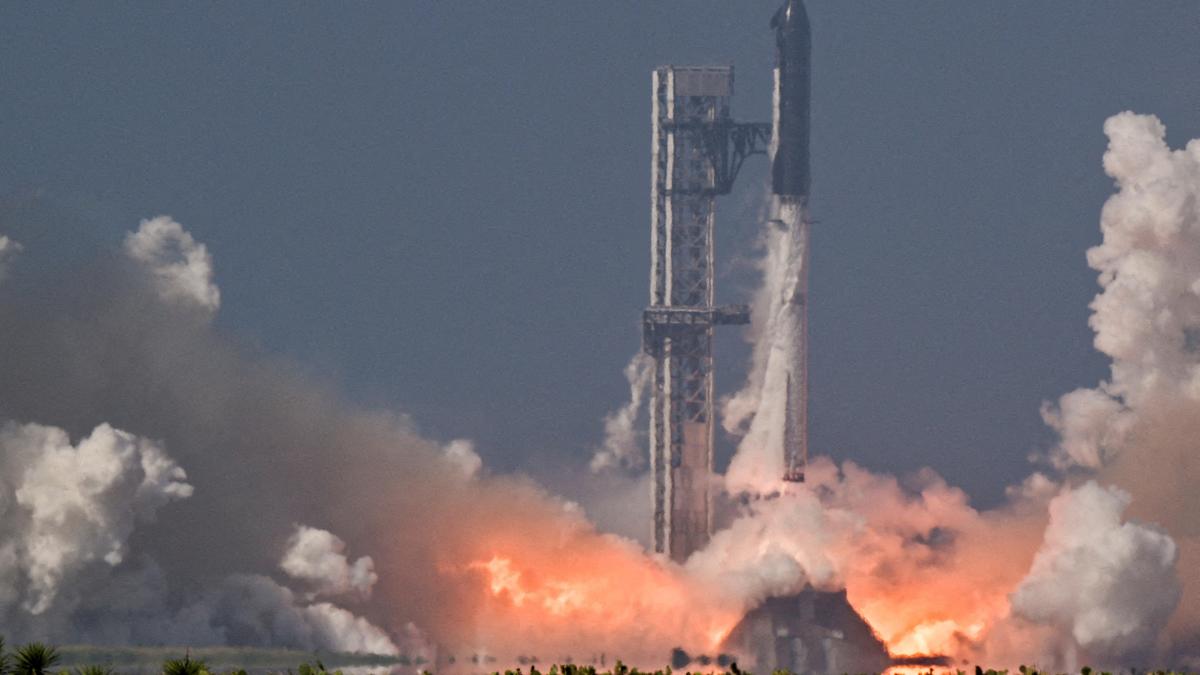
The Lunar Resources Registry, a private business that locates valuable resources on the moon and helps investors conduct the required exploration and extraction operations, notes: “The space race is evolving into space industrialization.” Image for Representation.
| Photo Credit: Reuters

Humans have always looked at the sky, using the stars as navigation guides or for spiritual storytelling. Every human civilization has looked to the stars and used celestial movements to measure time and find meaning.

This insatiable thirst for knowledge combined with technological advancements have made it possible for us to dream of travelling in space. These dreams became more and more real after the Second World War, the Industrial Revolution, the Cold War and the large-scale exploitation of the Earth’s resources.

Dreams of space travel started small with the launch of Sputnik-1 by the Soviet Union, and escalated with the U.S. Apollo landing on the moon in 1969.

Six decades later, plans are ramping up for space tourism, missions to the moon and Mars, and mining on the moon.

The Lunar Resources Registry, a private business that locates valuable resources on the moon and helps investors conduct the required exploration and extraction operations, notes: “The space race is evolving into space industrialization.”

According to NASA, “the moon holds hundreds of billions of dollars of untapped resources,” including water, helium-3 and rare earth metals used in electronics.

The dawn of the Anthropocene

As a group of academics researching various aspects of environmental sustainability on Earth, we are alarmed at the speed of these developments and the impacts resource exploitation will have on lunar and space environments.

There is a movement among the international geologic scientific community calling for a new epoch — the Anthropocene — reflecting the enormous extent to which human activity has altered the planet since the end of the Second World War.

Stratigraphers — geologists who study the layers of rock and sediment — look for measurable global impact of human activities in the geologic record. According to their research, the starting point for the Anthropocene has been identified as beginning in the 1950s, and the fallout from nuclear testing.

To shock humankind into preventing the extensive destruction in space that we have wrought on Earth, it may be effective to add a “lunar Anthropocene” to the moon’s geologic time scale.

The case for a lunar Anthropocene is interesting. It can be argued that since the first human contact with the moon’s surface, we have seen anthropogenic impact. This impact is likely to increase dramatically. This is presented as justification for a new geologic epoch for the moon.

Damaging the Earth

This new “human epoch” is hotly debated among stratigraphers as well as researchers in other disciplines. For humanities researchers and artists, the importance of the Anthropocene lies in the power the concept has to evoke human responsibility for bringing the Earth’s system to a tipping point.

In The Shock of the Anthropocene, historians Christophe Bonneuil and Jean-Baptiste Fressoz argue that the new human epoch entails recognizing that technoscientific advances — which have driven socio-political economies relying on extractivism, consumption and waste — have led to the extent of damage we measure on Earth at present.

For millenia, most societies understood the importance of their relationship with the natural world for survival. But industrialization and the endlessly growing economy in developed countries has destroyed this relationship.

For example, trees used to be respected for providing timber, food, shade and more. But our industrial growth changed all that; in the past 100 years, more trees have been cut than had been felled in the preceding 9,000 years.

A lunar Anthropocene

And now the Anthropocene, this age of human impact, is also arriving on the moon.

NASA estimates there are already 227,000 kilos of human garbage littering the moon, mostly from space explorations, including moon buggies and other equipment, excrement, statues, golf balls, human ashes and flags, among other objects.

An increasing number of moon missions and extracting resources from the moon could destroy lunar environments. This mirrors what has happened on our planet: humans have used this collection of “natural resources” and produced enough waste and degradation to bring us to the current sixth mass extinction precipice.

Our throwaway society leads to not only habitat destruction on Earth, but also now on the moon and in space. We must rethink what we really need. Without a fully functional Earth system, including biodiversity and nature’s contribution to life, we will be unable to survive.

If the intent is to issue a word of caution and pre-emptively shock and elicit a feeling of responsibility on the part of those actors likely to impact the moon’s surface, it may very well be the right time to name a lunar Anthropocene. This may help prevent the kind of extensive and careless destruction we have caused and continue to witness on Earth.

The Conversation

Christine Daigle, Professor of Philosophy, Brock University; Jennifer Ellen Good, Associate Professor and Chair, Communication, Popular Culture and Film, Brock University, and Liette Vasseur, Professor, Biological Sciences, Brock University

This article is republished from The Conversation under a Creative Commons license. Read the original article.



Source link

Science Tags:astronomy news, Humanity’s impact on moon, mining to the moon, missions to moon and mars, space news, space tourism, space travel

Post navigation

Previous Post: Rupee falls seven paise to close at 83.03 against U.S. dollar
Next Post: Disruptions in Red Sea route likely to raise freight and forwarding cost by 25-30%: Report

Related Posts

  • For elephants, like people, greetings are a complicated affair Science
  • 23 private companies in race for SSLV tech transfer from ISRO Science
  • Great Barrier Reef suffering ‘one of the most severe’ coral bleaching events on record Science
  • How do birds fly in a coordinated and seemingly effortless fashion? Science
  • 2023 Nobel Prize in Physics: Seeing electrons through brief pulses of light | Explained Science
  • Three-hour long maiden test flight of Gaganyaan mission to commence at 7 am on October 21   Science

More Related Articles

Acclaimed primatologist Frans de Waal dies at 75 Science
Brazil strengthens climate goals, targets 48% lower emissions by 2025 Science
New tests confirm antiquity of ancient human footprints in New Mexico Science
IISc researchers develop machine learning models for designing next generation nuclear reactor materials Science
India is a powerhouse of mathematics, says Krishnaswami Alladi Science
Pyramids were built along a ‘lost’ branch of the Nile, study finds Science
SiteLock

Archives

  • July 2024
  • June 2024
  • May 2024
  • April 2024
  • March 2024
  • February 2024
  • January 2024
  • December 2023
  • November 2023
  • October 2023
  • September 2023
  • August 2023
  • July 2023
  • June 2023
  • May 2023
  • April 2023
  • March 2023
  • February 2023
  • January 2023
  • December 2022
  • November 2022
  • October 2022
  • September 2022
  • August 2022
  • July 2022
  • June 2022
  • May 2022

Categories

  • Business
  • Nation
  • Science
  • Sports
  • World

Recent Posts

  • On MS Dhoni’s Birthday, His Parents’ Gesture For Fans In Ranchi Goes Viral. Watch
  • Senegal’s President Faye looks to reunite ECOWAS, a bloc split by coups
  • Gautam Adani’s Best Wishes To India’s Paris Olympics Team
  • 6 Schoolchildren Injured As Van Overturns After Hitting Bus In Surat: Cops
  • Nobel laureate Alice Munro’s daughter says stepdad abused her and mom knew

Recent Comments

  1. ywdVpqHiNZCtUDcl on UP Teacher Who Asked Students To Slap Muslim Classmate
  2. bRstIalYyjkCUJqm on UP Teacher Who Asked Students To Slap Muslim Classmate
  3. GkJwRWEAbS on UP Teacher Who Asked Students To Slap Muslim Classmate
  4. xreDavBVnbGqQA on UP Teacher Who Asked Students To Slap Muslim Classmate
  5. aANVRzfUdmyb on UP Teacher Who Asked Students To Slap Muslim Classmate
  • Russia Says No Issues With Oil Payment From India Nation
  • Heatwave and poll effects drag factory output, new orders to 3-month low in May Business
  • Kerala Court On AAP Petition Nation
  • Vast Destruction, 48 Dead In Southern Mexico Due To Hurricane Otis World
  • Israeli military intelligence chief resigns over failure to prevent Hamas’ Oct. 7 attack  World
  • Received 11 Income Department Notices In 72 Hours: Trinamool MP Nation
  • Rupee falls 9 paise to settle at all-time low of 83.22 against U.S. dollar Business
  • 6 Killed, Many Houses Destroyed As Israeli Tanks Advance Into North Gaza World

Editor-in-Chief:
Mohammad Ariff,
MSW, MAJMC, BSW, DTL, CTS, CNM, CCR, CAL, RSL, ASOC.
editor@artifex.news

Associate Editors:
1. Zenellis R. Tuba,
zenelis@artifex.news
2. Haris Daniyel
daniyel@artifex.news

Photograher:
Rohan Das
rohan@artifex.news

Artifex.News offers Online Paid Internships to college students from India and Abroad. Interns will get a PRESS CARD and other online offers.
Send your CV (Subjectline: Paid Internship) to internship@artifex.news

Links:
Associate Journalism
About Us
Privacy Policy

News Links:
Breaking News
World
Nation
Sports
Business
Entertainment
Lifestyle

Registered Office:
72/A, Elliot Road, Kolkata - 700016
Tel: 033-22277777, 033-22172217
Email: office@artifex.news

Editorial Office / News Desk:
No. 13, Mezzanine Floor, Esplanade Metro Rail Station,
12 J. L. Nehru Road, Kolkata - 700069.
(Entry from Gate No. 5)
Tel: 033-46011099, 033-46046046
Email: editor@artifex.news

Copyright © 2023 Artifex.News Newsportal designed by Artifex Infotech.