





1,2,3,4,5,6,7…………………………………………………………………………………………………………………………………………………………………………………………………………..∞
The dots lead us to infinity. Or so I can say and immediately end this article here. Try imagining the highest number imaginable (which is, in layman’s terms ‘infinity’). Can you? Let’s hold that thought as it will become a crucial point of departure for our deep understanding of the infinity.
The brain-melting vagueness of the infinite can be quite annoying, especially in a world of rigorous mathematics. Yet, the story of the mathematical ‘infinity’ is where the infinite has found its shoes and socks.
Two best friends
In the beginning, the concept of the infinity introduced itself to the ancient philosophers and mathematicians who dealt with the cosmos. “Infinity” was the playground for philosophers and mathematicians alike. They were quite chummy when it came to solving fallacies and mysteries regarding ‘infinity’.
In Ancient Greece, way before Socrates, one of the crucial answers people were hunting for was that of the archē — the beloved mysterious origin, the beginning. It was a question rooted in the ontology of existence and life. Infinity peeks out here first.
In Ancient Greece, way before Socrates, one of the crucial answers people were hunting for was that of the archē.
| Photo Credit:
Getty Images/iStockphoto
In the hunt for the archē, a prominent philosopher named Anaxagoras had put forth his two cents. He believed that the universe was made up of infinite elements; a mixture of these elements in everything. I mean, he clearly was onto something then. To give you a bit of context, this was the time when the only popular theories of origin were
1) Everything was made up of water (Thales of Miletus)
2) Everything was made up of four things — air, water, fire, earth (Empedocles)
3) Everything was made up of air (Anaximenes)
4) Everything came from a “boundless” source. (This theory by Anaximander put the idea of infinity as something boundless and unlimited inside our heads)

“There is no smallest among the small and no largest among the large; But always something is still smaller and something still larger.”Anaxagoras
While Anaxagoras still got many things wrong, he had derived a crucial mathematical edge to the understanding of infinity — that things could be infinitely divided and there’s no limit (no smallest and no largest).
It goes on and on and on,
Then it goes on and on and on again
We first said that in layman’s terms infinity is the highest number imaginable. But the act of putting a number on infinity is to state that there is an end.
Now another Greek philosopher named Zeno had two cents to offer in the name of the story of Achilles and the Tortoise.
The story is simple, actually. There was a tortoise and there was Achilles. They were both in a running race. Since it is known that Achilles was pro at running, the tortoise was given a head start.
After the tortoise had run some distance, Achilles could begin. Now here’s the plot twist. Every time Achilles would catch up to where the tortoise had been, the tortoise would have already moved some more distance ahead. The distance gets halved, every time Achilles moves towards the target. See, it’s like this. I move half a distance of A from B to reach my destination C. From B, I move another half a distance D to reach C. Every time I move half up front, I still have another half to cover. This distance between me and the destination can be infinitely halved. This way I can’t ever reach my destination C.
Our brother Zeno here, inferred from this example that motion is an illusion. The later generations of mathematicians and philosophers took it upon themselves to study this mind-bending infinity.
Infinite Series
Integers (in ordered lists) can extend in an infinite manner. The natural numbers with which we began our enquiry into the infinite is one such list. Zeno’s question had pivoted the modern mathematician’s brain towards arithmetic relating to infinite series. How do I find the sum of such a series?
It took about twenty centuries for Zeno’s paradox to be resolved. With calculus as a weapon, the seventeenth and eighteenth century mathematicians undertook to study the nature of infinite series with vigour.
Infinite Mirror Effect
is an example of an infinite geometric series (sum of an infinite geometric sequence).
Infiniti-es?
When Buzz Lightyear in Toy Story said “To infinity and beyond!”, he wasn’t kidding.
By the time German mathematician Georg Cantor joined in the infinity research, a good amount of foundation had been set in place by the virtuosos like Isaac Newton, Gottfried Leibniz, and John Wallis. Infinity had become proper in the numerical, numerous sense. Bringing set theory to the scene, Cantor revolutionised the infinity research by giving proof that different types of infinities exist.
Say there are two sets. If we know that for every element in a set there is a corresponding unique element in the other, then despite not knowing how many elements are there we can say that the two sets have the size (cardinality). Cantor took sets with infinite elements. For instance, sets of natural numbers, odd numbers, even numbers, are all infinite. Take two again. If we assume the same condition, then the infinite sets are also of the same size despite one set having half as many or fewer numbers (a set of primes will always have fewer numbers as compared to a set of natural numbers if we write them based on a finite range).
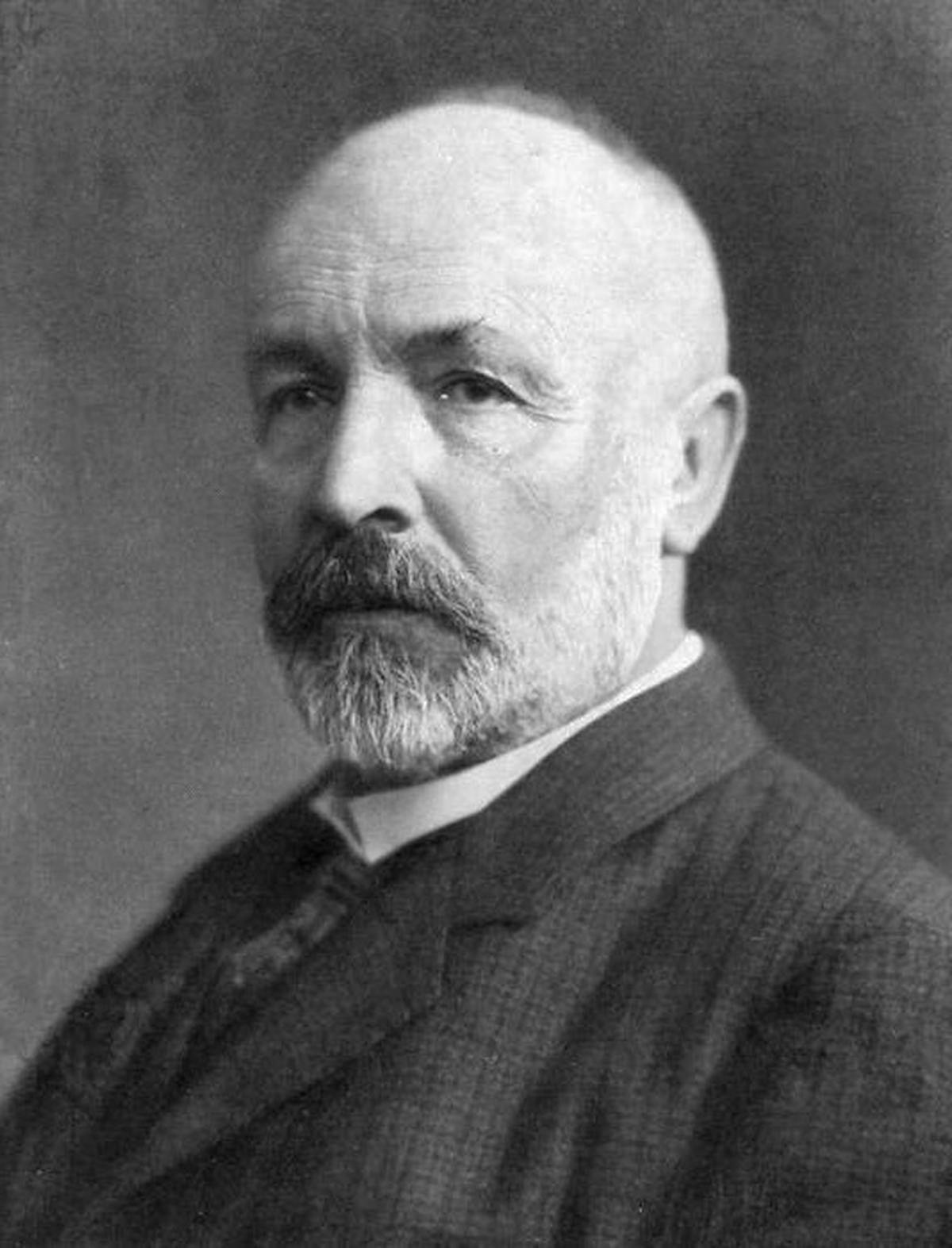
Georg Cantor.
| Photo Credit:
Wikimedia Commons
Now bring in the real numbers. Since real numbers can be rational or irrational, a set of real numbers will have a hard time having corresponding unique elements on the set of natural numbers since we can always come up with the most random real number, i.e. the list would be greatly uneven. Long story short, Cantor inferred from all these and studies them even further to recognise that some infinities are larger than some others. He also proved that real numbers are uncountable since we are unable to express them.
Paradox struck an arrow at him. If there are multiple infinities, surely there must be a largest! No. For that to exist, a set of all sets have to exist which does not exist (look up Cantor’s paradox tomorrow, study a paradox a day). Infinity twisted the logic once again!
Indefinite v/s Infinite
Indefinite and infinite are two things. One thing we often forget to register in our minds is that infinity truly has no end. Indefinite means that while we don’t know the end, it still exists. Infinite means that it is endless. Without differentiating this, our understanding of this ordeal becomes a conundrum. Infinity is a concept and not a number, clearly. By now we must be intelligent enough to understand that much.
While infinity doesn’t end, I unfortunately have to end my article here. take with you two things — infinity is not a number; infinity defies finite logic. One day if you find another paradox related to infinity, act surprised.
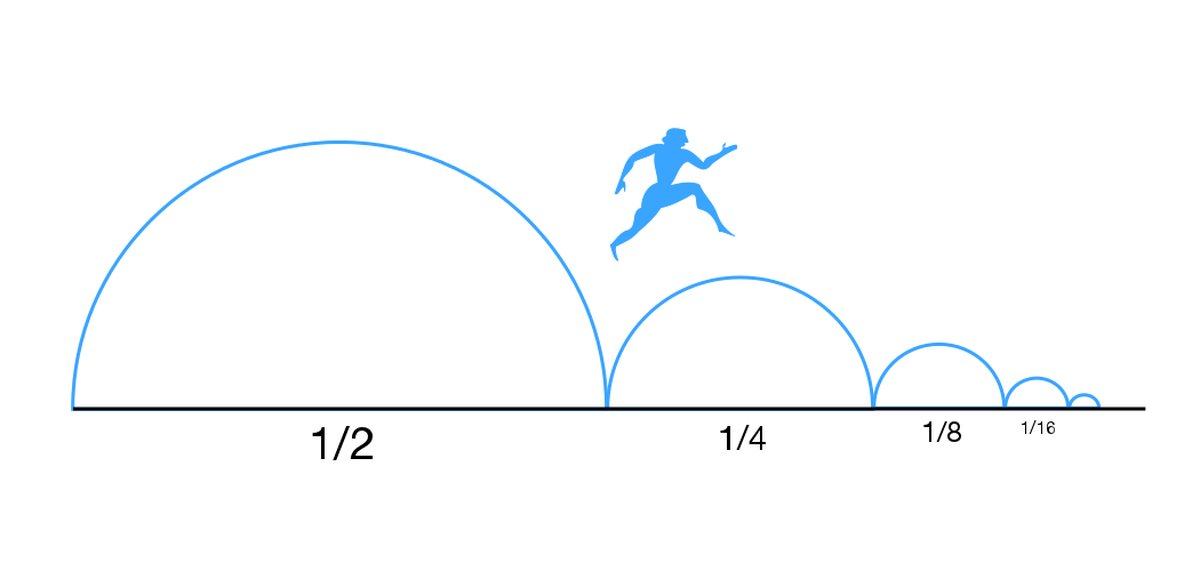
Achilles trying to catch up.
| Photo Credit:
Wikimedia Commons
So does Achilles ever catch up with the tortoise?
I mean I can literally have a running race with a tortoise and say yes. That is precisely the paradox. The sum of all the infinite half distances I cover will give me a finite number. Achilles will catch up with the tortoise after a finite lapse of time. Something without an end, ends.
In mathematical terms, this is basically resolved with the help of limits. An infinite series converges to finite value if we take partial sums.
Partial Sum: The sum of a finite number of terms in an infinite series.