




Skip to content
  • Facebook
  • X
  • Linkedin
  • WhatsApp
  • Associate Journalism
  • About Us
  • Privacy Policy
  • 033-46046046
  • editor@artifex.news
Artifex.News

Artifex.News

Stay Connected. Stay Informed.

  • Breaking News
  • World
  • Nation
  • Sports
  • Business
  • Science
  • Entertainment
  • Lifestyle
  • Toggle search form
  • Scorecard Of NEET Aspirant Arrested For Leak
    Scorecard Of NEET Aspirant Arrested For Leak Nation
  • Sensex climbs 383 points in early trade
    Sensex climbs 383 points in early trade Business
  • Access Denied World
  • Meet The Unlikely Hero Spain Are Relying On For Euro 2024 Tie Against Italy
    Meet The Unlikely Hero Spain Are Relying On For Euro 2024 Tie Against Italy Sports
  • Byju’s Delays Salaries Again, Blames “Few Misguided Foreign Investors”
    Byju’s Delays Salaries Again, Blames “Few Misguided Foreign Investors” Nation
  • What is the outlook on the global economy? | Explained
    What is the outlook on the global economy? | Explained Business
  • Milkman Shot Dead In Broad Daylight In Haryana’s Sonipat, 3 Arrested
    Milkman Shot Dead In Broad Daylight In Haryana’s Sonipat, 3 Arrested Nation
  • Cops Probe Political Links Of Bhole Baba After Killer Hathras Stampede
    Cops Probe Political Links Of Bhole Baba After Killer Hathras Stampede Nation
Alaknanda: Indian astronomers spot implausibly old spiral galaxy

Alaknanda: Indian astronomers spot implausibly old spiral galaxy

Posted on December 29, 2025 By admin


Astronomers from India have discovered the second farthest spiral galaxy in the depths of the universe, using the powerful James Webb Space Telescope (JWST), and have named it ‘Alaknanda’.

The galaxy was an unexpected sight during a broader study of galaxy shapes in the early universe. The findings were published in Astronomy & Astrophysics in November.

The study’s lead author Rashi Jain, a PhD student at the National Centre for Radio Astrophysics in Pune, was analysing public JWST data from the UNCOVER survey, which contains about 70,000 objects, to understand the morphologies of galaxies in the early universe. That’s when she stumbled on the galaxy with two perfectly symmetrical spiral arms.

The first question that popped into her mind was: “Should this exist so early in the universe?”

‘Meticulous analysis’

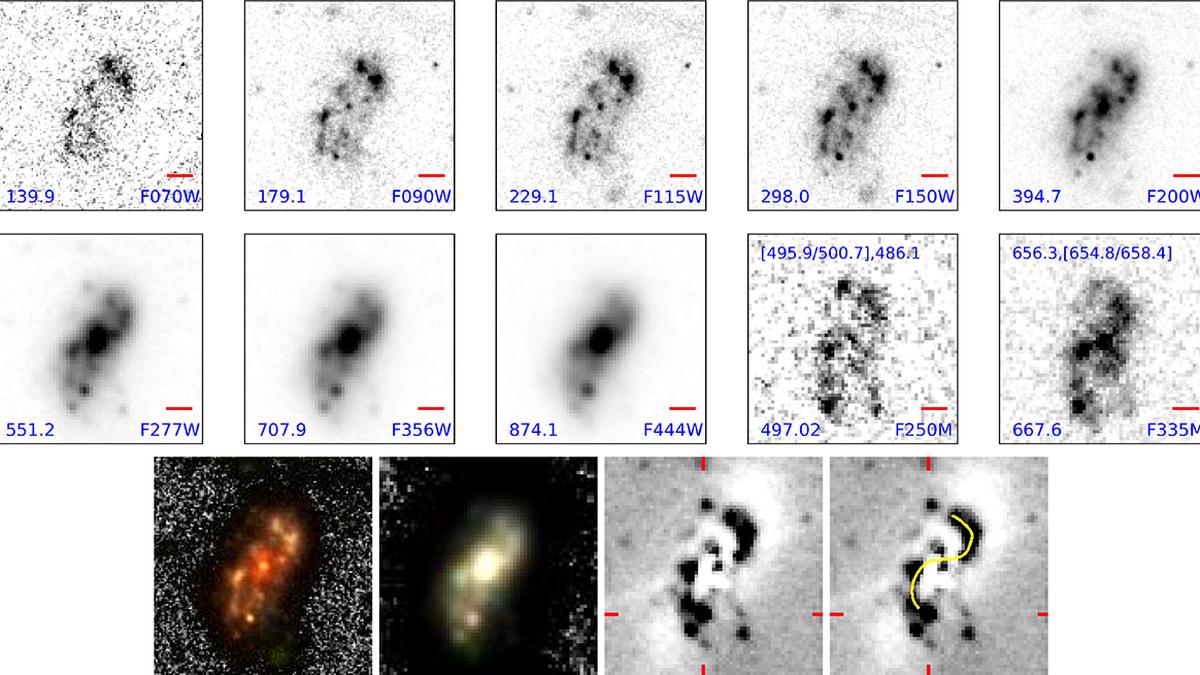
Ms. Jain and her doctoral advisor Yogesh Wadadekar undertook a detailed study to determine the galaxy’s nature. They found it had a prominent disk with two clear spiral arms and a small central bulge. When they removed the smooth light from the disk and the bulge, the spiral arms remained visible, confirming they were real and not an artifact in the light data.

They also found that new stars formed along the spiral arms at about equivalent to 60 stars of our sun’s mass every year. This confirmed Alaknanda was a fully developed spiral galaxy, and only 1.5 billion years after the Big Bang.

Ms. Jain named the galaxy ‘Alaknanda’ for the river in Uttarakhand. She was looking for a female name to be consistent with how galaxies are often referred to in Indian languages.

“I remembered seeing Alaknanda and Mandakini, both tributaries of the Ganga, flowing together during my visit to Uttarakhand. Since our own Milky Way is called Mandakini in Hindi and is also a spiral galaxy, I named this one Alaknanda,” she said.

“The discovery is serendipitous and the result reflects the power of JWST-quality data and meticulous analysis,” Girish Kulkarni, a professor at the Department of Theoretical Physics at the Tata Institute of Fundamental Research, Mumbai, said. “It’s not so much a brand-new technique as careful work making the most of the observations.”

Prof. Kulkarni wasn’t involved in the study.

Too soon, too ready

Alaknanda’s existence poses a significant puzzle for astronomers.

“Current models suggest it takes billions of years for the stable, rotating disks necessary for spiral arms to form,” said Ms. Jain.

However, Alaknanda took shape when the universe was only about 1.5 billion years old, defying the current models of galaxy formation.

According to Prof. Kulkarni, understanding galaxy formation is a “complex system problem,” akin to predicting the weather or the climate. Unlike “simple” physics problems, where fundamental principles might be unknown, complex problems involve known principles but have too many interacting parts to be modelled perfectly.

“Current simulations don’t yield spiral galaxies with this degree of structure at z ~ 4, and when observations disagree with simulations, it usually tells us which ingredients need refinement,” Prof. Kulkarni said.

This means any mismatch is scientifically more useful rather than troubling.

(‘z ~ 4’ is a reference to the redshift, which is the stretching of light to longer wavelengths as the light source recedes from the observer, in this case the earth. The ‘z’ measures the fractional increase in wavelength.)

So how did Alaknanda manage to form a mature spiral disk in such a short time?

According to Ms. Jain, there are two theories about the formation of spiral arms. One is that the galaxy grew steadily by drawing in cold gas, allowing it to settle into a stable, rotating disk in which density waves could form and sustain the spiral patterns. The other is that Alaknanda interacted or merged with a smaller companion galaxy, causing the arms to form.

Even so, astronomers believe spiral arms would have needed more time to form in such a young universe.

“There could be some factor accelerating this process,” Ms. Jain said.

‘Robust findings’

Astronomers usually study galaxies in the distant universe using the energies of light they emit, which reveal the chemical composition and physical conditions in the galaxy. In the absence of such data, as in the new study, they measure the galaxy’s brightness at different wavelengths to reconstruct its overall energy distribution. This is called photometric analysis.

Jain et al. did this using data from the JWST. And with the reconstructed spectrum, they were able to estimate its redshift, stellar mass, and star-formation history.

Prof. Kulkarni said that while the study relied on photometric analysis, its findings appear robust as the team carried out three independent and consistent redshift measurements. However, he suggested the researchers also examine detailed spectroscopic data, such as JWST’s Integral Field Unit images, to ensure the observed structure isn’t caused by clumpy features and to confirm Alaknanda is truly spiral rather than a chance alignment.

The current observations are also insufficient to determine which of the two plausible mechanisms is responsible for Alaknanda’s arms. To this end the team plans to propose further observations with JWST or with the Atacama Large Millimeter/submillimeter Array in Chile.

Indian astronomy

Finally, the discovery of Alaknanda is also a significant achievement for Indian science. Prof. Kulkarni said India’s presence in major JWST discoveries has been limited by a smaller astronomy workforce, fewer dedicated training programmes, and lower funding compared to that in the bigger research economies, as well as less sustained participation in large international survey collaborations.

To catch up and then jump ahead, the Indian astronomy community is pursuing a two-pronged strategy: to build domestic facilities, like the proposed 10-metre optical telescope in Hanle, to train the next generation of scientists, and to join large, multinational projects like the Square Kilometer Array (SKA) and LIGO, which can guarantee access to world-class instruments.

Shreejaya Karantha is a freelance science writer.

Published – December 29, 2025 11:45 am IST



Source link

Science

Post navigation

Previous Post: Silver Price Today: Futures jump 6% to record ₹2.54 lakh/kg; cross $80/ounce in global markets
Next Post: Access Denied

Related Posts

  • The animal that senses electrical boxes, tolerates snow, and has ‘mating trains’
    The animal that senses electrical boxes, tolerates snow, and has ‘mating trains’ Science
  • Before and after satellite images of Wayanad landslip
    Before and after satellite images of Wayanad landslip Science
  • How the concept of open science can be beneficial
    How the concept of open science can be beneficial Science
  • New physics-based model shows healthy guts resist microbial chaos
    New physics-based model shows healthy guts resist microbial chaos Science
  • Will understanding cancer become a data problem? 
    Will understanding cancer become a data problem?  Science
  • What our ancestors’ genomes can tell us about modern health | Explained
    What our ancestors’ genomes can tell us about modern health | Explained Science

More Related Articles

National Mathematics Day and the double life of Jantar Mantar National Mathematics Day and the double life of Jantar Mantar Science
New species of finless snake eel named after Kanniyakumari New species of finless snake eel named after Kanniyakumari Science
Surprise: reading a quantum clock can cost more than keeping it ticking Surprise: reading a quantum clock can cost more than keeping it ticking Science
Microplastics promote cloud formation, with likely effects on weather and climate Microplastics promote cloud formation, with likely effects on weather and climate Science
Fossils suggest even smaller ‘hobbits’ roamed an Indonesian island 700,000 years ago Fossils suggest even smaller ‘hobbits’ roamed an Indonesian island 700,000 years ago Science
ISRO may postpone soft landing on Moon to August 27 based on health of lander module: Official ISRO may postpone soft landing on Moon to August 27 based on health of lander module: Official Science
SiteLock

Archives

  • December 2025
  • November 2025
  • October 2025
  • September 2025
  • August 2025
  • July 2025
  • June 2025
  • May 2025
  • April 2025
  • March 2025
  • February 2025
  • January 2025
  • December 2024
  • November 2024
  • October 2024
  • September 2024
  • August 2024
  • July 2024
  • June 2024
  • May 2024
  • April 2024
  • March 2024
  • February 2024
  • January 2024
  • December 2023
  • November 2023
  • October 2023
  • September 2023
  • August 2023
  • July 2023
  • June 2023
  • May 2023
  • April 2023
  • March 2023
  • February 2023
  • January 2023
  • December 2022
  • November 2022
  • October 2022
  • September 2022
  • August 2022
  • July 2022
  • June 2022
  • May 2022

Categories

  • Business
  • Nation
  • Science
  • Sports
  • World

Recent Posts

  • Access Denied
  • U.S. offers Ukraine 15-year security guarantee as part of peace plan, Zelenskyy says
  • Access Denied
  • Australia to remove tariffs on 100% of Indian exports from January 1, says Piyush Goyal
  • Access Denied

Recent Comments

  1. CurtisFrach on UP Teacher Who Asked Students To Slap Muslim Classmate
  2. dfb{{98991*97996}}xca on UP Teacher Who Asked Students To Slap Muslim Classmate
  3. "dfbzzzzzzzzbbbccccdddeeexca".replace("z","o") on UP Teacher Who Asked Students To Slap Muslim Classmate
  4. 1}}"}}'}}1%>"%>'%> on UP Teacher Who Asked Students To Slap Muslim Classmate
  5. bfg6520<s1﹥s2ʺs3ʹhjl6520 on UP Teacher Who Asked Students To Slap Muslim Classmate
  • India slams Pakistan for ‘baseless & deceitful narratives’ on Kashmir at UNGA
    India slams Pakistan for ‘baseless & deceitful narratives’ on Kashmir at UNGA World
  • “If India Win This World Cup…”: AB de Villiers Drops Bold Virat Kohli Retirement Statement
    “If India Win This World Cup…”: AB de Villiers Drops Bold Virat Kohli Retirement Statement Sports
  • Access Denied Sports
  • Access Denied Sports
  • Biden expected to make major announcement about his re-election bid: media reports
    Biden expected to make major announcement about his re-election bid: media reports World
  • PM Modi condoles T P G Nambiar’s demise, hails his contributions
    PM Modi condoles T P G Nambiar’s demise, hails his contributions Nation
  • Access Denied World
  • Case Against 17 Over Irregularities In Madhya Pradesh Scheme For Labourers
    Case Against 17 Over Irregularities In Madhya Pradesh Scheme For Labourers Nation

Editor-in-Chief:
Mohammad Ariff,
MSW, MAJMC, BSW, DTL, CTS, CNM, CCR, CAL, RSL, ASOC.
editor@artifex.news

Associate Editors:
1. Zenellis R. Tuba,
zenelis@artifex.news
2. Haris Daniyel
daniyel@artifex.news

Photograher:
Rohan Das
rohan@artifex.news

Artifex.News offers Online Paid Internships to college students from India and Abroad. Interns will get a PRESS CARD and other online offers.
Send your CV (Subjectline: Paid Internship) to internship@artifex.news

Links:
Associate Journalism
About Us
Privacy Policy

News Links:
Breaking News
World
Nation
Sports
Business
Entertainment
Lifestyle

Registered Office:
72/A, Elliot Road, Kolkata - 700016
Tel: 033-22277777, 033-22172217
Email: office@artifex.news

Editorial Office / News Desk:
No. 13, Mezzanine Floor, Esplanade Metro Rail Station,
12 J. L. Nehru Road, Kolkata - 700069.
(Entry from Gate No. 5)
Tel: 033-46011099, 033-46046046
Email: editor@artifex.news

Copyright © 2023 Artifex.News Newsportal designed by Artifex Infotech.