



Skip to content
  • Facebook
  • X
  • Linkedin
  • WhatsApp
  • YouTube
  • Associate Journalism
  • About Us
  • Privacy Policy
  • 033-46046046
  • editor@artifex.news
Artifex.News

Artifex.News

Stay Connected. Stay Informed.

  • Breaking News
  • World
  • Nation
  • Sports
  • Business
  • Science
  • Entertainment
  • Lifestyle
  • Toggle search form
  • India vs UAE Asia Cup | Kuldeep magic floors UAE, sets up facile win for India
    India vs UAE Asia Cup | Kuldeep magic floors UAE, sets up facile win for India Sports
  • Spain Can Test Luis De La Fuente Project Against Scotland
    Spain Can Test Luis De La Fuente Project Against Scotland Sports
  • Did Delhi Officer’s Son Sexually Abuse Teen Too? What Cops Said
    Did Delhi Officer’s Son Sexually Abuse Teen Too? What Cops Said Nation
  • On Pension Row, Nirmala Sitharaman’s Sharp Counter To Congress’ “U-Turn” Jab
    On Pension Row, Nirmala Sitharaman’s Sharp Counter To Congress’ “U-Turn” Jab Nation
  • Himanta Sarma After Trump Shot At
    Himanta Sarma After Trump Shot At Nation
  • Boeing 737 Rolls Off Runway In US, Passengers Deplaned On Grass
    Boeing 737 Rolls Off Runway In US, Passengers Deplaned On Grass World
  • Trump and Zelenskyy meet in New York amid rising questions about U.S. support for Ukraine
    Trump and Zelenskyy meet in New York amid rising questions about U.S. support for Ukraine World
  • FIFA World Cup turnout defies concerns, as Americans flock for the spectacle
    FIFA World Cup turnout defies concerns, as Americans flock for the spectacle Sports
How the Aravalli Hills formed and why they look the way they do

How the Aravalli Hills formed and why they look the way they do

Posted on December 28, 2025 By admin


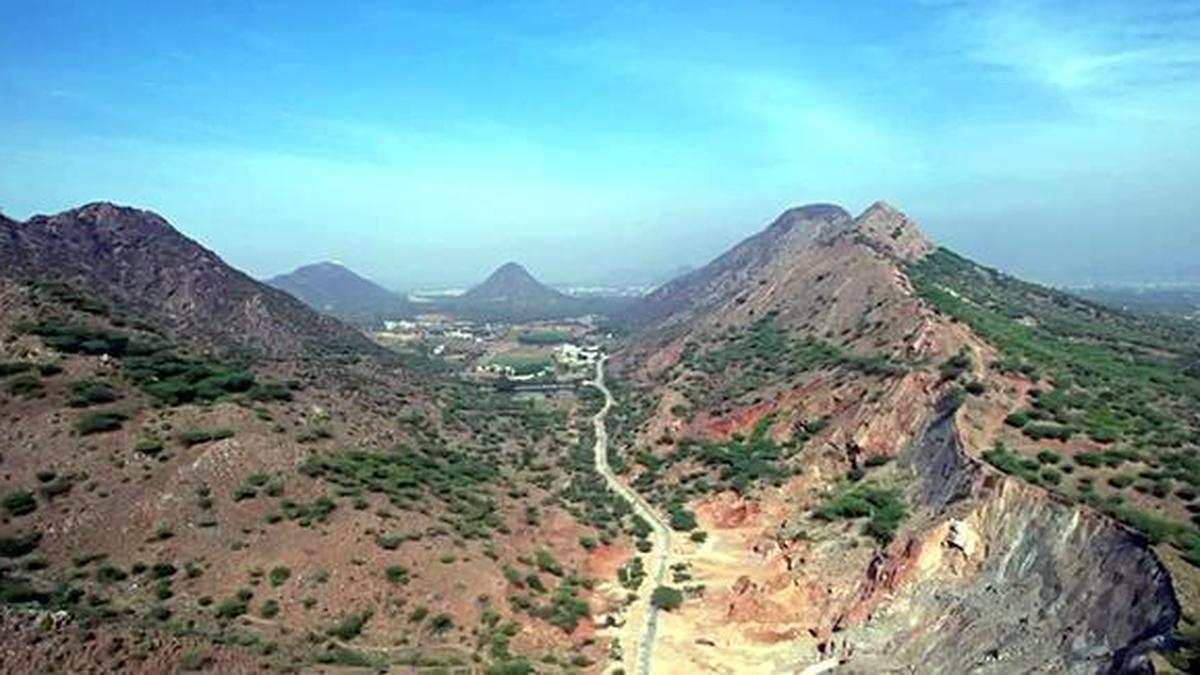
A drone view of the Aravalli Hills in Ajmer.
| Photo Credit: ANI

The Aravalli Hills look modest today but they sit on some of the oldest and most studied rocks in India. Geologists care about them because they preserve a long record of how a piece of the earth’s crust in northwestern India was built, deformed, heated, and intruded by magma, then worn down.

The Hills’ features are better understood as part of a belt of ancient rocks that many scholars have called the Aravalli-Delhi orogenic belt. Within this belt, geologists have distinguished two broad successions of rocks, called the older Aravalli Supergroup and the younger Delhi Supergroup.

Making the Aravalli

Before the Aravalli sediments were laid down, an older crustal foundation already existed in the region. Research has described this basement and the overlying Aravalli succession as a connected system, with sediments accumulating on older crust. Many researchers have interpreted the earliest phase as one in which the crust stretched and thinned, creating basins. Rivers and shallow seas then filled these basins with sand, mud, and carbonate sediments and in some places with volcanic material.

This means the ‘raw material’ for the Aravalli Hills first appeared as sedimentary layers in the basins rather than as a preexisting ridge.

According to geologists, these basins later closed when tectonic forces pushed the crustal blocks together. The layered rocks folded, broke along faults, and were carried over one another along thrusts. As the rocks were buried deeper and were heated, many of them changed (metamorphism), with sandstone turning into quartzite, mudstone into phyllite or schist, and limestone into marble. Studies have also confirmed the presence of large crustal structures consistent with this kind of compression and thrusting at depth.

There were also episodes when magma rose into the crust and crystallised as granitoid bodies. Using zircon dating, geologists have constrained when such intrusions formed. One 2003 study reported a zircon age of about 967.8 million years, give or take 1.2 million years, for the Chang pluton granitoid gneiss in central Rajasthan. This kind of dated intrusion is a mark that tectonic and thermal activity continued long after the earlier sedimentation.

Even after compression and intrusion, the present landscape didn’t appear overnight. Over a very long span of time, while the more resistant rocks, especially quartzite, tended to remain as ridges, wind and water wore the weaker rocks down faster. A 2022 review of the Delhi Supergroup and Delhi Basin emphasised that the belt’s history spans long intervals and multiple tectonic and thermal episodes, which geologists have said could explain why the present hills are really remnants rather than a young, steep mountain range.

Geology to environment

The geology of the Aravalli Hills influences the local soils and movement of water by the kinds of rocks present, the way those rocks break and weather, and the rainfall patterns.

Quartzite is common in many Aravalli ridges. This type of rock is tough because it forms when sandstone is buried and heated until the grains recrystallise and lock together. When quartzite reaches the surface, it often forms rocky ridges with thin soils. Thin soils hold less water and fewer nutrients, which affects what plants can grow and how quickly the slopes erode after being disturbed. In practical terms, the ridge can support vegetation but it’s also easier to damage and slower to recover if the soil is stripped away.

Hard crystalline and metamorphic rocks usually don’t store much water in pores the way sand does. Instead groundwater often lies in fractures and joints and in weathered zones, which means it’s unevenly distributed. Some locations yield water because the rock fractures connect well while nearby locations are dry because the rock is less broken or the weathered layer is thin.

In many parts of the Aravalli Hills, most of the monsoon rains arrive in a few months and there are long dry periods in between. One July 2025 study of the Northern Ridge in Delhi described a climate with hot summers and annual rainfall averaging 710 mm — the kind of seasonality known to favour plants that can tolerate drought.

Because the Hills’ soils are typically thin and there’s little water outside the southwest monsoon, even small disturbances can have lasting effects. Quarrying and mining both remove soil and alter the local drainage. A field study in the Asola Bhatti area in 2018 reported patterns of soil erosion consistent with such disturbances and linked them to lower soil richness and diversity. The researchers also noted that the soil could regenerate in some sites but only if conditions allowed.

Published – December 28, 2025 12:23 pm IST


Source link

Science

Post navigation

Previous Post: Access Denied
Next Post: Editors Council accuses section in Bangladesh’s interim government of allowing violence

Related Posts

  • Science for All Newsletter Why bats do not fall ill from the viruses they spread
    Science for All Newsletter Why bats do not fall ill from the viruses they spread Science
  • SpaceX agrees to take Italian experiments to Mars
    SpaceX agrees to take Italian experiments to Mars Science
  • Gaganyaan astronauts | IAF fighter pilots with distinguished service
    Gaganyaan astronauts | IAF fighter pilots with distinguished service Science
  • Other than the red pigment, what material was used in the red paint by people of Peru’s Sicán culture?
    Other than the red pigment, what material was used in the red paint by people of Peru’s Sicán culture? Science
  • Artemis II astronauts preparing for historic lunar flyby
    Artemis II astronauts preparing for historic lunar flyby Science
  • Naturally occurring bile acid can blunt statin-induced diabetes
    Naturally occurring bile acid can blunt statin-induced diabetes Science

More Related Articles

Subclinical TB is the reason for slow drop in TB incidence, says Soumya Swaminathan Subclinical TB is the reason for slow drop in TB incidence, says Soumya Swaminathan Science
What is Terraforming?  What is Terraforming?  Science
In Japan, a third of today’s 18-year-old women may not have children: Study In Japan, a third of today’s 18-year-old women may not have children: Study Science
Sci-Five | The Hindu Science Quiz: On Snow Leopards Sci-Five | The Hindu Science Quiz: On Snow Leopards Science
More than 800 coal plants worldwide could be profitably decommissioned, research group says More than 800 coal plants worldwide could be profitably decommissioned, research group says Science
Signs of life? Why astronomers are excited about carbon dioxide and methane in the atmosphere of an alien world Signs of life? Why astronomers are excited about carbon dioxide and methane in the atmosphere of an alien world Science
SiteLock

Archives

  • October 2026
  • September 2026
  • August 2026
  • July 2026
  • June 2026
  • May 2026
  • April 2026
  • March 2026
  • February 2026
  • January 2026
  • December 2025
  • November 2025
  • October 2025
  • September 2025
  • August 2025
  • July 2025
  • June 2025
  • May 2025
  • April 2025
  • March 2025
  • February 2025
  • January 2025
  • December 2024
  • November 2024
  • October 2024
  • September 2024
  • August 2024
  • July 2024
  • June 2024
  • May 2024
  • April 2024
  • March 2024
  • February 2024
  • January 2024
  • December 2023
  • November 2023
  • October 2023
  • September 2023
  • August 2023
  • July 2023
  • June 2023
  • May 2023
  • April 2023
  • March 2023
  • February 2023
  • January 2023
  • December 2022
  • November 2022
  • October 2022
  • September 2022
  • August 2022
  • July 2022
  • June 2022
  • May 2022

Categories

  • Business
  • Nation
  • Science
  • Sports
  • World

Recent Posts

  • Saudi Supreme Court sets aside Sri Lankan migrant worker’s death penalty
  • Nedumbassery accident: CPI(M) stages protest march to police station over ‘indifference’ in handling of case
  • Why CJI Surya Kant said ‘no’ to Rahul Gandhi’s request to meet | Explained
  • September WPI Inflation rises to 11.39% as food, fuel and manufactured goods prices increase
  • Frankfurt-Delhi Air India flight diverted to Jaipur following bomb threat

Recent Comments

  1. RobertTes on UP Teacher Who Asked Students To Slap Muslim Classmate
  2. Manuelret on UP Teacher Who Asked Students To Slap Muslim Classmate
  3. RobertTes on UP Teacher Who Asked Students To Slap Muslim Classmate
  4. RobertTes on UP Teacher Who Asked Students To Slap Muslim Classmate
  5. BrentWes on UP Teacher Who Asked Students To Slap Muslim Classmate
  • Thailand’s new PM Shinawatra keen to explore untapped potentials in ties with India
    Thailand’s new PM Shinawatra keen to explore untapped potentials in ties with India World
  • Cricket Australia drops David Warner, Marcus Stoinis, Ashton Agar from central contracts list 2024-25
    Cricket Australia drops David Warner, Marcus Stoinis, Ashton Agar from central contracts list 2024-25 Sports
  • PM Narendra Modi Hails Russia As India’s ‘All-Weather Friend’, Lauds Vladimir Putin’s Leadership
    PM Narendra Modi Hails Russia As India’s ‘All-Weather Friend’, Lauds Vladimir Putin’s Leadership Nation
  • Nikki Halley raises  million in February, bags first Senate endorsement, but rules out third-party run
    Nikki Halley raises $12 million in February, bags first Senate endorsement, but rules out third-party run World
  • Why the Dhruva Sarja-Prem film ‘KD: The Devil’ is trapped in formula
    Why the Dhruva Sarja-Prem film ‘KD: The Devil’ is trapped in formula Nation
  • Donald Trump returns to Pennsylvania assassination attempt site for huge rally with Vance, Elon Musk
    Donald Trump returns to Pennsylvania assassination attempt site for huge rally with Vance, Elon Musk World
  • Five held for alleged attack on anti-narcotics squad
    Five held for alleged attack on anti-narcotics squad Nation
  • ‘Would Struggle To Make It To Karnataka Xl ‘: Ex-India Star Slams Shardul Thakur
    ‘Would Struggle To Make It To Karnataka Xl ‘: Ex-India Star Slams Shardul Thakur Sports

Editor-in-Chief:
Mohammad Ariff,
MSW, MAJMC, BSW, DTL, CTS, CNM, CCR, CAL, RSL, ASOC.
editor@artifex.news

Associate Editors:
1. Zenellis R. Tuba,
zenelis@artifex.news
2. Haris Daniyel
daniyel@artifex.news

Photograher:
Rohan Das
rohan@artifex.news

Associate Journalists
1. Subrata Paul - AN/2020/01
2. Quamruz Zaman - AN/2021/22
3. Ahmed Sha - AN/2021/035
4. Ajay Kumar Shaw - AN/2021/39
5. Tahqiqul Hoda - AN/2021/21

Artifex.News offers Online Paid Internships to college students from India and Abroad. Interns will get a PRESS CARD and other online offers.
Send your CV (Subjectline: Paid Internship) to internship@artifex.news

Links:
Associate Journalism
About Us
Privacy Policy

News Links:
Breaking News
World
Nation
Sports
Business
Entertainment
Lifestyle

Registered Office:
72/A, Elliot Road, Kolkata - 700016
Tel: 033-22277777, 033-22172217
Email: office@artifex.news

Editorial Office / News Desk:
No. 13, Mezzanine Floor, Esplanade Metro Rail Station,
12 J. L. Nehru Road, Kolkata - 700069.
(Entry from Gate No. 5)
Tel: 033-46011099, 033-46046046
Email: editor@artifex.news

Copyright © 2023 Artifex.News Newsportal designed by Artifex Infotech.