





Skip to content
  • Facebook
  • X
  • Linkedin
  • WhatsApp
  • Associate Journalism
  • About Us
  • Privacy Policy
  • 033-46046046
  • editor@artifex.news
Artifex.News

Artifex.News

Stay Connected. Stay Informed.

  • Breaking News
  • World
  • Nation
  • Sports
  • Business
  • Science
  • Entertainment
  • Lifestyle
  • Toggle search form
  • Not MS Dhoni, This Ex-India Star Was First-Choice Captain For CSK In IPL 2008
    Not MS Dhoni, This Ex-India Star Was First-Choice Captain For CSK In IPL 2008 Sports
  • Going through hostile Australian cricketing experience shaped me as a cricketer, as a person: Kohli
    Going through hostile Australian cricketing experience shaped me as a cricketer, as a person: Kohli Sports
  • Kanwar Yatra route: More than 17,600 trees felled in Uttar Pradesh, says Panel to NGT
    Kanwar Yatra route: More than 17,600 trees felled in Uttar Pradesh, says Panel to NGT Nation
  • Belgium-Sweden football match halted following gunman attack in Brussels
    Belgium-Sweden football match halted following gunman attack in Brussels World
  • Access Denied
    Access Denied Nation
  • Access Denied Sports
  • Access Denied World
  • Morning Digest | Adhir Ranjan Chowdhury declines to join ‘one nation, one election’ panel; No Question Hour, private members business during September 18-22 special session of Parliament, and more
    Morning Digest | Adhir Ranjan Chowdhury declines to join ‘one nation, one election’ panel; No Question Hour, private members business during September 18-22 special session of Parliament, and more World
Just five DNA letters flip chromatin from fluid to solid-like state

Just five DNA letters flip chromatin from fluid to solid-like state

Posted on December 26, 2025 By admin


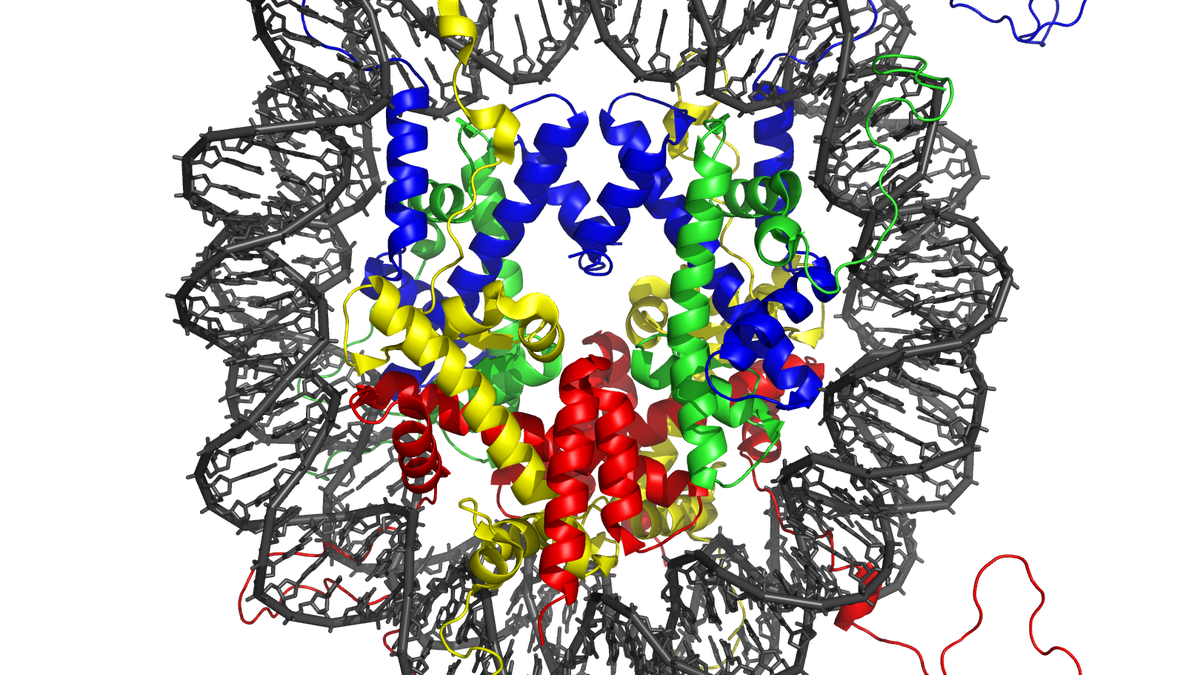
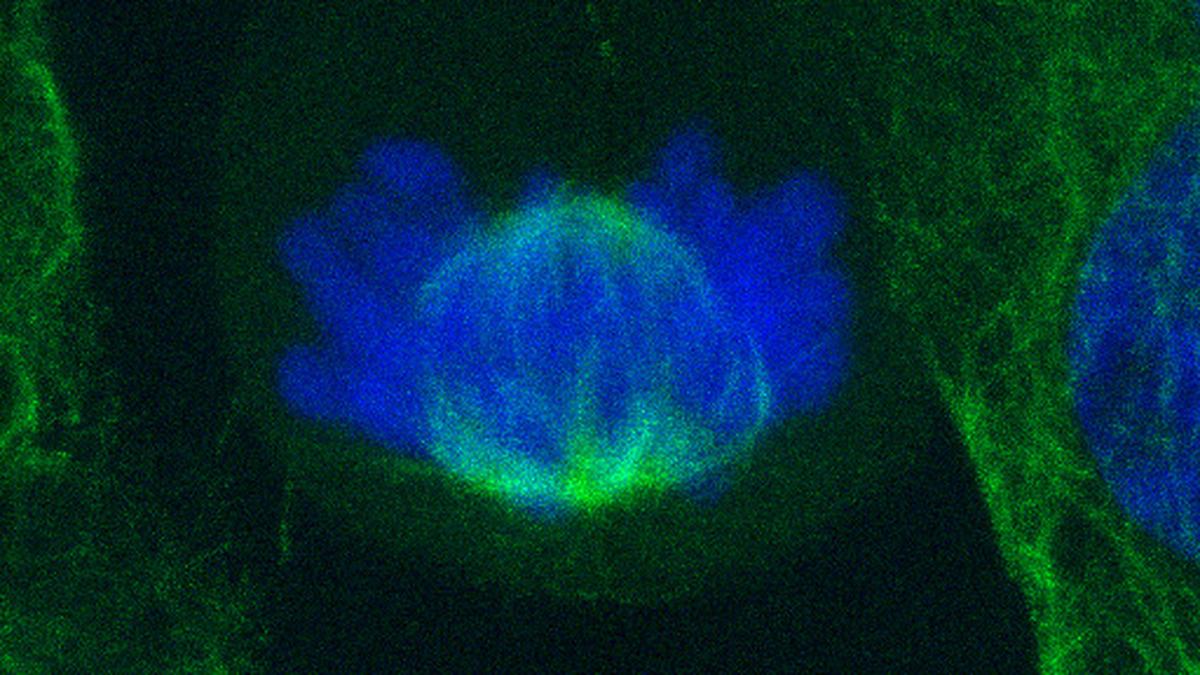
DNA inside human cells is not free-floating. Instead, it is tightly wrapped around small protein units forming a long chain, with DNA looping around each unit before moving on to the next. This DNA-protein complex is called chromatin and allows nearly 2 m of genetic material to fit inside a nucleus only a few micrometres wide.

However, chromatin does more than pack DNA efficiently: its arrangement influences which genes are accessible and which remain shut down. Some regions are loosely organised, allowing the cell to read genetic instructions, while others are dense and harder to access. How cells control these physical states has been a central question in molecular biology.

A new study in Science has now reported that a surprisingly small structural detail, the spacing between neighbouring DNA-protein units, can influence how chromatin behaves. That’s because DNA isn’t straight, UT Southwestern Medical Centre biochemistry professor and the study’s senior author Michael Rosen explained. It is twisted, so even small spacing changes can shift how protein beads sit along the DNA, reshaping the entire strand.

These bead-like proteins, called histones, are connected by short stretches of exposed DNA. In living cells, the length of this linker DNA varies naturally across the genome, differing by only a few DNA building blocks.

Because changes in orientation propagate along the chromatin fibre, Prof. Rosen added, they alter the shape of the entire molecule and how it interacts with nearby strands. These interaction differences, rather than changes in DNA sequence or protein composition, cause chromatin made from identical components to behave in very different ways.

To investigate this, the researchers built chromatin in the laboratory using identical DNA and proteins, altering only the length of the linker DNA. They compared chromatin with shorter linkers to chromatin with slightly longer ones (differing by just five DNA base pairs).

The team used rapid freezing and high-resolution imaging. Individual nucleosomes — the building blocks of chromatin — are large enough to be captured directly, allowing researchers to visualise most molecules inside the clusters. They tracked how the clusters formed, merged, moved, and broke apart.

The results revealed a clear divide. Chromatin with shorter DNA linkers remained more open along its length, positioning its units to reach outward and interact with neighbouring strands, like loosely laid yarn that easily tangles. These clusters were densely connected and mechanically resistant, fusing slowly and proving difficult to break apart.

Chromatin with longer linkers folded inward on the other hand, with units interacting more within the same strand. This reduced connections between neighbouring strands, producing clusters that were less stable, more fluid, and easier to dissolve.

“Those different interaction patterns are what make one system behave like a simple liquid and the other behave more like silly putty or toothpaste,” Prof. Rosen said.

National Institutes of Health biochemist Yamini Dalal said the study reinforces and unifies long-standing, disparate ideas using powerful interdisciplinary techniques. Chromatin has long been understood as a self-organising structure, she said, with nucleosome spacing strongly influencing how it folds.

“The genome’s organisation is encoded in the chromatin itself. You don’t need additional instructions to make structure emerge.”

When the researchers examined human and mouse cells, they found dense chromatin regions with packing patterns similar to those seen in laboratory experiments. Prof. Rosen suggested this shows that the same physical rules apply inside the nucleus as in the test tube, although whether cells actively use this feature to regulate chromatin function remains an open question.

Dr. Dalal agreed that the physics demonstrated is biologically realistic but cautioned against assuming that cells fine-tune this spacing everywhere. Maintaining exact five-base-pair differences across a dynamic chromatin would be difficult, she said. Such effects may matter most in highly ordered genomic regions, such as repetitive DNA, where even small disruptions could alter how easily regulatory molecules move through and access DNA.

Disorder in chromatin’s repetitive DNA stretches is already linked to genome instability in cancer and ageing. Dr. Dalal viewed the findings as a physical blueprint for understanding these fragilities.

From a gene function standpoint as well, the study is provocative. Sarah Teichmann, Cambridge University professor and co-founder of the international Human Cell Atlas project, said the results raise the possibility that chromatin’s physical state could influence how genes are regulated across different cell types. Large efforts such as the Human Cell Atlas, which map molecular differences between cells, could eventually test whether such physical chromatin states vary with cell identity, she said.

Anirban Mukhopadhyay is a geneticist by training and science communicator from New Delhi.

Published – December 26, 2025 06:00 am IST


Source link

Science

Post navigation

Previous Post: U.S. launches strike against Islamic State militants in northwest Nigeria

Related Posts

  • Scientists, civil society members write open letter to Bharat Biotech and ICMR over prosecution of researchers
    Scientists, civil society members write open letter to Bharat Biotech and ICMR over prosecution of researchers Science
  • Eye care diagnosis from a distance
    Eye care diagnosis from a distance Science
  • ISRO conducts first Earth-bound manoeuvre of Aditya-L1 
    ISRO conducts first Earth-bound manoeuvre of Aditya-L1  Science
  • India’s drug safety deficit: critical gaps in an overly complex system need urgent remedies
    India’s drug safety deficit: critical gaps in an overly complex system need urgent remedies Science
  • Who do langurs drink salt water?
    Who do langurs drink salt water? Science
  • ‘We look forward to work with ISRO and get the Indian astronaut into space’
    ‘We look forward to work with ISRO and get the Indian astronaut into space’ Science

More Related Articles

Study offers clues to why COVID-19 vaccine protection wanes quickly Study offers clues to why COVID-19 vaccine protection wanes quickly Science
IISc launches product accelerator programme, Pravriddhi IISc launches product accelerator programme, Pravriddhi Science
Ayurveda, Siddha: Can Indian Knowledge Systems be evidence-based? Ayurveda, Siddha: Can Indian Knowledge Systems be evidence-based? Science
Nobel Prize 2023 for Medicine awarded to Katalin Karikó and Drew Weissman for their work in mRNA vaccines Nobel Prize 2023 for Medicine awarded to Katalin Karikó and Drew Weissman for their work in mRNA vaccines Science
NISAR satellite mounted on GSLV for launch on July 30, 2025 NISAR satellite mounted on GSLV for launch on July 30, 2025 Science
Wuhan keen to shake off pandemic label five years on Wuhan keen to shake off pandemic label five years on Science
SiteLock

Archives

  • December 2025
  • November 2025
  • October 2025
  • September 2025
  • August 2025
  • July 2025
  • June 2025
  • May 2025
  • April 2025
  • March 2025
  • February 2025
  • January 2025
  • December 2024
  • November 2024
  • October 2024
  • September 2024
  • August 2024
  • July 2024
  • June 2024
  • May 2024
  • April 2024
  • March 2024
  • February 2024
  • January 2024
  • December 2023
  • November 2023
  • October 2023
  • September 2023
  • August 2023
  • July 2023
  • June 2023
  • May 2023
  • April 2023
  • March 2023
  • February 2023
  • January 2023
  • December 2022
  • November 2022
  • October 2022
  • September 2022
  • August 2022
  • July 2022
  • June 2022
  • May 2022

Categories

  • Business
  • Nation
  • Science
  • Sports
  • World

Recent Posts

  • Just five DNA letters flip chromatin from fluid to solid-like state
  • U.S. launches strike against Islamic State militants in northwest Nigeria
  • Access Denied
  • No room for spin: Australia goes into the 4th Ashes with a pace-heavy attack against England
  • Access Denied

Recent Comments

  1. CurtisFrach on UP Teacher Who Asked Students To Slap Muslim Classmate
  2. dfb{{98991*97996}}xca on UP Teacher Who Asked Students To Slap Muslim Classmate
  3. "dfbzzzzzzzzbbbccccdddeeexca".replace("z","o") on UP Teacher Who Asked Students To Slap Muslim Classmate
  4. 1}}"}}'}}1%>"%>'%> on UP Teacher Who Asked Students To Slap Muslim Classmate
  5. bfg6520<s1﹥s2ʺs3ʹhjl6520 on UP Teacher Who Asked Students To Slap Muslim Classmate
  • Supreme Court Notice To Gyanvapi Mosque Panel On Plea For ASI Survey Of “Shivling” Area
    Supreme Court Notice To Gyanvapi Mosque Panel On Plea For ASI Survey Of “Shivling” Area Nation
  • Trump pardons anti-abortion activists who blockaded clinic entrances
    Trump pardons anti-abortion activists who blockaded clinic entrances World
  • AI startup Perplexity makes .5-billion bid for Google’s Chrome browser
    AI startup Perplexity makes $34.5-billion bid for Google’s Chrome browser Business
  • Why do astronauts wear pressurised suits? | Explained
    Why do astronauts wear pressurised suits? | Explained Science
  • Data | In Telangana, districts near capital have flourished, while those in periphery lag behind
    Data | In Telangana, districts near capital have flourished, while those in periphery lag behind Business
  • New York taxi driver hits 6 pedestrians, 3 taken to hospital, police say
    New York taxi driver hits 6 pedestrians, 3 taken to hospital, police say World
  • Not our everyday forecast: Odd weather you won’t believe is real
    Not our everyday forecast: Odd weather you won’t believe is real Science
  • Japanese investors sell foreign bonds in July amid fall in U.S. yields
    Japanese investors sell foreign bonds in July amid fall in U.S. yields World

Editor-in-Chief:
Mohammad Ariff,
MSW, MAJMC, BSW, DTL, CTS, CNM, CCR, CAL, RSL, ASOC.
editor@artifex.news

Associate Editors:
1. Zenellis R. Tuba,
zenelis@artifex.news
2. Haris Daniyel
daniyel@artifex.news

Photograher:
Rohan Das
rohan@artifex.news

Artifex.News offers Online Paid Internships to college students from India and Abroad. Interns will get a PRESS CARD and other online offers.
Send your CV (Subjectline: Paid Internship) to internship@artifex.news

Links:
Associate Journalism
About Us
Privacy Policy

News Links:
Breaking News
World
Nation
Sports
Business
Entertainment
Lifestyle

Registered Office:
72/A, Elliot Road, Kolkata - 700016
Tel: 033-22277777, 033-22172217
Email: office@artifex.news

Editorial Office / News Desk:
No. 13, Mezzanine Floor, Esplanade Metro Rail Station,
12 J. L. Nehru Road, Kolkata - 700069.
(Entry from Gate No. 5)
Tel: 033-46011099, 033-46046046
Email: editor@artifex.news

Copyright © 2023 Artifex.News Newsportal designed by Artifex Infotech.