




Skip to content
  • Facebook
  • X
  • Linkedin
  • WhatsApp
  • Associate Journalism
  • About Us
  • Privacy Policy
  • 033-46046046
  • editor@artifex.news
Artifex.News

Artifex.News

Stay Connected. Stay Informed.

  • Breaking News
  • World
  • Nation
  • Sports
  • Business
  • Science
  • Entertainment
  • Lifestyle
  • Toggle search form
  • ‘What Does Mud Taste Like?’: PM Narendra Modi’s Question To Rohit Sharma Over Viral Gesture
    ‘What Does Mud Taste Like?’: PM Narendra Modi’s Question To Rohit Sharma Over Viral Gesture Sports
  • Google Launches AI Feature Air View+ To Provide Real-Time Air Quality Info On Maps
    Google Launches AI Feature Air View+ To Provide Real-Time Air Quality Info On Maps Nation
  • Hours After Killing Cash Van Guard, Robbers Shoot At Man In Another State
    Hours After Killing Cash Van Guard, Robbers Shoot At Man In Another State Nation
  • Vietnam flood death toll rises to 90
    Vietnam flood death toll rises to 90 World
  • Access Denied Sports
  • Taiwan raises concerns about situation ‘getting out of hand’ with China drills
    Taiwan raises concerns about situation ‘getting out of hand’ with China drills World
  • SEBI bans financial influencer Asmita Patel, five others from market, impound illegal gains of more than ₹53 crore
    SEBI bans financial influencer Asmita Patel, five others from market, impound illegal gains of more than ₹53 crore Business
  • Jio Financial continues slide, likely delaying index removal
    Jio Financial continues slide, likely delaying index removal Business
Did an ancient Vaigai flood contribute to Keezhadi’s abandonment?

Did an ancient Vaigai flood contribute to Keezhadi’s abandonment?

Posted on December 24, 2025 By admin


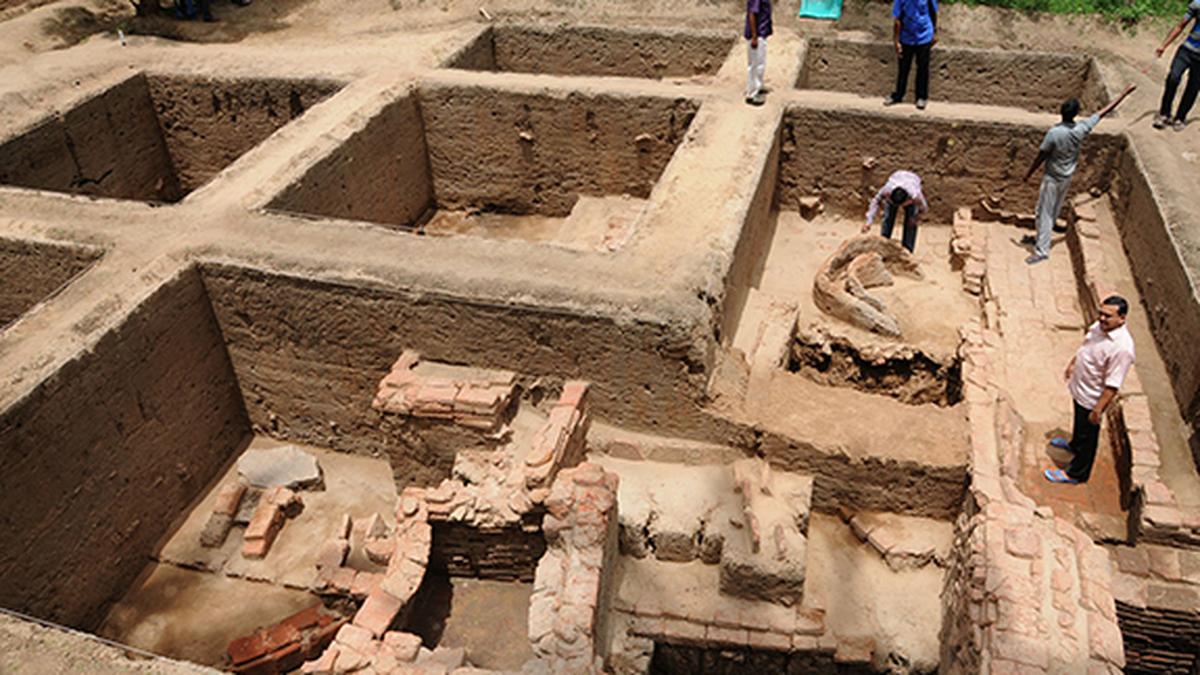
Along the Vaigai river in southern Tamil Nadu, archaeologists have been excavating an old settlement at Keezhadi. They have already found brick walls, channels that look like drains or small canals, floors made of fine clay, and many pieces of pottery. These finds matter because Tamil poems from the Sangam period talk about busy towns and trade in this region but the poems don’t give firm dates. To connect the stories, the structures, and the river’s history, researchers need a reliable timeline for when different layers of sediment were laid down and when the buildings were buried.

A recent study by researchers from Physical Research Laboratory in Ahmedabad and the Department of Archaeology of Tamil Nadu has now reported when flood sediments covered the Keezhadi structures. The authors focused on the fact that Keezhadi, which is in Sivaganga district, sits on a mound on the Vaigai floodplain and that the buildings are not exposed at the surface. Instead, they lie under layers of sand, silt, and clay that the river likely deposited when it flooded. If the team could date the burial sediments, they figured, they’d be able to estimate when the settlement was damaged or abandoned and then covered up.

Telling time with light

To do this, the team used a method called optically stimulated luminescence (OSL) dating. The basic idea is simple even if the lab work is not. Small grains of minerals, especially quartz, sit in the ground and slowly collect energy from natural radiation in the surrounding sediment. Sunlight ‘resets’ this stored energy when the grains are exposed at the surface. Later, if the grains are buried and kept away from light, they start storing energy again. In an OSL lab, scientists stimulate the grains with light and measure the glow (or luminescence) they give off. That glow helps estimate how long it has been since the grains last saw sunlight, which is usually close to the time they were buried by new sediment.

The team collected four sediment samples from two excavation pits at Keezhadi, called KDI-1 and KDI-2, each from a different depth and layer. They hammered light-tight metal tubes horizontally into the sediment so that sunlight couldn’t reach the grains. In the laboratory, they opened the tubes under red light, removed the outer part that might have been exposed during collection, and kept the inner part for the actual dating measurements. Then they cleaned and separated quartz grains using chemical and magnetic methods designed to remove other minerals and contamination.
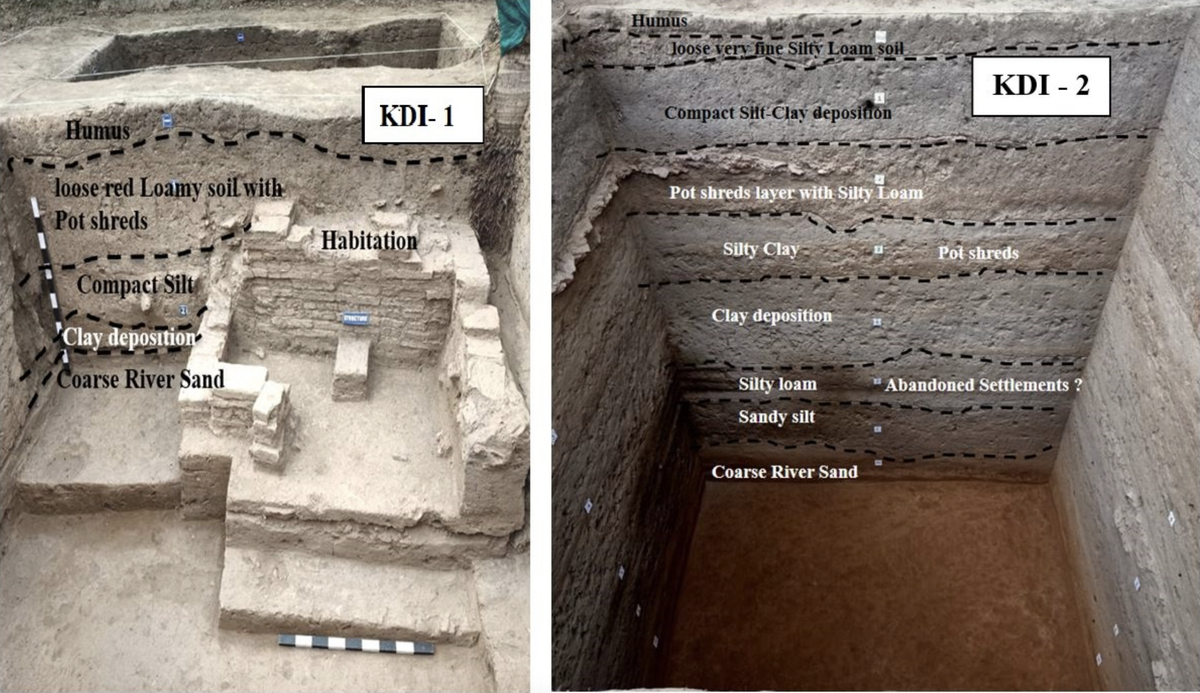
The different litho-stratigraphic layers at the Keezhadi site.

The different litho-stratigraphic layers at the Keezhadi site.
| Photo Credit:
DOI: 10.18520/cs/v129/i8/712-718

Their measurements used a standard procedure (called the single aliquot regeneration protocol) to estimate the radiation dose stored in the quartz since it was buried. They also measured the natural radioactivity of the sediment (from the uranium, thorium, and potassium in it) to estimate the yearly dose rate the grains received in the ground. Finally, using the stored dose and the dose rate, they calculated the burial age for each layer.

The authors reported that their quartz signals behaved well in the tests and that the spread in the dose measurements suggested the grains had been bleached enough by sunlight before burial for the dating to be reliable.

High-energy flood

This way, the team reported that the four OSL ages spanned roughly the last 1,200 years and that they vary with depth in a way that fits the idea of layered flood deposits. In the KDI-1 pit, one sample from a depth of 80 cm depth was aged to about 670 years while a deeper sample from 150 cm down was aged to about 1,170 years. In the KD-2 pit, a sample from 290 cm deep was aged to around 940 years and another from 380 cm to around 1,140 years.

The paper described fine silty-clay layers sitting over brick structures and coarse sand layers deeper down. It also noted potsherd layers and fragments of roof tiles at some levels and describes the brick features as organized, planned construction. The authors also pointed to canals of different widths, suggesting water management that could include different kinds of flow, e.g. freshwater and wastewater.

Taking all these details together, the authors concluded that the burial of the “urban-like” structures at Keezhadi likely happened a little over a thousand years ago — around 1,155 years before present in their phrasing — and this burial was related to a high-energy flood event that deposited sands and then finer silts and clays on the floodplain.

In other words, the Vaigai river seemed to have delivered enough sediment during major floods to cover parts of the settlement, and this process may have forced the settlement to be abandoned or its residents to relocate.
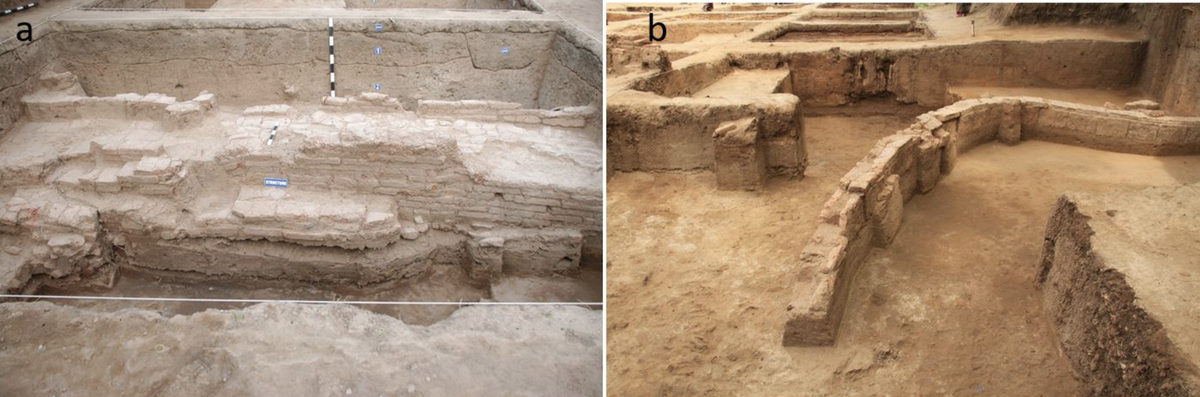
A “well-planned brick structure” (left) and a canal used to transport water, both at the Keezhadi site.

A “well-planned brick structure” (left) and a canal used to transport water, both at the Keezhadi site.
| Photo Credit:
DOI: 10.18520/cs/v129/i8/712-718

Climate context

The study also placed this finding in a broader climate context. The authors noted that in the climate of the late Holocene period (around 5,000 years ago to today), conditions in the Indian subcontinent weren’t stable and that South Indian rivers showed signs of fluctuating through wet and dry periods over time. They also discussed how rivers could shift course and floods plus channel changes could damage or cut off settlements that depend on river water.

The Vaigai is today a few kilometres away from the Keezhadi site, supporting the idea that the river has moved across the floodplain over long periods.

Archaeology isn’t only about digging up objects: it’s also about reading landscapes and sediments like a history book. A brick wall reveals that people built something. A layer of sand and silt above it reveals that something happened later in the environment. A dating method like OSL helps place that environmental event on a timeline.

In this case, the timeline suggests that parts of the Keezhadi settlement were buried by flood deposits roughly a millennium ago. That doesn’t automatically mean climate change in the modern sense caused it even if it also supports a simpler point: that big river floods and shifts can reshape where people live. Indeed, they have been doing so for a long time.

The study also has practical implications for how historians and archaeologists interpret Keezhadi. Many discussions about the site have focused on how old it is and the period to which it belongs. The new work doesn’t date the construction of the bricks themselves; instead it dates the sediment that covered the remains. That could help answer a different question: when did the covering happen?

Knowing that can help archaeologists separate the “time people lived here” from the “time nature buried what they left behind”. It can also guide future excavation plans: if different parts of the mound accumulated sediment at different rates, as the paper suggests when comparing the thickness of layers in the two pits, then some areas may preserve older layers better than others.

The study was published in Current Science on October 25.

Published – December 24, 2025 12:21 pm IST



Source link

Science

Post navigation

Previous Post: Indian woman murdered in Canada, suspect identified

Related Posts

  • Crocodiles yield to flower power, study finds 
    Crocodiles yield to flower power, study finds  Science
  • On soaps and detergents: how they are made and manufactured
    On soaps and detergents: how they are made and manufactured Science
  • Scientists search for a female partner for world’s ‘loneliest’ plant
    Scientists search for a female partner for world’s ‘loneliest’ plant Science
  • Send robots into space rather than people, says Britain’s Astronomer Royal
    Send robots into space rather than people, says Britain’s Astronomer Royal Science
  • Suriname pledges to shield 90% of forests, far beyond global conservation goal
    Suriname pledges to shield 90% of forests, far beyond global conservation goal Science
  • How climate change contributes to wildfires like Chile’s
    How climate change contributes to wildfires like Chile’s Science

More Related Articles

Consumption of ultra-processed and fast foods leading cause of diabetes in India, reveals new study Consumption of ultra-processed and fast foods leading cause of diabetes in India, reveals new study Science
Centre to nudge banks to fund renewable energy projects Centre to nudge banks to fund renewable energy projects Science
The brightest object in the universe is a black hole that eats a star a day The brightest object in the universe is a black hole that eats a star a day Science
Why do rain clouds appear grey? Why do rain clouds appear grey? Science
Finally, physicists have a way to ‘see’ inside short-lived nuclei Finally, physicists have a way to ‘see’ inside short-lived nuclei Science
Japan weather bureau says 90% chance of El Nino ending by May Japan weather bureau says 90% chance of El Nino ending by May Science
SiteLock

Archives

  • December 2025
  • November 2025
  • October 2025
  • September 2025
  • August 2025
  • July 2025
  • June 2025
  • May 2025
  • April 2025
  • March 2025
  • February 2025
  • January 2025
  • December 2024
  • November 2024
  • October 2024
  • September 2024
  • August 2024
  • July 2024
  • June 2024
  • May 2024
  • April 2024
  • March 2024
  • February 2024
  • January 2024
  • December 2023
  • November 2023
  • October 2023
  • September 2023
  • August 2023
  • July 2023
  • June 2023
  • May 2023
  • April 2023
  • March 2023
  • February 2023
  • January 2023
  • December 2022
  • November 2022
  • October 2022
  • September 2022
  • August 2022
  • July 2022
  • June 2022
  • May 2022

Categories

  • Business
  • Nation
  • Science
  • Sports
  • World

Recent Posts

  • Did an ancient Vaigai flood contribute to Keezhadi’s abandonment?
  • Indian woman murdered in Canada, suspect identified
  • Business events that shaped India in 2025
  • Access Denied
  • Access Denied

Recent Comments

  1. CurtisFrach on UP Teacher Who Asked Students To Slap Muslim Classmate
  2. dfb{{98991*97996}}xca on UP Teacher Who Asked Students To Slap Muslim Classmate
  3. "dfbzzzzzzzzbbbccccdddeeexca".replace("z","o") on UP Teacher Who Asked Students To Slap Muslim Classmate
  4. 1}}"}}'}}1%>"%>'%> on UP Teacher Who Asked Students To Slap Muslim Classmate
  5. bfg6520<s1﹥s2ʺs3ʹhjl6520 on UP Teacher Who Asked Students To Slap Muslim Classmate
  • Rupee settles 4 paise lower at 83.50 against U.S. dollar
    Rupee settles 4 paise lower at 83.50 against U.S. dollar Business
  • Indian Bank plans to recover bad debts of ₹7,000 cr. in FY25
    Indian Bank plans to recover bad debts of ₹7,000 cr. in FY25 Business
  • Novak Djokovic, Andy Murray To Put Injuries Behind, Start Wimbledon Campaigns Today
    Novak Djokovic, Andy Murray To Put Injuries Behind, Start Wimbledon Campaigns Today Sports
  • India’s sunflower oil, soy oil imports up as palm oil imports fall
    India’s sunflower oil, soy oil imports up as palm oil imports fall Business
  • Probe Agency To Delhi High Court
    Probe Agency To Delhi High Court Nation
  • MS Dhoni Takes Dig At IPL Retention Rumours, Says “Everyone’s A Team Owner…”
    MS Dhoni Takes Dig At IPL Retention Rumours, Says “Everyone’s A Team Owner…” Sports
  • Thousands Flee As Israel Raids Gaza Strip
    Thousands Flee As Israel Raids Gaza Strip World
  • Navalny’s mother brings flowers to his grave a day after thousands attended his funeral in Moscow
    Navalny’s mother brings flowers to his grave a day after thousands attended his funeral in Moscow World

Editor-in-Chief:
Mohammad Ariff,
MSW, MAJMC, BSW, DTL, CTS, CNM, CCR, CAL, RSL, ASOC.
editor@artifex.news

Associate Editors:
1. Zenellis R. Tuba,
zenelis@artifex.news
2. Haris Daniyel
daniyel@artifex.news

Photograher:
Rohan Das
rohan@artifex.news

Artifex.News offers Online Paid Internships to college students from India and Abroad. Interns will get a PRESS CARD and other online offers.
Send your CV (Subjectline: Paid Internship) to internship@artifex.news

Links:
Associate Journalism
About Us
Privacy Policy

News Links:
Breaking News
World
Nation
Sports
Business
Entertainment
Lifestyle

Registered Office:
72/A, Elliot Road, Kolkata - 700016
Tel: 033-22277777, 033-22172217
Email: office@artifex.news

Editorial Office / News Desk:
No. 13, Mezzanine Floor, Esplanade Metro Rail Station,
12 J. L. Nehru Road, Kolkata - 700069.
(Entry from Gate No. 5)
Tel: 033-46011099, 033-46046046
Email: editor@artifex.news

Copyright © 2023 Artifex.News Newsportal designed by Artifex Infotech.