


Skip to content
  • Facebook
  • X
  • Linkedin
  • WhatsApp
  • Associate Journalism
  • About Us
  • Privacy Policy
  • 033-46046046
  • editor@artifex.news
Artifex.News

Artifex.News

Stay Connected. Stay Informed.

  • Breaking News
  • World
  • Nation
  • Sports
  • Business
  • Science
  • Entertainment
  • Lifestyle
  • Toggle search form
  • “Really Surprised”: Australia Great On R Ashwin’s Retirement From International Cricket
    “Really Surprised”: Australia Great On R Ashwin’s Retirement From International Cricket Sports
  • Received Bangladesh’s Request To Extradite Sheikh Hasina, Confirms India
    Received Bangladesh’s Request To Extradite Sheikh Hasina, Confirms India Nation
  • Sundaram Home Finance eyes ₹225 crore disbursal in Madhya Pradesh
    Sundaram Home Finance eyes ₹225 crore disbursal in Madhya Pradesh Business
  • 5 Asteroid To Skim Past Earth This Week, 2 The Size Of Airplane: NASA
    5 Asteroid To Skim Past Earth This Week, 2 The Size Of Airplane: NASA World
  • Germany To Try Ex-Stasi Officer For Pole Murder Nearly 50 Years Ago
    Germany To Try Ex-Stasi Officer For Pole Murder Nearly 50 Years Ago World
  • Chinese Foreign Minister Wang Yi warns Philippines over U.S. missile deployment
    Chinese Foreign Minister Wang Yi warns Philippines over U.S. missile deployment World
  • Apple Trader Runs Pablo Escobar-esque Drug Op In Shimla, Evades Cops For Years
    Apple Trader Runs Pablo Escobar-esque Drug Op In Shimla, Evades Cops For Years Nation
  • Rupee rises 7 paise against US dollar in early trade
    Rupee rises 7 paise against US dollar in early trade Business
Why are India’s communications satellites so heavy? | Explained

Why are India’s communications satellites so heavy? | Explained

Posted on November 3, 2025 By admin


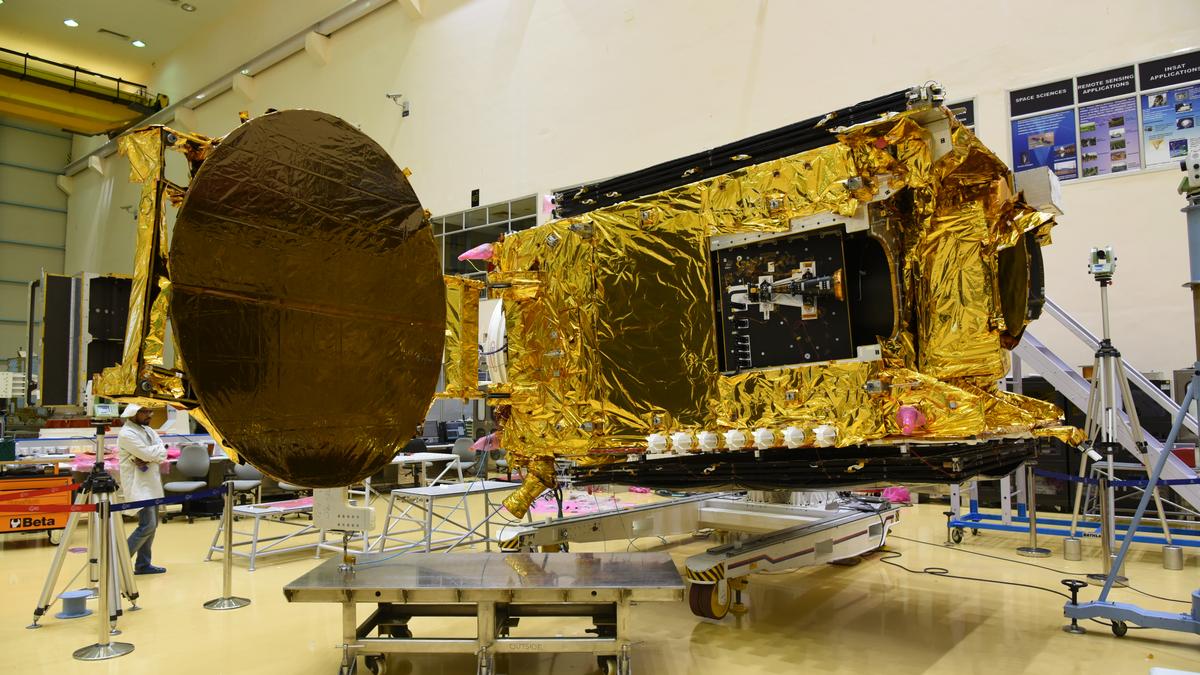
A photo of the GSAT-30 communications satellite.
| Photo Credit: ISRO

On November 2, the Indian Space Research Organisation (ISRO) launched the GSAT-7R satellite for the Indian Navy. The satellite’s launch mass was 4,410 kg — rendering the launch the heaviest of a communications satellite from Indian soil. For this mission, ISRO used its LVM-3 rocket, the most powerful yet in its stable of launch vehicles.

India’s communications satellites are heavy because they combine wide coverage, high power, and long service life in one spacecraft.

To serve the entire country and nearby seas, the communications payload needs to support many channels across multiple frequency bands. These are typically the C (4-8 GHz), the Ku (12-18 GHz), and sometimes the Ka (27-40 GHz) bands. This in turn requires several large deployable antennas, high-power amplifiers, waveguides, filters, switches, and either many analog transponders or flexible digital processors.

The antennas and pointing mechanisms also need to hold tight alignment in space, so the structure and thermal control systems are correspondingly robust and add more mass.

The satellites’ high throughput demands several kilowatt of electrical power. To supply this for 12–15 years, satellites carry large solar arrays, batteries large enough to account for daily eclipses, and power-conditioning units. These elements also increase mass, even as they must be built to withstand radiation and repeated heating and cooling cycles.

The spacecrafts’ long life demands redundancy, including in the form of duplicate computers, radios, and power units, so that they can continue working after failures. Redundancy improves reliability but increases weight.

Next, getting to the geostationary orbit (GTO) adds more mass in propellant. The GTO is a highly elliptical orbit that’s used to move satellites into the geostationary or geosynchronous orbits. A launch vehicle like ISRO’s LVM-3 will place the satellite into the GTO, and from there the satellite will use its own propulsion systems to move into the final intended orbit. In a GTO, the perigee, i.e. the point closest to the earth, can be a low-earth orbit (150-2,000 km above) while the apogee can be as high as the geostationary orbit (35,786 km).

When a communications satellite first enters the GTO, it must perform orbit-raising and station-keeping manoeuvres, as well as manage its momentum for more than a decade. The chemical propulsion systems that are still common on many Indian satellites need significant quantities of fuel for these tasks.

Finally, economic factors reinforce these choices. Launch opportunities are limited and operators prefer fewer, more capable satellites to cover specific national needs. As a result, it’s better for communications satellites to be designed to have high power, broad coverage, long lifetimes, and robust backups. In future electric propulsion systems can reduce the propellant mass, although the trade-off between satellite capability and satellite lifetime will still remain.

chart visualization

Published – November 03, 2025 12:32 pm IST



Source link

Science

Post navigation

Previous Post: PM Modi launches RDI Fund to spur private investment in research
Next Post: More than half of Indian enterprises faced ransomware attacks: survey

Related Posts

  • Why do rain clouds appear grey?
    Why do rain clouds appear grey? Science
  • How do scientists determine the temperature of planets or stars?
    How do scientists determine the temperature of planets or stars? Science
  • The mind-bending maths that could stop ‘quantum hackers’
    The mind-bending maths that could stop ‘quantum hackers’ Science
  • Race for Sun heats up: These are various solar missions
    Race for Sun heats up: These are various solar missions Science
  • Deep tech investments in India doubling every three years, crossed  billion between 2021-23: Report
    Deep tech investments in India doubling every three years, crossed $1 billion between 2021-23: Report Science
  • NASA plans to build a nuclear reactor on the moon
    NASA plans to build a nuclear reactor on the moon Science

More Related Articles

Meghalaya polio case reveals Health Ministry’s reluctance to share details Meghalaya polio case reveals Health Ministry’s reluctance to share details Science
Race for Sun heats up: These are various solar missions Race for Sun heats up: These are various solar missions Science
New low-cost MRI machine can improve access to diagnostics in India New low-cost MRI machine can improve access to diagnostics in India Science
Science This Week | NASA’s OSIRIS-REx to bring back asteroid fragments, no signals from Vikram and Pragyan and more Science This Week | NASA’s OSIRIS-REx to bring back asteroid fragments, no signals from Vikram and Pragyan and more Science
A base deep in a Swedish forest is part of Europe’s hope to compete in the space race A base deep in a Swedish forest is part of Europe’s hope to compete in the space race Science
GSAT-7R will strengthen Indian Navy’s surveillance and communication in the Indian Ocean Region GSAT-7R will strengthen Indian Navy’s surveillance and communication in the Indian Ocean Region Science
SiteLock

Archives

  • November 2025
  • October 2025
  • September 2025
  • August 2025
  • July 2025
  • June 2025
  • May 2025
  • April 2025
  • March 2025
  • February 2025
  • January 2025
  • December 2024
  • November 2024
  • October 2024
  • September 2024
  • August 2024
  • July 2024
  • June 2024
  • May 2024
  • April 2024
  • March 2024
  • February 2024
  • January 2024
  • December 2023
  • November 2023
  • October 2023
  • September 2023
  • August 2023
  • July 2023
  • June 2023
  • May 2023
  • April 2023
  • March 2023
  • February 2023
  • January 2023
  • December 2022
  • November 2022
  • October 2022
  • September 2022
  • August 2022
  • July 2022
  • June 2022
  • May 2022

Categories

  • Business
  • Nation
  • Science
  • Sports
  • World

Recent Posts

  • Crushed stones beneath our railway tracks? Why?
  • Access Denied
  • Indonesia police find possible explosive powder in Jakarta mosque blasts
  • Access Denied
  • Access Denied

Recent Comments

  1. dfb{{98991*97996}}xca on UP Teacher Who Asked Students To Slap Muslim Classmate
  2. "dfbzzzzzzzzbbbccccdddeeexca".replace("z","o") on UP Teacher Who Asked Students To Slap Muslim Classmate
  3. 1}}"}}'}}1%>"%>'%> on UP Teacher Who Asked Students To Slap Muslim Classmate
  4. bfg6520<s1﹥s2ʺs3ʹhjl6520 on UP Teacher Who Asked Students To Slap Muslim Classmate
  5. pHqghUme9356321 on UP Teacher Who Asked Students To Slap Muslim Classmate
  • What Trump’s Elon Musk, Vivek Ramaswamy pick means to the U.S. government?
    What Trump’s Elon Musk, Vivek Ramaswamy pick means to the U.S. government? World
  • Karnataka Farmers On All-Night Protest Over Cauvery Water
    Karnataka Farmers On All-Night Protest Over Cauvery Water Nation
  • Access Denied Sports
  • Sonia Malhar vs Jayasurya Over #MeToo Allegations
    Sonia Malhar vs Jayasurya Over #MeToo Allegations Nation
  • Al Jazeera Goes Off-Air In Israel After Nation’s Shut Down Decision
    Al Jazeera Goes Off-Air In Israel After Nation’s Shut Down Decision World
  • Russia Issues New School Textbook, Says It Was “Forced” To March Into Ukraine
    Russia Issues New School Textbook, Says It Was “Forced” To March Into Ukraine World
  • Netanyahu says Israel dropped 153 tonnes of bombs on Gaza on October 19
    Netanyahu says Israel dropped 153 tonnes of bombs on Gaza on October 19 World
  • Access Denied World

Editor-in-Chief:
Mohammad Ariff,
MSW, MAJMC, BSW, DTL, CTS, CNM, CCR, CAL, RSL, ASOC.
editor@artifex.news

Associate Editors:
1. Zenellis R. Tuba,
zenelis@artifex.news
2. Haris Daniyel
daniyel@artifex.news

Photograher:
Rohan Das
rohan@artifex.news

Artifex.News offers Online Paid Internships to college students from India and Abroad. Interns will get a PRESS CARD and other online offers.
Send your CV (Subjectline: Paid Internship) to internship@artifex.news

Links:
Associate Journalism
About Us
Privacy Policy

News Links:
Breaking News
World
Nation
Sports
Business
Entertainment
Lifestyle

Registered Office:
72/A, Elliot Road, Kolkata - 700016
Tel: 033-22277777, 033-22172217
Email: office@artifex.news

Editorial Office / News Desk:
No. 13, Mezzanine Floor, Esplanade Metro Rail Station,
12 J. L. Nehru Road, Kolkata - 700069.
(Entry from Gate No. 5)
Tel: 033-46011099, 033-46046046
Email: editor@artifex.news

Copyright © 2023 Artifex.News Newsportal designed by Artifex Infotech.