



When we think of snakes, we often picture their iconic slithering, graceful, wave-like motion — a biological marvel that seems to defy friction and has fascinated zoologists for decades. That’s not the only move these elongated, limbless creatures have mastered. They are also known to climb trees, glide through the air, and navigate uneven terrain using a range of movement strategies like rectilinear motion, periodic undulation, and sidewinding, among others.
A peculiar and previously unreported manoeuvre by yellow anacondas has now slithered its way into the attention of physicists — a transient, non-planar movement young snakes adopt to move forward rapidly when threatened.
The starting point of this motion has been dubbed the ‘S-start’ in a recent study led by researchers at IIT-Bombay and Harvard University, and published in Nature Physics.
With the help of a biophysical model that treated the snake as an active, elastic rod, the researchers mapped the underlying mechanical constraints and muscle torque patterns required to perform the gait. They found that this form of locomotion depended on the snakes’ size, since only baby and juvenile anacondas exhibited it.
Raghunath Chelakkot, associate professor at the physics department at IIT Bombay and coauthor of the study, said this form of motion is primarily used as an escape response, where snakes try to optimise for speed rather than conserve energy. Unlike the typical, well-known planar motion where snakes move in a wave-like pattern along the ground, this newly observed movement involves young snakes bending their body in and out of the plane and partially lifting them out of the plane.
Biophysics of moving snakes
Despite having no arms, legs, wings or fins to propel their body forward or backward, snakes get around just fine, making them an excellent case study in limbless locomotion. This movement doesn’t come easily, however, because it requires internal and external structures.
A snake’s long, slender body is built around a flexible spine made up of hundreds of sharply curved ribs running its entire length. Muscles attached to these ribs twist and turn to push the snake forward.
The skin is covered in flexible, keratin-based scales. On the underside, wide belly scales provide grip while the smaller, more varied back scales help the snake move smoothly across different surfaces without slipping. Research has suggested that a snake’s ability to move, especially on flat ground, relies heavily on the directional friction created by its scales.
The internal and external systems enable a variety of distinct locomotion styles: lateral undulation, where body waves travel side to side; rectilinear motion, which involves alternating muscular expansion and contraction along the belly; concertina locomotion, where the body folds like an accordion; and sidewinding, an out-of-plane gait where snake lifts sections of its body to form rolling, helical curves.
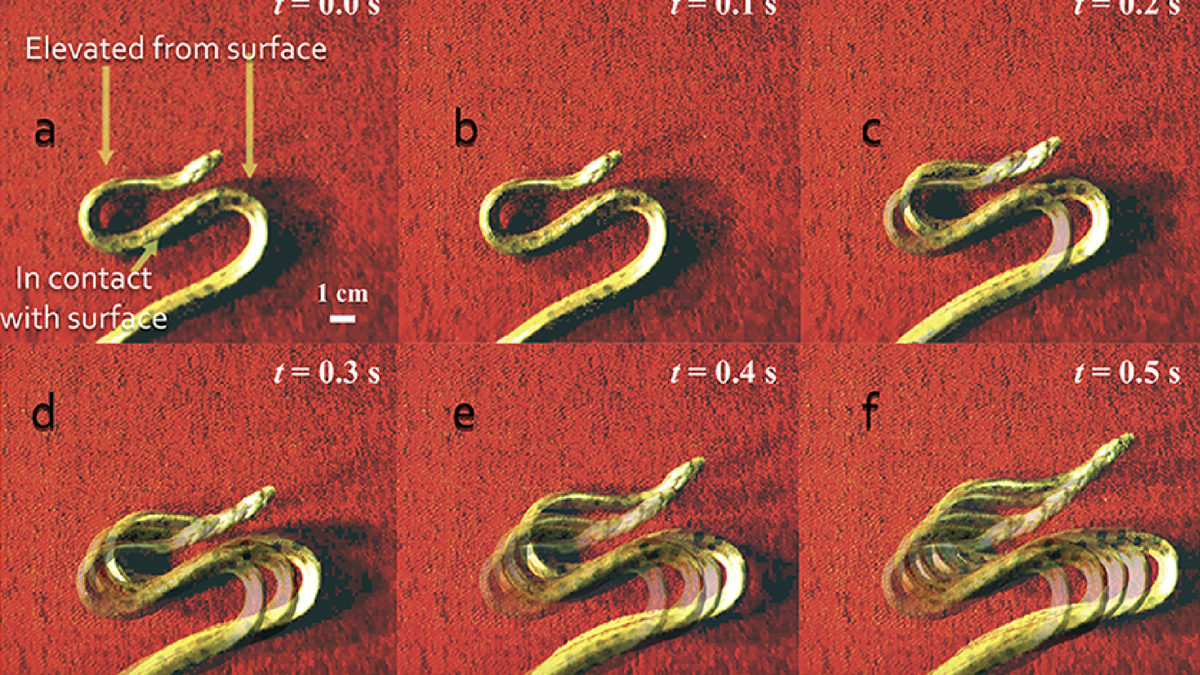
But unlike out-of-plane sidewinding, which is a steady motion travelling from head to tail, the newfound S-start gait is unsteady and pulsed. It begins with a burst of muscular force that travels down the body and then stops rather than continuing to propagate.
This unexpected motion prompted two compelling questions: How are they able to perform this motion? And why is this behaviour only seen in small, juvenile anacondas and not in other species or larger individuals? The answers could have useful applications in robotics or biomechanics, Chelakkot said.

The physics of S-starts
To unravel the puzzle, the researchers conducted locomotor trials on 10 newborn, five juvenile, and two adult captive-bred yellow anacondas in the U.S. The snakes were forced to S-start by simulating external threats and high-speed video recordings tracked their movement.
The team also developed a biophysical model that treated the snake as an elastic rod moving on a flat surface. This rod-like representation of the snake captured essential physical traits — passive bending and twisting resistance, gravitational forces, and frictional interactions with the ground — along with muscular torques (rotational forces) applied along the body.
Using the mathematical model, the researchers reproduced the S-start in the presence of a localised muscular torque triplet, where the two in-plane components shaped the S-curve and one out-of-plane torque at the centre contact region pushed the elastic rod against the ground.
The video recordings further confirmed that to perform the motion, the snake first forms an S-shape composed of three straight sections connected by two sharp curves. The curved parts then lift off the ground while the outer straight sections slide forward, with the middle section remaining stationary. This caused the curved regions to travel along the snake’s body, propelling it forward.
Only young anacondas
During the locomotor trials, the researchers observed that only the newborns and the juveniles performed the unique gait, not the adults. Numerical simulations of the snake’s movement using the model indicated that the S-start only worked well within a certain range of scaled body weight and muscular torque.
Since the gait requires the snake to lift certain sections of the body off the ground while pressing others down, it creates a tug-of-war between muscular strength and weight.
To lift off, the snake must overcome gravity, which becomes increasingly difficult as its weight increases. As snakes grow, they become larger and heavier, but not stronger in the same proportion. The bulk of the added weight comes from bone, not muscle, leaving larger snakes with relatively less muscle mass per unit of body weight. Thus, the adults lack the strength-to-weight ratio required to perform the out-of-plane lifting crucial to an S-start.
By probing the physics behind snake locomotion, the researchers found themselves uncovering patterns with roots in evolution. They observed that, when applied periodically, the torque triplets produced the well-known sidewinding motion.
“This hints at the possibility that S-start is utilised as a building block for multiple limbless gaits which involve out-of-plane bending of the body,” Chelakkot said. “Besides sidewinding, S-start appears to be a component in ‘lasso motion’ observed in tree-climbing snakes. All these facts hint at the possible evolutionary role of S-start in non-planar limbless gaits.”

Snakes, gaits, and robots
The researchers have expressed belief that by providing precise mathematical measures to reproduce such motion in artificial systems, these studies can help accelerate innovation in soft robotics, mimicking limbless locomotion. One example: snake-like robots that can navigate through very narrow or confined spaces.
These findings contribute to the global understanding of limbless locomotion across a wide variety of organisms, including not just snakes but also worms like earthworms and inchworms.
Chelakkot said that studying highly complex living organisms with versatile motions and postures opens up possibilities to expand and challenge existing elastic theories.
“It pushes scientists to look further into what are the different physical things that we can study to move from understanding simple bodies to more complex bodies like biological systems,” Chelakkot added.
Sanjukta Mondal is a chemist-turned-science-writer with experience in writing popular science articles and scripts for STEM YouTube channels.