
Skip to content
  • Facebook
  • X
  • Linkedin
  • WhatsApp
  • YouTube
  • Associate Journalism
  • About Us
  • Privacy Policy
  • 033-46046046
  • editor@artifex.news
Artifex.News

Artifex.News

Stay Connected. Stay Informed.

  • Breaking News
  • World
  • Nation
  • Sports
  • Business
  • Science
  • Entertainment
  • Lifestyle
  • Toggle search form
  • “Stop Donating To Wikipedia, Controlled By Far-Left Activists”: Elon Musk
    “Stop Donating To Wikipedia, Controlled By Far-Left Activists”: Elon Musk Nation
  • TCS Q3 profit drops 14% to ₹10,657 crore
    TCS Q3 profit drops 14% to ₹10,657 crore Business
  • Where is the ‘rainbow capital’ of the world?
    Where is the ‘rainbow capital’ of the world? Science
  • Icelanders head to polls after government collapse
    Icelanders head to polls after government collapse World
  • 6 Planets To Align In Rare Celestial Event. How To Watch
    6 Planets To Align In Rare Celestial Event. How To Watch World
  • Access Denied
    Access Denied Nation
  • Access Denied
    Access Denied Nation
  • 8-Month-Old Girl Slammed To The Ground By Mentally Challenged UP Man, Dies
    8-Month-Old Girl Slammed To The Ground By Mentally Challenged UP Man, Dies Nation
India lost 18 times more forest than it gained between 2015–2019, study finds  

India lost 18 times more forest than it gained between 2015–2019, study finds  

Posted on August 7, 2025 By admin


India suffered a substantial net loss in forest cover between 2015 and 2019, revealed a new study conducted by researchers from Indian Institute of Technology (IIT) Bombay and SASTRA Deemed University.  

The study said that for every 1 square kilometre of forest gained during the four-year period, the country lost nearly 18 square kilometres—an alarming ratio that underscores a significant fragmentation crisis in India’s forest ecosystems. 

“While the Forest Survey of India (FSI) and other independent studies regularly report on India’s gross forest cover, there has so far been no systematic framework to understand structural connectivity and monitor forest fragmentation across the country,” the study said.  

Led by Professor RAAJ Ramsankaran of IIT Bombay, and Dr. Vasu Sathyakumar and Sridharan Gowtham of SASTRA Deemed University, the study applied Morphological Spatial Pattern Analysis (MSPA) to forest cover data derived from the Copernicus Global Land Service (CGLS) Land Cover Map. It offers one of the first country-scale assessments of forest fragmentation in India using publicly available satellite data and open-source tools. 

A central feature of the study is its classification of forests into seven structural types, each with distinct ecological functions. Cores are large, intact habitats crucial for biodiversity and long-term stability. Bridges and loops enhance connectivity by linking cores or parts of the same core. Branches extend from cores, while edges mark their boundaries. Perforations are clearings within cores, and islets are small, isolated patches. The study finds that cores are the most resilient to degradation, whereas islets are highly vulnerable and prone to rapid fragmentation. Afforestation dominated by islets may have minimal ecological value. 

Mr. Ramsankaran said, “Our resilience-based ranking offers a practical tool for policymakers. Rather than treating all forest areas the same, it helps identify which morphologies are most vulnerable (like islets) and which offer long-term ecological value (like cores).” 

He added that afforestation programmes such as the National Compensatory Afforestation Fund Management and Planning Authority (CAMPA) or the National Mission for a Green India can benefit by focusing on strengthening existing cores and building bridges between them, which could potentially yield better-connected, more resilient, and ecologically sustainable forests.  

The framework also has the potential to inform infrastructure planning by helping identify areas where connectivity is most at risk, thus supporting more scientifically informed decisions and reducing ecological disruption.  

Mr. Ramsankaran explained, “The framework relies on an image processing technique called MSPA to detect and classify the structure of forest landscapes.”  

As part of the study, the researchers applied the analysis to digital forest cover maps of India for the years 2015 to 2019, obtained from the Copernicus Global Land Service (CGLS) Land Cover Map. Unlike most previous studies on forest cover, which report only net gains or losses, this study mapped forest loss and gain separately. 
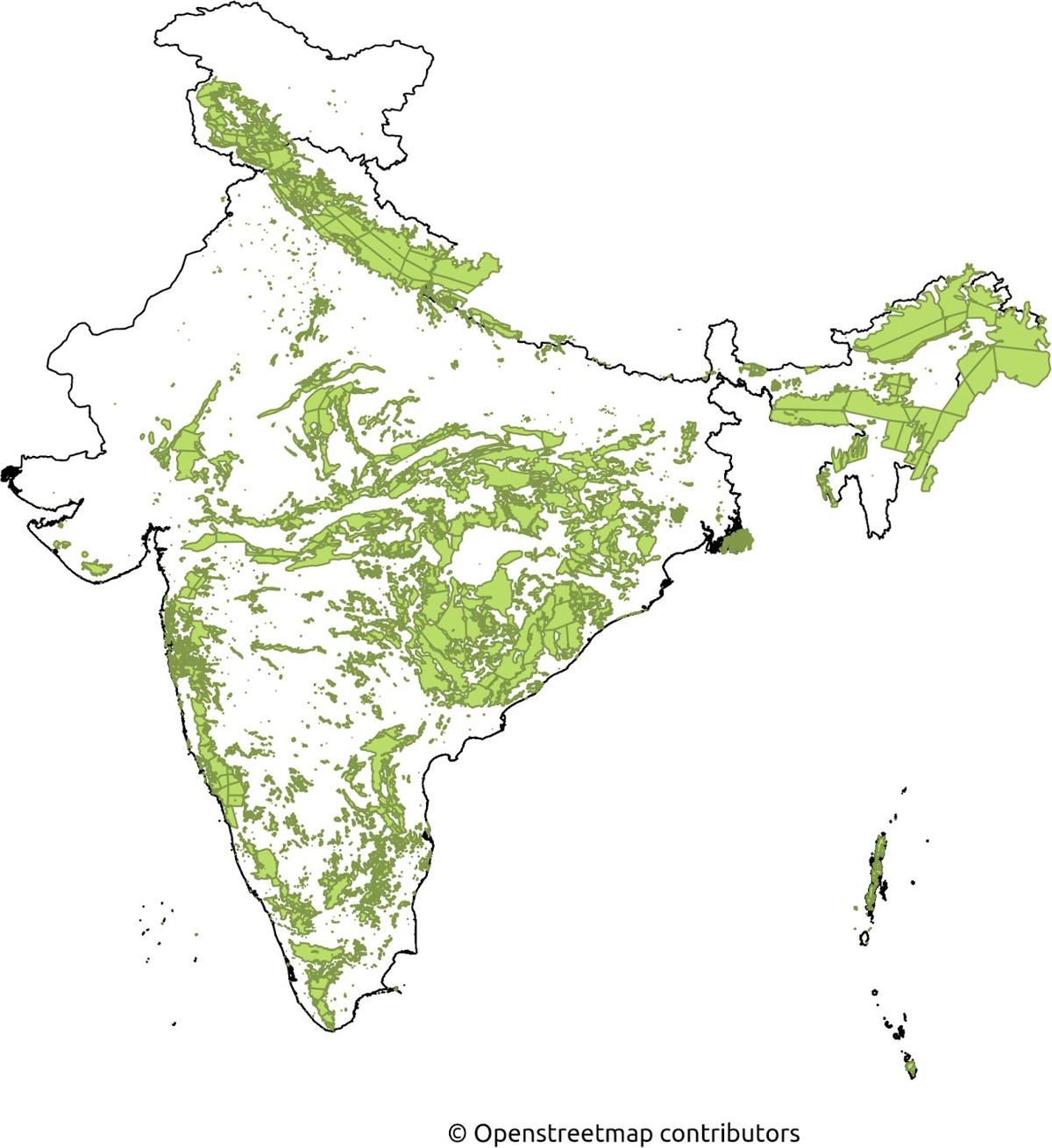
Indian forest cover map as of 2015.

Indian forest cover map as of 2015.

“The results show that from 2015 to 2019, all states in India experienced a net loss in forest cover. Overall, India lost 18 square kilometres of forest for every 1 square kilometre gained. Nearly half of the 56.3 sq. km. of gross forest gain occurred in Andhra Pradesh, Tamil Nadu, Karnataka, and Rajasthan, while Tamil Nadu and West Bengal together accounted for almost half of the 1,032.89 sq. km. of gross forest loss,” the study said.  

More significantly, over half of the newly added forest covers are islets, which do not substantially improve structural connectivity. This suggests that even where forest cover is increasing on paper, the ecological value and resilience of those forests may be limited.  

Explaining the implications of the study, Mr. Sathyakumar said, “Our results clearly show that most of the newly added forests during 2015–2019 were islets, highly fragmented and ecologically vulnerable patches. There is a need to move beyond the current quantity-based afforestation approach and explicitly incorporate structural connectivity into forest planning.” 

While the findings appear to differ to those of FSI, which often indicate an overall increase in forest cover, the results from FSI and this study are not directly comparable. FSI uses different criteria from the CGLS to identify forests and does not distinguish between fragmented and continuous forests. FSI defines forested areas as those with a minimum of 10% tree canopy cover and relies on satellite imagery with a 23.5 m resolution. In contrast, the CGLS dataset used in this study applies a 15% canopy threshold and a 100 m resolution. The researchers also had to rely on the internationally accepted CGLS dataset, as FSI data are not publicly available for similar analyses.  

Mr. Sathyakumar said, “Since FSI reports do not include forest connectivity assessments, direct comparisons aren’t possible. However, our data source has a globally validated accuracy of over 85%, making our connectivity results reliable. If FSI’s data were made available in GIS-compatible format, our methodology could be readily applied to it.” 

One limitation of the current study is that at 100 m resolution, narrow linear features such as roads and railways may not be fully detected, and forest fragments smaller than 100 m may be missed. However, the strength of the framework lies in its scalability, cost-effectiveness, and use of open-source tools. It can be expected to give consistent results with similar datasets at finer resolutions and can be applied at different spatial and temporal scales.  

Mr. Ramsankaran said, “Our framework is fully extensible to finer scales, such as districts or protected areas, and can be used to analyse the impacts of linear infrastructure like roads and rail lines on forest connectivity in a more focused manner. This makes it a valuable tool for long-term forest monitoring, planning and informed infrastructure development in and around forested areas, both in India and in similar contexts globally.” 

The researchers plan to further develop their framework to study local drivers of forest fragmentation and assess the effectiveness of current conservation and afforestation efforts. 

Published – August 07, 2025 02:30 pm IST


Source link

Science Tags:IIT Bombay research on India’s forest area, India’s forest cover, loss in forest cover in India, SASTRA university research on forest cover

Post navigation

Previous Post: Access Denied
Next Post: Access Denied

Related Posts

  • How an altered protein and fussy neurons conspire to cause microcephaly
    How an altered protein and fussy neurons conspire to cause microcephaly Science
  • India’s invasive aliens problem complicates wait to understand scope
    India’s invasive aliens problem complicates wait to understand scope Science
  • India’s newest private physics institute hinges success on ‘less is more’
    India’s newest private physics institute hinges success on ‘less is more’ Science
  • Could gut fungi be linked to severe COVID? What to make of new research findings
    Could gut fungi be linked to severe COVID? What to make of new research findings Science
  • Physicists predict a Solar Deepavali this year
    Physicists predict a Solar Deepavali this year Science
  • Europe is the fastest-warming continent, at nearly twice global average: report
    Europe is the fastest-warming continent, at nearly twice global average: report Science

More Related Articles

Sci-Five | The Hindu Science Quiz: On Frogs Sci-Five | The Hindu Science Quiz: On Frogs Science
Nearly 900 million poor people exposed to climate shocks, UN warns Nearly 900 million poor people exposed to climate shocks, UN warns Science
Hearing tests show that minke whales can hear high-frequency sounds Hearing tests show that minke whales can hear high-frequency sounds Science
From lapis-laden trade routes to mass armies: the changing value of blue From lapis-laden trade routes to mass armies: the changing value of blue Science
China becomes AI’s biggest testing ground China becomes AI’s biggest testing ground Science
Science for all newsletter Milkweed is a toxic treat for monarch butterflies Science for all newsletter Milkweed is a toxic treat for monarch butterflies Science
SiteLock

Archives

  • October 2026
  • September 2026
  • August 2026
  • July 2026
  • June 2026
  • May 2026
  • April 2026
  • March 2026
  • February 2026
  • January 2026
  • December 2025
  • November 2025
  • October 2025
  • September 2025
  • August 2025
  • July 2025
  • June 2025
  • May 2025
  • April 2025
  • March 2025
  • February 2025
  • January 2025
  • December 2024
  • November 2024
  • October 2024
  • September 2024
  • August 2024
  • July 2024
  • June 2024
  • May 2024
  • April 2024
  • March 2024
  • February 2024
  • January 2024
  • December 2023
  • November 2023
  • October 2023
  • September 2023
  • August 2023
  • July 2023
  • June 2023
  • May 2023
  • April 2023
  • March 2023
  • February 2023
  • January 2023
  • December 2022
  • November 2022
  • October 2022
  • September 2022
  • August 2022
  • July 2022
  • June 2022
  • May 2022

Categories

  • Business
  • Nation
  • Science
  • Sports
  • World

Recent Posts

  • Ranji Trophy: Bengal picks up Delhi’s gauntlet to win by nine wickets
  • Stock markets close lower amid elevated crude oil, rising inflation
  • C.Ve. Shanmugam wants AIADMK leadership to consult with functionaries over party’s bypoll loss
  • Activists allege tender for beach pathway for persons with disabilities is incomplete
  • BOXING | Battle between BFI chief and general secretary intensifies

Recent Comments

  1. RobertTes on UP Teacher Who Asked Students To Slap Muslim Classmate
  2. Manuelret on UP Teacher Who Asked Students To Slap Muslim Classmate
  3. RobertTes on UP Teacher Who Asked Students To Slap Muslim Classmate
  4. RobertTes on UP Teacher Who Asked Students To Slap Muslim Classmate
  5. BrentWes on UP Teacher Who Asked Students To Slap Muslim Classmate
  • Access Denied
    Access Denied Nation
  • BETWEEN WICKETS | Great win for Harmanpreet’s team, and some lessons for the men
    BETWEEN WICKETS | Great win for Harmanpreet’s team, and some lessons for the men Sports
  • Sharath Kamal To Be India’s Flag Bearer, Mary Kom Appointed Chef De Mission For Paris Olympics
    Sharath Kamal To Be India’s Flag Bearer, Mary Kom Appointed Chef De Mission For Paris Olympics Sports
  • Cricket World Cup 2023 ENG vs SA | One of my better hundreds purely on the conditions that were out there, says Heinrich Klaasen
    Cricket World Cup 2023 ENG vs SA | One of my better hundreds purely on the conditions that were out there, says Heinrich Klaasen Sports
  • Andhra Congress Chief YS Sharmila Files Nomination For Kadapa Seat
    Andhra Congress Chief YS Sharmila Files Nomination For Kadapa Seat Nation
  • U.S. inflation ebbs in May as prices of goods slide
    U.S. inflation ebbs in May as prices of goods slide World
  • Cops Collect CCTV DVR From Arvind Kejriwal’s House
    Cops Collect CCTV DVR From Arvind Kejriwal’s House Nation
  • Manu Bhaker, Trolled For Wearing Paris Olympic Medals, Gives Fiery Reply
    Manu Bhaker, Trolled For Wearing Paris Olympic Medals, Gives Fiery Reply Sports

Editor-in-Chief:
Mohammad Ariff,
MSW, MAJMC, BSW, DTL, CTS, CNM, CCR, CAL, RSL, ASOC.
editor@artifex.news

Associate Editors:
1. Zenellis R. Tuba,
zenelis@artifex.news
2. Haris Daniyel
daniyel@artifex.news

Photograher:
Rohan Das
rohan@artifex.news

Associate Journalists
1. Subrata Paul - AN/2020/01
2. Quamruz Zaman - AN/2021/22
3. Ahmed Sha - AN/2021/035
4. Ajay Kumar Shaw - AN/2021/39
5. Tahqiqul Hoda - AN/2021/21

Artifex.News offers Online Paid Internships to college students from India and Abroad. Interns will get a PRESS CARD and other online offers.
Send your CV (Subjectline: Paid Internship) to internship@artifex.news

Links:
Associate Journalism
About Us
Privacy Policy

News Links:
Breaking News
World
Nation
Sports
Business
Entertainment
Lifestyle

Registered Office:
72/A, Elliot Road, Kolkata - 700016
Tel: 033-22277777, 033-22172217
Email: office@artifex.news

Editorial Office / News Desk:
No. 13, Mezzanine Floor, Esplanade Metro Rail Station,
12 J. L. Nehru Road, Kolkata - 700069.
(Entry from Gate No. 5)
Tel: 033-46011099, 033-46046046
Email: editor@artifex.news

Copyright © 2023 Artifex.News Newsportal designed by Artifex Infotech.