



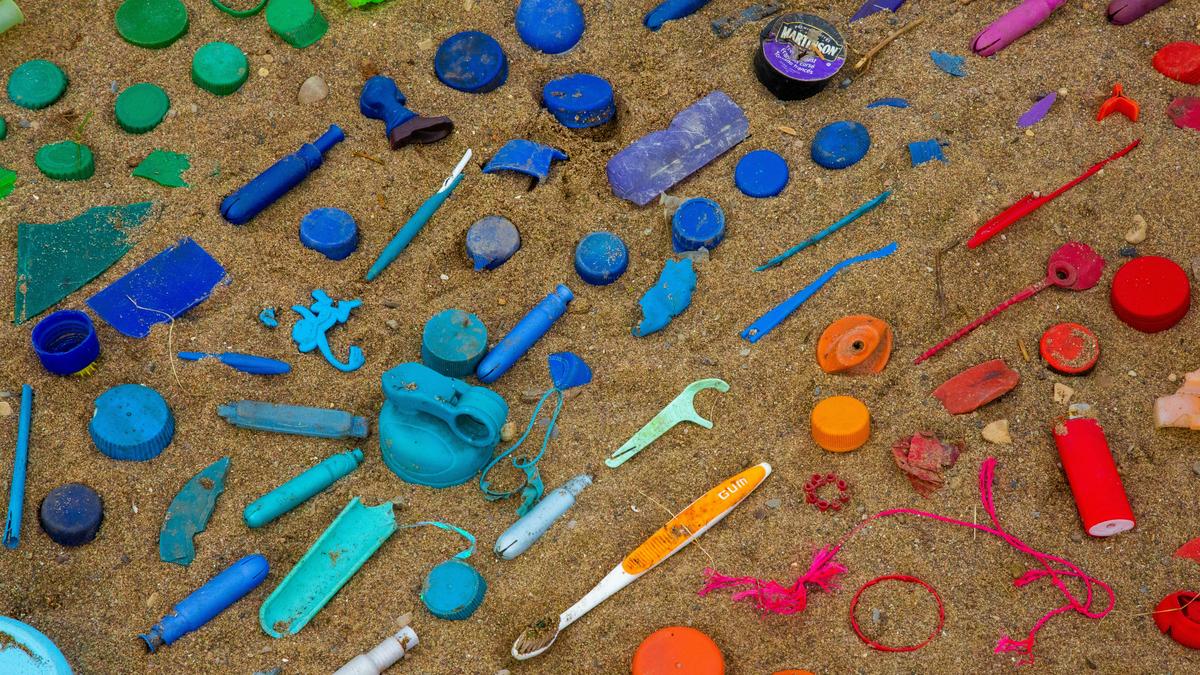
During her time in a drug discovery lab, structural biologist Kavyashree Manjunath first started thinking about how much plastic her group used, even for a single experiment. From the smallest of tips used to draw solutions to pipettes, bottles, and more — the plastic waste from her lab alone was enough to shock the average environment-friendly scientist. If they stopped to think about it the way she had.
One slightly comforting thought is that the plastic is recycled. But Manjunath found that that’s not always the case. “Over a period of 65 years, since the large-scale production of plastic started, almost 8.3 billion tonnes of plastic has been produced,” she said, quoting a 2017 Science Advances study. “Out of this, less than 10% alone is recycled. Almost 4.9 billion tonnes are there in the environment, in some form or other.”
In their own fields
The immense amounts of plastics lying around choking our planet has driven multiple biologists to look for sustainable solutions in their own fields. Some of them work on bacteria that can chew up plastics; others work directly with enzymes that can clean up the waste. Multiple scientists, including Manjunath, have turned into entrepreneurs, starting companies to use their solutions on a larger scale.
But the field is still very nascent, with most labs and companies still in the early discovery process. Biodegrading the tonnes of plastic we have generated — and will generate in the years to come — is the goal. But like most things in science, the path to success is long and arduous. How long the methods take to degrade plastic and the kinds of plastic they can act on remain some of the major bottlenecks to get across.
Delving into past work, Manjunath discovered there are natural enzymes that can break down the highly abundant polyethylene terephthalate (PET), a polyester found in many kinds of plastic items. Since Kohei Oda and his team at the Kyoto Institute of Technology first discovered the bacterium Ideonella sakaiensis, which breaks PET down using two enzymes, multiple groups have worked on isolating and improving those enzymes to try and degrade plastic efficiently.
But most of these natural enzymes take several months to years to work. “I thought, ‘can these enzymes be engineered to break down PET much faster so that it can be used at a large scale in the industry?’” Manjunath said.
To develop these enzymes, she founded Apratima Biosolutions, a start-up incubated at the Centre for Cellular and Molecular Platforms (CCAMP), Bengaluru. One enzyme they developed can break down 90% of PET waste in 17 hours, into products like terephthalic acid and ethylene glycol, which can be purified and used again.
She and her team are now working on making the enzymes even faster and cheaper. Once the technology is ready, her plan is to partner with the PET recycling industry to help scale it up. “The main thing is the speed, because if it takes some 10 days or something, it’s not feasible, right?”
‘Really fascinated’
Degrading PET waste as quickly as possible is one part of the problem; there are many other kinds of problematic plastics out there. Some scientists are using microbes to directly degrade the plastic. These methods are slower but, depending on the versatility of the microbes involved, can offer some advantages.
Sukanya Punthambaker and Vaskar Gnyawali, former researchers at the Wyss Institute at Harvard University and co-founders and CEO and Chief Scientific Officer of Breaking Inc., developed such an approach. They discovered a bacterium called X-32 that degrades PET as well as polyolefins, found in some packaging materials and polyamides like nylon.
“Polyolefins have one of the toughest carbon-carbon bonds to break, so we were really fascinated that this one microbe can do all three major plastic types,” Punthambaker said.
As of now, it takes the microbe 22 months to reduce these forms of plastic to carbon dioxide, water, and biomass. They are currently working on figuring out the enzymes involved so they can isolate them and edit their genes in a way to improve their speed and efficiency.
They also plan to test whether their microbe can be scaled up for use at an industrial level.
The biological approach
Apart from companies, academic researchers are also finding biological solutions to get rid of plastic. University of California San Diego nanoengineering professor Jon Pokorski is one of them. He is studying ways to make biodegradable plastic from scratch. He recently reported a method to make thermoplastic polyurethane (TPU), a commercial plastic found in memory foam, footwear, and foot mats, but infused with heat-resistant bacterial spores.
Pokorski and his team first evolved heat-resistant spores, made of Bacillus subtilis bacteria, in the lab. Then they incorporated the spores into the plastic; the spores can survive the high temperatures of plastic production and remain dormant in normal conditions. But as soon as the plastic is in a compost, the spores become active and start eating. Based on their findings, the bacteria took about five months to degrade 90% of the strips of TPU when they were in a moist, nutrient-rich compost environment ideal for their activation.
The longer time may be a trade-off but Pokorski believes using the live-bacteria approach to degrade plastic is more amenable to scaling up than using pure enzymes.
“Purifying an enzyme is quite a challenge, especially purifying enough of it to satisfy the problem of millions of tonnes of plastic every year,” Pokorski said. “I would argue that our solution is a much more viable solution for scaling. Because you’re not relying on a single enzyme to perform its function; you’re relying on something that’s going to replicate.”
Currently, at the academic lab scale they have tested, they needed very small amounts of spores for about a kilogram of plastic, and adding the spores improved the mechanical properties of the plastic as well.
“Like rebar reinforces concrete, the spores serve as a reinforcing additive to the polymer,” Pokorski explained. “Ideally the plastic will either last longer or you could use less plastic because it’s a better product.”
However, he thinks consumer acceptance could be a challenge. “I don’t know how regulatory agencies would feel about bacteria in plastics,” he said. “The bacteria that are used are pretty harmless, but you never know, right?”
The rate-limiting step
Another advantage of using bacteria to break down plastic, according to biomolecular engineer Nathan Crook, is one can then evolve them to become more efficient. At North Carolina State University, Crook discovered a way to attach the two previously discovered PET-degrading enzymes onto the surface of a very fast-growing bacteria called Vibrio natriegens and use it to eat up plastic as it would eat any other carbon source. They are now working on evolving it in the lab in a way that it can break plastics down faster.

“The enzymes that break down the plastic are the rate-limiting step,” Crook said. “If you have an organism where the only way it can survive is to break down plastic, it’s going to find a way to mutate its enzyme so that they’re really good at breaking down plastic.”
But Manjunath, who works with enzymes, thinks scaling them up is not an issue. “There are a lot of fermentation industries which can produce the enzyme in large quantities,” she said. The challenges she anticipates instead are whether the enzyme can be reused and the amount of PET waste loading they will need to optimise.
“For example, if you have a 10-litre reactor, how much PET waste can you load into it?” she asked. “Because the less you load, the more expensive it becomes, so you have to make sure the technology is able to handle large quantities of PET waste at a given time.”
Another major challenge is to make sure the enzymes can degrade different kinds of PET waste — even the highly crystalline variety. Most enzymes in use now target PET used in packaging materials, but not the ones found in the pesky plastic bottles.
‘See the plastic gone’
Despite its challenges, some leading scientists and companies still prefer the enzyme approach. Greg Beckhamm, a senior researcher at the National Renewable Energy Laboratory in the US and his team worked on improving one of the PET-degrading enzymes, such that it could also degrade the crystalline PET in water bottles.
Carbios, a French company that’s one of the giants in the plastic-degrading business, have also engineered a highly efficient and heat-stable PET-degrading enzyme. Heating the plastic makes it easier to degrade, so the company worked on making the enzymes heat-stable to increase its speed of action.
According to a 2020 Nature paper, their enzyme takes 10 hours to degrade 90% of PET waste. The broken-down components can also be used as raw materials for fresh bottles, leading to a circular PET economy. They are now planning on building a large PET recycling plant to degrade plastic at a much larger scale but have now postponed it due to a delay in funding.

“It takes time because this is a very new technology in this particular domain, right?” said Manjunath. “But I think these kinds of solutions are very essential.”
According to Crook, it need not only be a company that does the job of clearing up the plastic polluting the environment. “Maybe there’s a non-profit that takes on this thing and tries to clean things up, or a governmental organisation that does this at a loss, because it’s so expensive to clean up all the plastic,” he said.
“I want to see the plastic gone in some way. Maybe it’s our [bacterial] strain or somebody else’s. At the moment, we’re open to a variety of things.”
Rohini Subrahmanyam is a freelance journalist in Bengaluru.
Published – February 04, 2025 05:30 am IST