




San Diego, California:
We named him Squirt – not because he was the smallest of the 16 cuttlefish in the pool, but because anyone with the audacity to scoop him into a separate tank to study him was likely to get soaked. Squirt had notoriously accurate aim.
As a comparative psychologist, I’m used to assaults from my experimental subjects. I’ve been stung by bees, pinched by crayfish and battered by indignant pigeons. But, somehow, with Squirt it felt different. As he eyed us with his W-shaped pupils, he seemed clearly to be plotting against us.
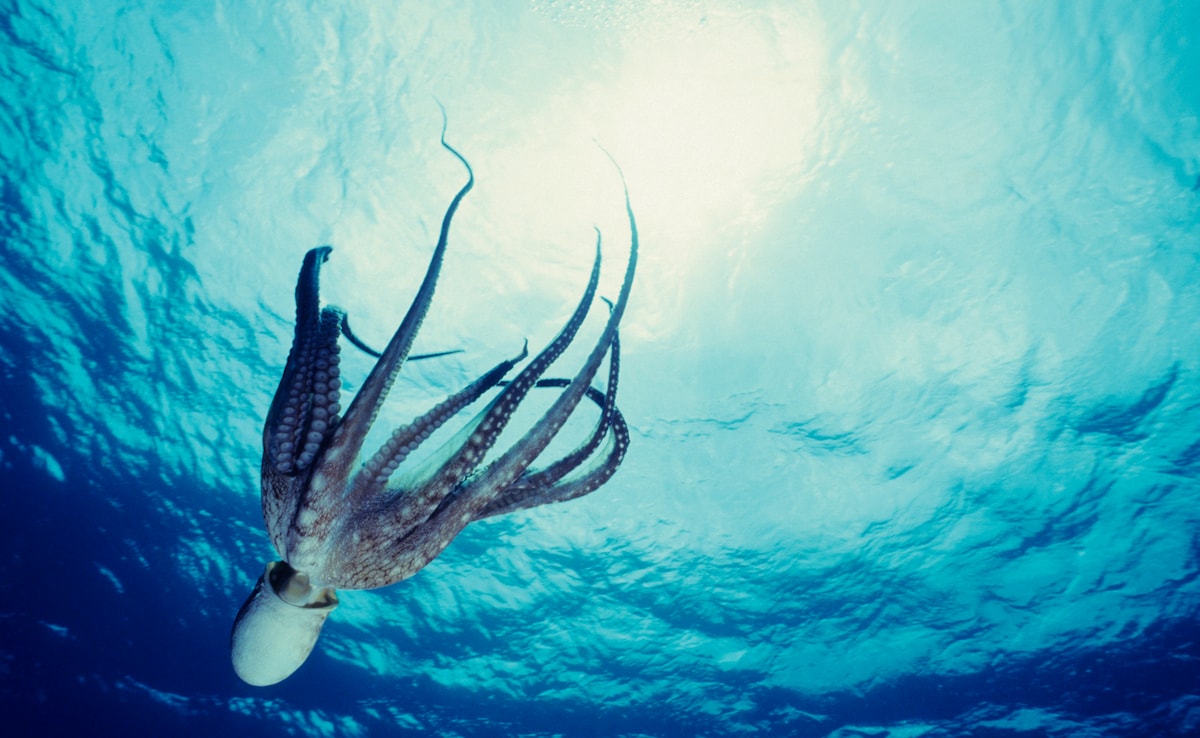
Of course, I’m being anthropomorphic. Science does not yet have the tools to confirm whether cuttlefish have emotional states, or whether they are capable of conscious experience, much less sinister plots. But there’s undeniably something special about cephalopods – the class of ocean-dwelling invertebrates that includes cuttlefish, squid and octopus.
As researchers learn more about cehpalopods’ cognitive skills, there are calls to treat them in ways better aligned with their level of intelligence. California and Washington state both approved bans on octopus farming in 2024. Hawaii is considering similar action, and a ban on farming octopus or importing farmed octopus meat has been introduced in Congress. A planned octopus farm in Spain’s Canary Islands is attracting opposition from scientists and animal welfare advocates.
Critics offer many arguments against raising octopuses for food, including possible releases of waste, antibiotics or pathogens from aquaculture facilities. But as a psychologist, I see intelligence as the most intriguing part of the equation. Just how smart are cephalopods, really? After all, it’s legal to farm chickens and cows. Is an octopus smarter than, say, a turkey?
A big, diverse group
Cephalopods are a broad class of mollusks that includes the coleoids – cuttlefish, octopus and squid – as well as the chambered nautilus. Coleoids range in size from adult squid only a few millimeters long (Idiosepius) to the largest living invertebrates, the giant squid (Architeuthis) and colossal squid (Mesonychoteuthis) which can grow to over 40 feet in length and weigh over 1,000 pounds.
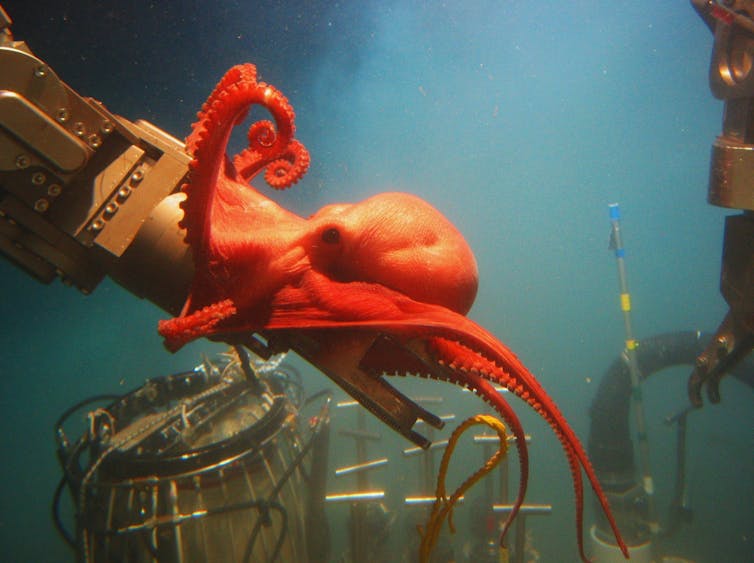
Some of these species live alone in the nearly featureless darkness of the deep ocean; others live socially on active, sunny coral reefs. Many are skilled hunters, but some feed passively on floating debris. Because of this enormous diversity, the size and complexity of cephalopod brains and behaviors also varies tremendously.
Almost everything that’s known about cephalopod cognition comes from intensive study of just a few species. When considering the welfare of a designated species of captive octopus, it’s important to be careful about using data collected from a distant evolutionary relative.
Can we even measure alien intelligence?
Intelligence is fiendishly hard to define and measure, even in humans. The challenge grows exponentially in studying animals with sensory, motivational and problem-solving skills that differ profoundly from ours.
Historically, researchers have tended to focus on whether animals think like humans, ignoring the abilities that animals may have that humans lack. To avoid this problem, scientists have tried to find more objective measures of cognitive abilities.
One option is a relative measure of brain to body size. The best-studied species of octopus, Octopus vulgaris, has about 500 million neurons; that’s relatively large for its small body size and similar to a starling, rabbit or turkey.
More accurate measures may include the size, neuron count or surface area of specific brain structures thought to be important for learning. While this is useful in mammals, the nervous system of an octopus is built completely differently.
Over half of the neurons in Octopus vulgaris, about 300 million, are not in the brain at all, but distributed in “mini-brains,” or ganglia, in the arms. Within the central brain, most of the remaining neurons are dedicated to visual processing, leaving less than a quarter of its neurons for other processes such as learning and memory.
In other species of octopus, the general structure is similar, but complexity varies. Wrinkles and folds in the brain increase its surface area and may enhance neural connections and communication. Some species of octopus, notably those living in reef habitats, have more wrinkled brains than those living in the deep sea, suggesting that these species may possess a higher degree of intelligence.
Holding out for a better snack
Because brain structure is not a foolproof measure of intelligence, behavioral tests may provide better evidence. One of the highly complex behaviors that many cephalopods show is visual camouflage. They can open and close tiny sacs just below their skin that contain colored pigments and reflectors, revealing specific colors. Octopus vulgaris has up to 150,000 chromatophores, or pigment sacs, in a single square inch of skin.
Like many cephalopods, the common cuttlefish (Sepia officinalis) is thought to be colorblind. But it can use its excellent vision to produce a dizzying array of patterns across its body as camouflage. The Australian giant cuttlefish, Sepia apama, uses its chromatophores to communicate, creating patterns that attract mates and warn off aggressors. This ability can also come in handy for hunting; many cephalopods are ambush predators that blend into the background or even lure their prey.
The hallmark of intelligent behavior, however, is learning and memory – and there is plenty of evidence that some octopuses and cuttlefish learn in a way that is comparable to learning in vertebrates. The common cuttlefish (Sepia officinalis), as well as the common octopus (Octopus vulgaris) and the day octopus (Octopus cyanea), can all form simple associations, such as learning which image on a screen predicts that food will appear.
Some cephalopods may be capable of more complicated forms of learning, such as reversal learning – learning to flexibly adjust behavior when different stimuli signal reward. They may also be able to inhibit impulsive responses. In a 2021 study that gave common cuttlefish a choice between a less desirable but immediate snack of crab and a preferred treat of live shrimp after a delay, many of the cuttlefish chose to wait for the shrimp.
A new frontier for animal welfare
Considering what’s known about their brain structures, sensory systems and learning capacity, it appears that cephalopods as a group may be similar in intelligence to vertebrates as a group. Since many societies have animal welfare standards for mice, rats, chickens and other vertebrates, logic would suggest that there’s an equal case for regulations enforcing humane treatment of cephalopods.
Such rules generally specify that when a species is held in captivity, its housing conditions should support the animal’s welfare and natural behavior. This view has led some U.S. states to outlaw confined cages for egg-laying hens and crates too narrow for pregnant sows to turn around.
Animal welfare regulations say little about invertebrates, but guidelines for the care and use of captive cephalopods have started to appear over the past decade. In 2010, the European Union required considering ethical issues when using cephalopods for research. And in 2015, AAALAC International, an international accreditation organization for ethical animal research, and the Federation of European Laboratory Animal Science Associations promoted guidelines for the care and use of cephalopods in research. The U.S. National Institutes of Health is currently considering similar guidelines.
The “alien” minds of octopuses and their relatives are fascinating, not the least because they provide a mirror through which we can reflect on more familiar forms of intelligence. Deciding which species deserve moral consideration requires selecting criteria, such as neuron count or learning capacity, to inform those choices.
Once these criteria are set, it may be well to also consider how they apply to the rodents, birds and fish that occupy more familiar roles in our lives.
(Author: Rachel Blaser, Professor of Neuroscience, Cognition and Behavior, University of San Diego)
(Disclosure Statement: Rachel Blaser does not work for, consult, own shares in or receive funding from any company or organization that would benefit from this article, and has disclosed no relevant affiliations beyond their academic appointment)
This article is republished from The Conversation under a Creative Commons license. Read the original article.
(Except for the headline, this story has not been edited by NDTV staff and is published from a syndicated feed.)