
Resource-geopolitics and security in the Indo-Pacific is a subject that is drawing the attention of countries in this region, which accounts for more than half the world’s population, 60% of global GDP, as well as two-thirds of global economic growth.
Resource geopolitics and security were central to the colonial project. The prosperity of the West was built largely on access to the vast resources of the colonised countries. However, while the colonial phase of history is over, there is still concern about neo-colonialist policies operating in open or disguised form in relations between developed and developing countries in the Indo-Pacific.
A Widening Gap
Non-western countries have generally benefited from globalisation with foreign investment flows, more open markets, participation in supply chains and export-led growth, even if the gap between the rich and poor nations has widened simultaneously. Most importantly, the gap between technology-rich and resource-rich countries remains unbridged.
Many developing countries with vast mineral resources do not have the capital and technology to exploit them on their own. They need foreign capital and technology to develop them. The gap between what they earn from the export of these raw natural resources and what the developed countries earn from processing and value-addition for industrial use is vast.
Critical and emerging technologies, which require a major R&D and industrial base, will largely remain the preserve of the technologically advanced West. The advance they already have from the time of the Industrial Revolution is sought to be preserved to maintain their dominance of the global system.
The critical raw materials required for many of these technologies are largely in the non-Western countries, though a country like Australia possesses large quantities of lithium, iron ore, uranium, coal and natural gas. This is where geopolitics and security come into play.
Feeding Chinese Manufacturing
This broad picture is blurred with a country like China becoming the world’s biggest manufacturing power and needing access to natural resources to feed its vast industrial machine, critical raw materials to maintain its dominance in green technologies, for instance, besides access to agricultural resources of other countries in the region to feed its vast population with rising living standards.
It is noteworthy that after Australia sought an investigation into the source of the COVID-19-causing virus in Wuhan and China imposed sanctions on it, iron ore imports were not included in those curbs.
Apart from geopolitics and security per se, resource geopolitics is an element in the strengthening of India-Australia ties. Australia has turned towards India to reduce its over-dependence on China, and India is interested in access to Australia’s natural resources such as uranium and coal in particular.
Indonesia, the largest producer of nickel, is trying to transform itself from an exporter into a key player in the global value chain by banning the export of the raw material.
China’s phenomenal rise has changed the balance of power in the Indo-Pacific region and well beyond. It is at the centre of geopolitics and security in the region, which is also resource-oriented in part. It is claiming exclusive military and economic rights over large parts of the South China Sea.
The idea behind China’s 9 or 10-dash line, which would make the South China Sea ‘Beijing’s Lake’, as former Japanese Prime Minister Shinzo Abe said, is to change the balance of military power in the region by extending the reach of its aircraft and missiles to challenge US military power in the region.
The US has bases, troops and a large naval presence in the region as part of a military alliance system that includes Japan, South Korea and the Philippines. It also holds the responsibility for the security of Taiwan.
Threats In South China Sea
China seeks to strategically control the important shipping lanes that traverse the South China Sea. Some of the most dynamic economies in the world are in this region, besides China itself as the biggest exporting country, and Japan and South Korea as well. These countries trade with all geographies. Over 60% of global maritime trade passes through these waters, amounting to $3.29 trillion, according to a 2016 estimate.
It is believed that the South China Sea has fairly abundant oil and natural gas resources — by one estimate, approximately 11 billion barrels of petroleum and 190 trillion cubic feet of natural gas in proven and probable reserves. But these are largely in uncontested areas close to the coasts.
Underwater exploration for oil has been done off the coasts of Vietnam, the Philippines, Indonesia, and China. There is already conflict between China and Vietnam over oil drilling in contested areas. In the past, China also protested against ONGC drilling in Vietnamese waters that Beijing claims. ONGC is still operating in this area.
For India, too, resource geopolitics in the western Pacific is important. India plans to increase its investment in Russia’s far-East to get access to its rich resources, be it coal, oil, natural gas, etc. The projected Vladivostok-Chennai corridor will pass through these waters. As much as 55% of India’s trade is done through the South China Sea and the Malacca Strait. This underlines the importance for India of freedom of navigation in the South China Sea.
In the context of the opening of the Arctic route, free and unhindered access through these waters increases their strategic importance further.
The South China Sea is rich in marine life. This heavily fished area is the main source of animal protein for this densely populated zone. Regional countries want to retain or exercise rights to these fishing stocks, but China is claiming sovereignty over the continental shelf of countries like the Philippines and Indonesia, contrary to the United Nations Convention on the Law of the Sea (UNCLOS).
Risks In The Indian Ocean Region
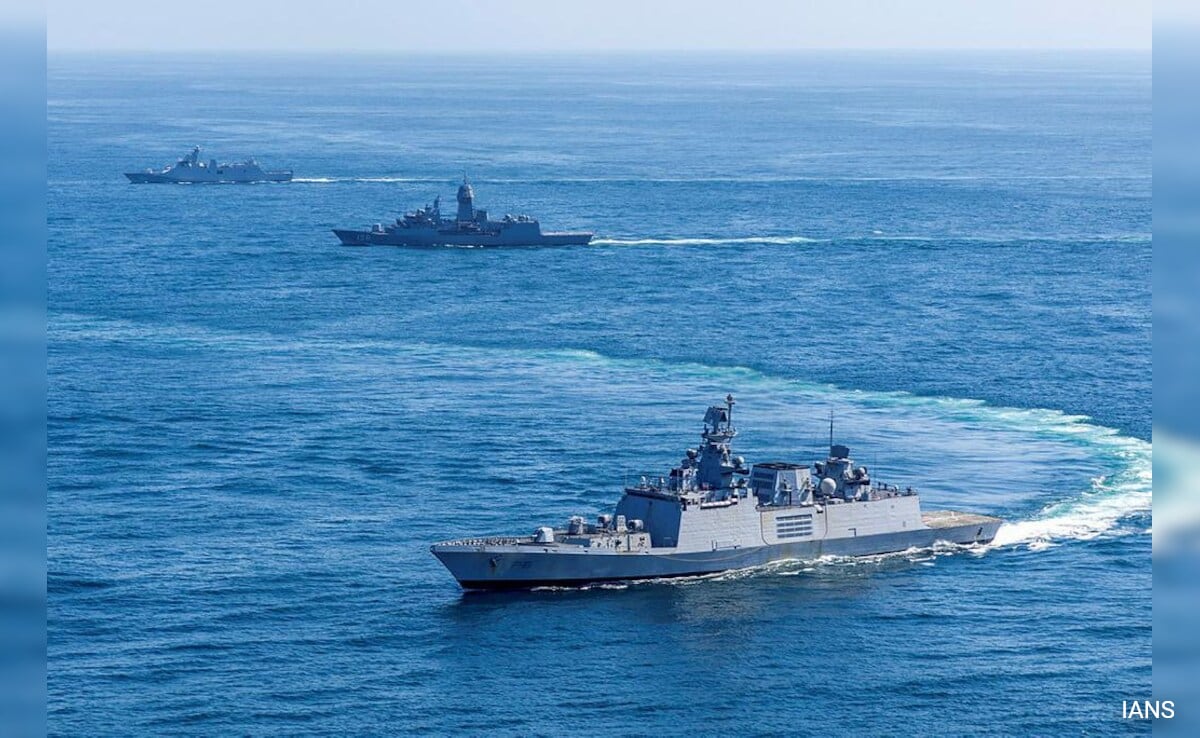
In the Indian Ocean, resource geopolitics and security is less of a factor than in the western Pacific Sea as there are no contested maritime territorial claims. There are, however, issues with regard to illegal, unreported and unregulated (IUU) fishing and intrusions into the continental shelf of countries, which requires monitoring. For countries like India, increased Chinese maritime presence has major geopolitical and security implications.
The Indian Ocean holds rich marine resources, and the fisheries sector is vital for the economies and livelihoods of the populations of the littoral states. The scale of IUU fishing in the EEZs of five countries in the Southwest Indian Ocean – Kenya, Madagascar, Mozambique, South Africa and Tanzania – is a major issue.
Here too, China has expanded its maritime footprint through its fishing fleet. It is a major state actor responsible for much of the IUU fishing worldwide. Its Distant Water Fishing (DWF) fleet in size, destructive conduct, and geopolitical purpose stands out. For China, its DWF is an instrument of national power. China encourages its fishing companies to undertake joint ventures and sign bilateral fishing agreements.
According to a report, China has acquired about 75% of the 130 fishing licenses issued by Mozambique. It exploits the gaps in the competence of Regional Fisheries Management Organisations (RFMOs) in the Indian Ocean, resulting in over-fishing. There are also suspicions that its fishing fleets are part of its military surveillance and intelligence networks.
Exploitation Of Marine Resources
The Indian Ocean Rim countries are faced with common pressing challenges of over-exploitation of natural marine resources. Fishing in the Indian Ocean grew by 300% from 1950 to 2018, reaching 6.5 million tonnes annually. Most of the countries in the region have formulated their own fisheries regulations, but they lack proper standards, guidelines, coherent regional arrangement and enforcement mechanisms, owing to limited data and capacity constraints.
Sea bed mining will be part of global competition for resources, and this includes the Indian Ocean. Nodules containing nickel, cobalt, iron, and massive sulphide deposits of manganese, copper, iron, nickel, cobalt, iron, zinc, silver and gold are present in sizeable quantities on the sea bed. China is preparing in a big way to mine minerals like nickel, copper, cobalt and manganese. These are critical materials needed in vast quantities to build a green economy. The International Seabed Authority is still figuring out how mining should be regulated, with some environmental groups wanting an outright ban.
Also, the western rim of the Indian Ocean is flush with oil and gas resources. Resource-related geopolitics and security have marked this area for several decades. The volatility of this area because of its hydrocarbon resources remains. As much as 40% of the world’s offshore oil production takes place in the Indian Ocean basin. It holds 16.8% of the world’s proven oil reserves and 27.9% of proven natural gas reserves. Nearly 80% of India’s crude oil requirement is also imported by sea via the Indian Ocean.
Climate change-induced phenomena, such as extreme weather events and rising ocean temperatures, adversely affect the reproductive patterns and quality of aquatic life in the Indian and Pacific oceans. Human security challenges are arising from climate change impacts such as sea-level rise, ocean acidification, and extreme weather events. The negative impacts of climate change extend beyond land-based agriculture to include fishing and aquaculture activities, which are significant components of agricultural output in the Indo-Pacific nations.
As the population of the Indo-Pacific region increases in the coming decades, its impact on food security and the economy from marine resources will become more substantial. In the Indo-Pacific, as elsewhere, the oceans, seas and coastal areas contribute to food security and poverty eradication. And yet, the oceans are under severe threat by human activities.
The lack of regional maritime security architecture has prompted major powers to compete for control over these resources and sea lanes.
A Blue Economy
The focus on a ‘Blue Economy’ is important for preserving the oceans as a source of human security. In the September 2015 Mauritius Declaration on Blue Economy, the Indian Ocean Rim Association (IORA) recognised the need for urgent action towards improved governance structures to preserve the ocean’s resources for future generations. The blue economy aims at the sustainable management of ocean resources in collaborations across borders and sectors through a variety of partnerships. Goal 14 of the Sustainable Development Goals (SDG) – Life Below Water – outlines the imperative need to increase cooperation for the conservation and sustainable use of the oceans, seas and marine resources.
Meanwhile, the Island states are concerned with nontraditional security threats from climate change, IUU fishing, piracy and oil spills as the biggest security threats in the Indian and Pacific Oceans. These issues have not been priority security concerns for major powers in the region, but this gap in the approach to Indo-Pacific security is being bridged.
India has proposed a cooperative framework to handle maritime issues in the Indian Ocean. Its objectives, as outlined by Indian Prime Minister Modi in 2015 under the banner of SAGAR (Security and Growth for All in the Region), are to seek a climate of trust and transparency, respect for international maritime rules and norms by all countries, sensitivity to each other’s interests, peaceful resolution of maritime issues, and increase in maritime cooperation.
(Kanwal Sibal was Foreign Secretary and Ambassador to Turkey, Egypt, France and Russia, and Deputy Chief Of Mission in Washington.)
Disclaimer: These are the personal opinions of the author
Waiting for response to load…