






Around 6,500 sorties were flown and fighter jets were airborne for 1,200 sorties.
The enemy had fortified its position at 18,000 feet on the icy heights of Kargil. A mass mobilization of troops began to evict the soldiers of Pakistan’s Northern Light Infantry (NLI) disguised as militants. What was assumed to be a low-scale limited intrusion, in the beginning, turned into a conflict just below the threshold of a full-scale war between nuclear-armed countries.
Twenty-five years ago, the Army and the Air Force jointly conducted the most challenging operations at high altitudes, telling the world that an armed conflict is possible between nuclear powers. A battle extensively covered by NDTV from the frontline. It was indeed India’s first televised war.
Enemy Spotted!
The Kargil sector extends over 168 kilometres from Kaobali Gali, north of Baltal, to Chorbat La near Turtuk, along the Line of Control. The average height of peaks along the mountain range is around 16,500 feet. Manning the outposts was an operational challenge during winter as temperatures dropped to -40 degrees in several regions. Therefore, several posts were vacated during winter, but some “winter cut-off posts” were still held, and the Army’s Aviation Corps conducted Winter Air Surveillance Operations (WASO) for reconnaissance.
Amidst the Lahore Peace Summit in 1999, Pakistan took advantage of this posturing and occupied several posts.
The first intrusions were reported by shepherds on May 3 in the Banju area of Batalik Sector, the operational area of the 121 Infantry Brigade. Later, 3 Punjab was sent on two patrols a day later, and on May 6, more intrusions were detected. By May 12, intrusions were detected in multiple sectors, signalling a larger operation.

Credits: Image posted on Facebook by Krishnachari
In the Kaksar sector, which lay east of Dras, a patrol of 4 Jat under Captain Saurabh Kalia’s command saw the enemy at Bajrang Post. Captain Kalia and his men were captured and brutally tortured to death for several days. In Turtuk, Pakistani helicopters were spotted in the last week of April with an underslung load, and later in May, a patrol of 12 Jat was ambushed near the LoC. Subsequent patrols were sent on May 16 and 19. The enemy was spread over an area of 150 kilometres.
Boots On The Ground
Remobilization of troops began, and a mass deployment started. The 3 Infantry Division had four undermanned Brigades in the region: 121 Infantry Brigades for the entire Kargil sector deployed along with Ladakh Scouts; 70 Infantry Brigades in Batalik, with two battalions in the Central Sector of Siachen Glacier, assisting the Brigade there; the other two battalions were involved in counter-terrorism operations in Kashmir. The third was the 114 Infantry Brigade, also known as the Siachen Brigade. The fourth brigade of 3 Inf Div was the 102 Infantry Brigade, responsible for the southern sectors of Siachen.
The Army faced setbacks during the early days of the conflict when ground troops were deployed to evict the enemy. The Dras sector, which was closest to the Line of Control, was the most vulnerable to the enemy’s precision artillery fire on Indian convoys. The uphill battle at 18,000 feet meant 10 Indian soldiers were needed to evict one intruder. The initial fog of war led to several casualties, and an air assault was necessary.
‘Air Force Enters’
The Chiefs of Staff Committee (COSC) was headed by General VP Malik. The Cabinet Security on Security (CCS), headed by Prime Minister AB Vajpayee, was initially reluctant to deploy attack helicopters to avoid an escalation. General Malik, in his book ‘India’s Military Conflicts and Diplomacy’, writes that the CCS was initially reluctant to deploy attack helicopters to avoid an escalation. He writes that before his return from overseas, Air Chief Marshal AY Tipnis was not ready to use air power. Firstly, attack helicopters like Mi-25/35 could not fly at that altitude, and secondly, the escalation of conflict.

Photo Credit: Image posted on X by @IAF_MCC
Air Marshal Arjun Subramaniam in his book ‘Full Spectrum’ writes that the IAF chief said he was not kept in the loop during the initial days of war and therefore there was pressure on him to deliver.
Then foreign minister Jaswant Singh on May 18, 1999, had opposed the idea of deploying IAF and the Navy, but on May 25, a go-ahead was given to deploy fighters. Though the IAF had been providing air support to the army since May 17, for the first time a go-ahead was given for combat ops but with a caveat: “Do not cross the Line of Control”. The IAF was not kept in the loop between May 7 and May 15 by the army in operational planning and only sought chopper support.
The area of intrusion in a sector was limited to five to 10 kilometres, and the restriction to not cross the LOC meant the aircraft flying close to enemy positions. The bunkers were camouflaged, and the Air Force never conducted precision strikes at 18,000 feet. The challenges limited the effectiveness of bombing to some extent. In 1999, the Indian Air Force conducted Exercise Trishul in the Himalayas, many weeks before the Kargil conflict, flying over 5,000 sorties for high-altitude operations.
‘Changing the strategy’
The IAF fleet had two MiG-21, MiG-27/MiG-23 BN, Jaguar, and Mi-17 squadrons for offensive operations. There were two MiG-29, one MiG-21, and MiG-23 MF squadrons for air defence roles. Mirage 2000s were deployed for offensive and surveillance missions along with Canberra photo reconnaissance bombers and the mighty MiG-25 for a similar role.
The attack on the Tiger Hill complex began on May 26, with Mi-17, MiG-21s, MiG-23s, and MiG-27s taking charge. Interestingly, the Mi-25/35 attack helicopters were not built to operate at such an altitude. Guns were fitted on Mi-17 for attack roles, an Indian ‘jugaad’ that worked effectively.
On May 21, a Canberra bomber on a reconnaissance mission was hit by a US-made shoulder-fired, Stinger, Surface-to-Air Missile (SAM). The aircraft managed to land back safely, but the threat of SAMs became imminent. On May 27, a MiG-27 piloted by Flight Lieutenant Nachiketa Rao was lost over the Batalik sector due to an engine flameout. Flt Lt Rao managed to eject, but his location was unknown. Squadron Leader Ajay Ahuja, piloting a MiG-21, tried to ascertain the MiG-27’s wreckage’s location and was hit by an enemy SAM. He ejected but was on the other side of the LOC and was captured and brutally tortured by the Pakistani troops. The next day, a Mi-17 helicopter was the target of the Stinger missile while it was attacking the Tololing peak.
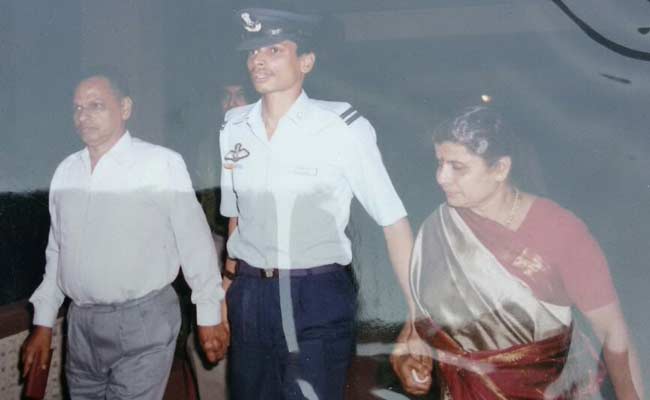
(Flight Lieutenant (Later Group Captain) Nachiketa with his parents a day after returning to India after his release)
The IAF recalibrated its strategy. Attack helicopters were not deployed for such roles, and they were more vulnerable to SAMs and air defence guns. Installing flares to counter missile attacks and flying at 30,000 feet as the Stinger could not operate at such altitude.
Kaiser Tufail, a former Pakistan Air Force pilot, in his blog ‘Aeronaut’, writes the Pakistani version of operational planning and said that X Corps commander Lt General Mahmood Ahmed broke the news of a limited operation across the LOC. During the operation briefing, Lt Gen Mahmood was asked the type of air support the troops needed, to which he said, “I have Stingers on every peak”. Air Commodore Saleem Nawaz asked him if these missiles have a limited attack envelope and it doesn’t stop the IAF and artillery from attacking us from high altitude, to which Lt Gen Mahmood said, our troops were well positioned and concealed and the IAF wouldn’t be able to pick it up from the air.
IAF in full force
During the initial days of its offensive operations, the aircraft used rockets and guns to attack the crest of the mountain peak, for which they had to dive low, attack, and then pull quickly. This manoeuvre made them vulnerable to SAMs. After Sq Ldr Ajay Ahuja’s capture, all low-level flights were abandoned, and only medium-level strikes were sanctioned.

250 kg and 500 kg dumb bombs were dropped, and relentless bombing of peaks in the Tiger Hill complex began. Fighter jets would first conduct strikes, and later army operations were conducted. The strikes by Mirage 2000 on Muntho Dhalo in the Batalik sector, a logistics headquarters, turned the tide. On June 16, Mirage 2000s attacked the logistics camp with 36 250-kg bombs, which destroyed the supply lines to forward troops in Batalik and Kaksar. It was followed by attacks on Kukarthang, a fuel dump supply, struck by MiG-27. The post was re-taken by 1/11 Gorkha Rifles later.
Twenty-five years ago, on June 24, 1999, Wing Commander Raghunath Nambiar and Sqn Leader Monish Yadav from 7 Squadron flew the first mission over Tiger Hill where precision strikes using the Israeli ‘Litening Pod’ was used.
Air Marshal Nambiar in an NDTV column said, “The Laser was steadily flashing, and we waited anxiously for the target to explode, thus signalling a successful delivery. The time of flight of an LGB under the delivery conditions that we had dropped it in was under 30 seconds, but to us in the cockpit, it appeared as an eternity. Our joy knew no bounds as the entire video image of the target burst out into a soundless explosion.”
#CrossHair on #TigerHill : IAF used 2X1000Lbs Paveway LGB, with other fighters striking targets with unguided bombs. The Targets were acquired on Electro-Optical sensor, weapons released & targets destroyed within few secs.#RememberingKargil@DefenceMinIndia@SpokespersonMoDpic.twitter.com/Za2fQDUwsq
— Indian Air Force (@IAF_MCC) June 23, 2018
Eight Laser Guided Bombs were used by the Mirage in the mission and one by a Jaguar.
The IAF writes, “An army unit states that: You guys have done a wonderful job. Your Mirage boys with their precision laser-guided bombs targeted an enemy Battalion HQ in the Tiger Hill area with tremendous success. Five Pakistani officers were reported killed in that attack and their Command and Control broke down – as a result of which our troops have walked over the entire Tiger Hills area. The enemy is on the run. They are on the run in other sectors also. At this rate, the end of the conflict may come soon.”
Group Captain Tufail gives the Pakistani account of Mirage strikes and said, “The Mirage-2000s scored at least five successful laser-guided bomb hits on forward dumping sites and posts. During the last days of operations which ended on 12 July, it was clear that delivery accuracy had improved considerably.”
On June 24, a Jaguar pilot was tasked to bomb point 4388 but mistakenly lazered at an army base in Gulteri in Pakistan Occupied Kashmir where then Pakistan Army Chief General Pervez Musharraf and Prime Minister Nawaz Sharif were present. NDTV accessed the exclusive Indian Air Force documents in 2016. The IAF pilot was stopped by his senior officials from bombing the camp and avoiding a major escalation.
Battle Damage Assessment (BDA) is part of an airstrike. Footage shared by the IAF a few years ago shows the damage precision strikes on Tiger Hill did. After bombing Tiger Hill, Wing Commander Nambiar filmed the area to assess enemy presence. “The entire squadron was gathered around the TV as the tape was rewound and played back. Clearly visible on the tape were four enemy soldiers rushing across the screen a few seconds before the bomb got to them,” he writes.

A piece of rock and soil from Tiger Hill at the Prime Minister’s Museum in Delhi
Operation Safed Sagar was a turning point in the war. Had the Indian Air Force not intervened, the casualties suffered by the army would’ve been much higher. Never in the history of the IAF, air strikes were conducted at such altitude. Shortcomings during operational planning were reviewed in the Kargil Review Committee Report, which says that the deploying air force had a “strong impact on the course of the tactical battle…”
Jubar, Tololing, Tiger Hill, Point 4388 in the Mushkoh Valley, Kukarthang, Thaur Hill, Point 5312, and Muntho Dhalo are a few such points targeted by the Air Force.
During the 60 days of the operation, around 6,500 sorties were flown and fighter jets were airborne for 1,200 sorties, out of which 550 were for attack missions.