




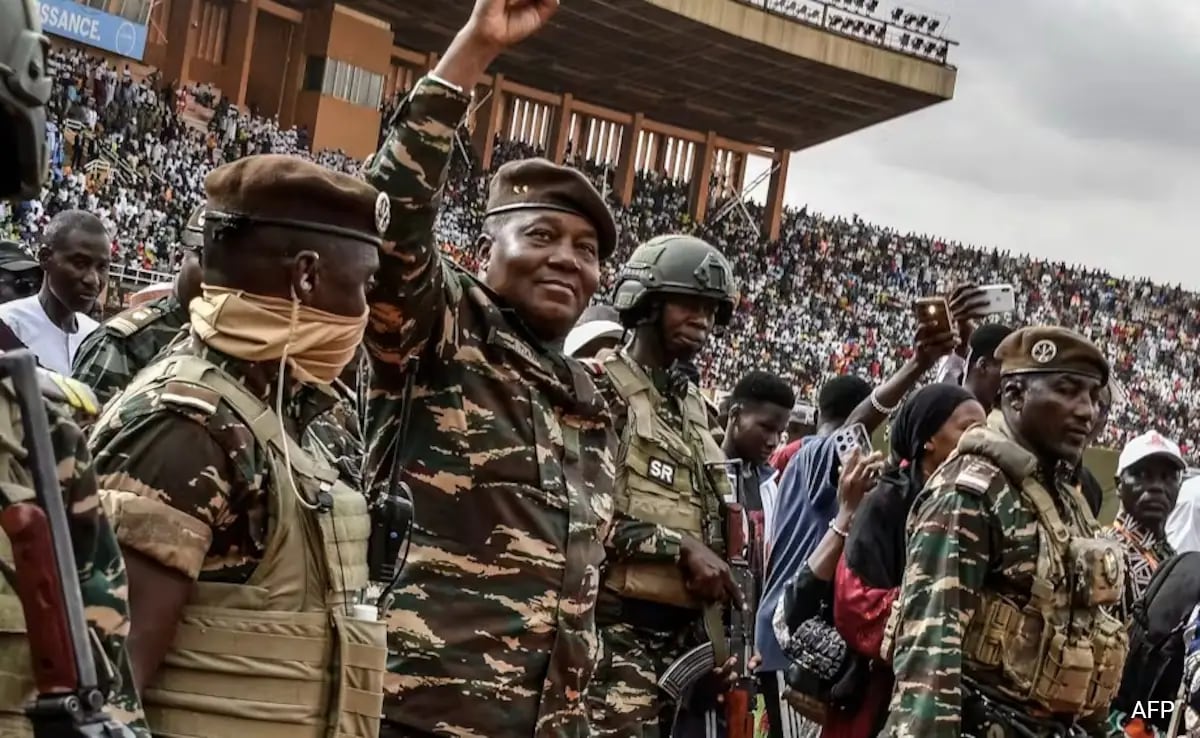
In the last few years, there has been a spate of military coups in Mali, Niger, Burkina Faso, Sudan and Guinea. Military rule, long dormant in African politics, is back.
Coup leaders have suppressed protest, gagged the media and spilled much civilian blood in the name of public safety. They claim to be protecting their people from enemies both internal and external – some invented to justify their takeovers and others very real (while military regimes have arguably made violent extremism worse, they did not create it).
The generals fight with one another as much as with their enemies, leading to duelling coups in Burkina Faso and a full-on civil war in Sudan.
In west Africa, soldiers have shaken up the geopolitical order, pushing away France and the United States, while drawing the Russian Federation (or more precisely, Russia-funded mercenaries) closer.
Outside observers, and a fair number of insiders, were blindsided by these events. That’s because military rule, with its drab aesthetics and Cold War trappings, seemed like a relic of the past. Explanations for its return have mostly focused on meddling outsiders, especially Russia. Others emphasise the inherent vice of African states – the weaknesses that were there from the beginning of independence, including poverty and corruption, that made people disenchanted with democracy.
I’m a military historian, and over the last few years I watched with alarm as the history I was writing about military dictatorships in the 1980s became current events. Military rule has deep roots, as my open-access book Soldier’s Paradise: Militarism in Africa After Empire argues. The coups of the last few years are a return to one of independent Africa’s most important political traditions: militarism.
Militarism, or rule by soldiers, is a form of government where military objectives blur into politics, and the values of the armed forces become the values of the state at large.
West Africa’s recent string of coups can only be understood in the long view of postcolonial history. The military regimes of the past were brutally innovative. They made new rules, new institutions and new standards for how people should interact. They promised to make Africa an orderly and prosperous paradise. They failed, but their promises were popular.
Africa’s military regimes
Militaries ruled by force, not consensus, but plenty of people liked their disciplinary verve. Whipping the public into shape, sometimes literally, had a real appeal to people who felt that the world had become too unruly. Independence did not always mean freedom, and soldiers’ rigid ideas shaped decolonisation in ways that we’re only starting to understand.
Long submerged by more hopeful ideological currents, militarism is now rising back to the surface of African politics. My book describes where militarism came from, and why it lasted so long.
Petty and paranoid
Between 1956 and 2001 there were about 80 successful coups, 108 failed ones and 139 plots across Africa south of the Sahara. Some countries had many coups (Sudan has the highest, with 18 known attempts since 1950) while others had none (like Botswana). But even in places where the military wasn’t in charge, the threat of a military takeover shaped how civilians governed.
The successful coups produced military regimes that were remarkably durable. Their leaders promised their regimes would be “transitional” or “custodial” and that they would hand back power to civilians as soon as they could.
Few did, and in some countries military rule lasted for decades. This could involve a graveyard-like stability where a single soldier-king ruled for an entire generation (like Burkina Faso), or constant turmoil as one junta gave way to another (like Nigeria). Military governments were petty and paranoid – each officer knew he had a line of rivals behind him waiting for their moment.
In these “revolutions”, as coup plotters called their takeovers, a new ideology emerged. Militarism was a coherent and relatively consistent vision for society, even though not all military regimes were the same. It had its own political values (obedience, discipline), morals (honour, bravery, respect for rank), and an economic logic (order, which they promised would bring prosperity).
It had a distinct aesthetic, and a vision for what Africa should look and feel like. The military’s internal principles became the rules of politics at large. Officers came to believe that the training they used to make civilians into soldiers could transform their countries from the ground up. Some came to believe, ironically, that only strict discipline would bring true freedom.
The army officers who took power tried to remake their societies along military lines. They had utopian plans, and their ideology could not be boiled down to the big ideas of their times, like capitalism and communism. There were military regimes of the left, right and centre; radical and conservative; nativist and internationalist.
Militarism was a freestanding ideology, not just American liberalism, Soviet socialism or European neocolonialism dressed up in a uniform. Powerful outsiders pulled some of the strings in African politics, but not all of them, and officers were proud of the fact that they followed no one’s orders but their own.
Military tyranny
Part of militarism’s appeal was its maverick independence, and military regimes endeared themselves to the public by cutting ties with unpopular foreigners, just like Niger and Burkina Faso did with France in 2023.
Soldiers ran their countries like they fought wars. Combat was their metaphor for politics. Their goal was to win – and they accepted that people would get hurt along the way.
But what did “winning” look like when the enemy was their own people? They declared war on indiscipline, drugs and crime. To civilians, all of this was hard to distinguish from tyranny, and military rule felt like a long, brutal occupation.
No military dictatorship succeeded in making the martial utopia that soldiers promised. Other parts of government pushed back against the military’s plans, and African judiciaries proved especially formidable opponents. Civil society groups fought them tooth and nail, and challenges came from abroad, especially from the African diaspora.
Like most revolutions that don’t succeed, militarists blamed the public for not committing to their vision and outsiders for sabotaging them. They do this today, too.
Today’s military regimes don’t seem to have the same long-term visions of their predecessors, but the longer they stay in power the more likely they are to start making plans. Despite all their promises to return to the barracks, they don’t seem to be going any time soon.
If we’re trying to anticipate what the continent’s military regimes might do next, it makes sense to look to the past. In the late 20th century, military regimes promised to make Africa into a “soldier’s paradise”. That promise is part of their strategy today.
(Author: Samuel Fury Childs Daly, Associate Professor of History, University of Chicago)
(Disclosure Statement: Samuel Fury Childs Daly does not work for, consult, own shares in or receive funding from any company or organisation that would benefit from this article, and has disclosed no relevant affiliations beyond their academic appointment)
This article is republished from The Conversation under a Creative Commons license. Read the original article.
(Except for the headline, this story has not been edited by NDTV staff and is published from a syndicated feed.)