

Skip to content
  • Facebook
  • X
  • Linkedin
  • WhatsApp
  • YouTube
  • Associate Journalism
  • About Us
  • Privacy Policy
  • 033-46046046
  • editor@artifex.news
Artifex.News

Artifex.News

Stay Connected. Stay Informed.

  • Breaking News
  • World
  • Nation
  • Sports
  • Business
  • Science
  • Entertainment
  • Lifestyle
  • Toggle search form
  • 4/5 In 15.5 Overs, 10 Maidens: West Indies’ Jayden Seales Sets ‘Cheapest’ Record In Tests With Great Display vs Bangladesh
    4/5 In 15.5 Overs, 10 Maidens: West Indies’ Jayden Seales Sets ‘Cheapest’ Record In Tests With Great Display vs Bangladesh Sports
  • In videos | Budget 2024
    In videos | Budget 2024 Business
  • In Meghalaya, superstitions add to reasons delaying cancer care
    In Meghalaya, superstitions add to reasons delaying cancer care Science
  • BRICS countries recognize group’s importance for multipolarity: Jaishankar
    BRICS countries recognize group’s importance for multipolarity: Jaishankar World
  • Access Denied World
  • Why countries struggle to eliminate fossil fuel subsidies | Explained
    Why countries struggle to eliminate fossil fuel subsidies | Explained Science
  • Rohit Sharma’s Wife Ritika Sajdeh Reveals Son’s Name. It Doesn’t Start With R But…
    Rohit Sharma’s Wife Ritika Sajdeh Reveals Son’s Name. It Doesn’t Start With R But… Sports
  • Access Denied Sports
What Are Bomb Cyclones And How Do They Form?

What Are Bomb Cyclones And How Do They Form?

Posted on November 29, 2024 By admin


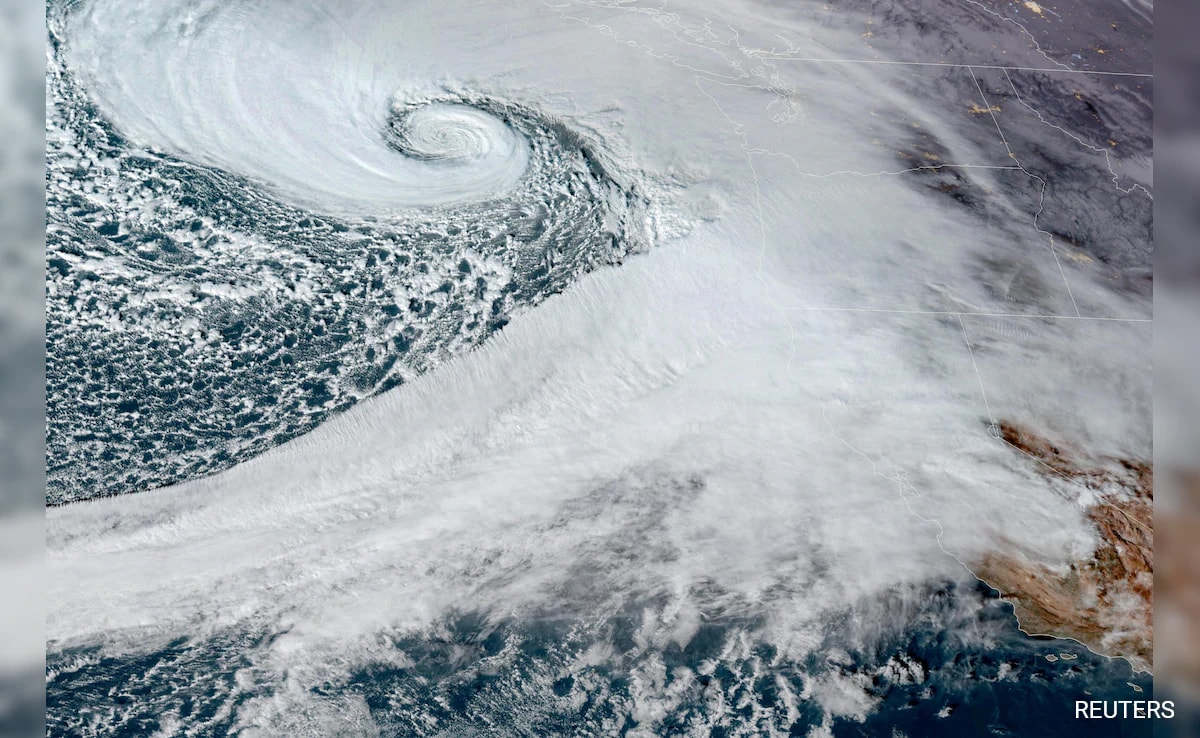
A dangerous weather phenomenon called a bomb cyclone that occurs in mid-latitudes – between Earth’s tropics and the polar regions – can bring strong and damaging winds, torrential rains, heavy snowfall, flooding and frigid temperatures.

Here is an explanation of bomb cyclones:

  1. WHAT IS A BOMB CYCLONE? A bomb cyclone, also referred to as explosive cyclogenesis or bombogenesis, is a mid-latitude cyclone that has rapidly intensified. A cyclone is a low-pressure weather system – one where the atmospheric pressure is lower at its center than in surrounding areas – with winds rotating inward. It circulates in a counterclockwise direction in the northern hemisphere and a clockwise direction in the southern hemisphere. A bomb cyclone’s winds can reach hurricane force – 74 miles (119 km) per hour – and stronger. These storms tend to form during winter and can spawn copious amounts of precipitation. They have life spans of about a week during which they grow to peak intensity over roughly four to five days and then dissipate over the last two, according to Jon Martin, a professor of meteorology at the University of Wisconsin at Madison.
  2. HOW DOES A BOMB CYCLONE FORM? Bomb cyclones form when the conditions at the surface and at the jet stream level are ideal for the storm to intensify. The jet stream is a narrow band of strong winds in the upper atmosphere. A variety of atmospheric processes combine to produce these storms. Almost all bomb cyclones have a precursor disturbance in the winds in the middle part of the troposphere – the lowest region of Earth’s atmosphere – about 3-5 miles (5-8 km) above the planet’s surface, Martin said. Another important feature common to many, but not all, explosive cyclogenesis events is a warm ocean surface. Many of the most intense bomb cyclones form over oceans. Precipitation can be prodigious. When water vapor changes into liquid and ice, as it does in these storms, enormous amounts of energy – called latent heat energy – are released. Some of that energy further intensifies the storm. By virtue of the atmospheric pressure getting so low, differences in pressure across the storm can become very large, powering strong winds that can have devastating effects.
  3. WHEN AND WHERE ARE THEY MOST LIKELY TO FORM? Explosive cyclogenesis occurs mostly over oceans and most commonly during the cold season in both hemispheres – roughly November to March for the northern hemisphere and roughly May through August in the southern hemisphere, though these storms can be earlier or later than that. Areas particularly prone are situated in so-called storm tracks along the east coast of continents because this is where the warmest ocean currents exist, such as the Kuroshio off Japan and the Gulf Stream off North America, Martin said. Bomb cyclones can be very destructive and pose particular danger to shipping interests, since many of them occur over the oceans, according to John Knox, an atmospheric scientist and professor of geography at the University of Georgia. Some bomb cyclones have occurred on the Great Lakes of North America and caused shipwrecks there, too, Knox said.
  4. WHAT HAPPENS TO THE ATMOSPHERIC PRESSURE? The average sea-level atmospheric pressure at middle latitudes is about 1012 millibars, or mb. In cyclones, this gets down to as low as 980 mb with regularity. With bomb cyclones, it can drop to 950 mb or lower, and the rate at which they intensify is at least 24 mb in 24 hours.
  5. WHY CAN WE NOT CALL IT A HURRICANE? While bomb cyclones can unleash hurricane-force winds and sometimes display characteristics of a hurricane, they are not hurricanes. They form from different physical processes and do not have the symmetry of hurricanes, which also are low-pressure systems. Bomb cyclones occasionally develop “eyes” resembling those at the center of a hurricane, Knox said. But a bomb cyclone has its origins in the mid-latitudes and is associated with weather fronts – a boundary between two air masses with different characteristics such as temperature – and a strong jet stream, Knox said. A hurricane originates in the tropics and is not associated with either weather fronts or a strong jet stream, Knox said.
  6. ARE BOMB CYCLONES BECOMING MORE COMMON? Global climate change, according to experts, is causing more frequent and more extreme weather events around the world. But are bomb cyclones becoming more common or more intense? Martin said it is not clear whether that is the case. The fact that Earth is warming has ramifications for cyclone dynamics that scientists are currently trying to figure out, Martin said. A warmer planet means more water vapor in the air and that would tend to make at least the latent heat portion of the empowerment of these storms stronger, Martin said. However, the warming is not uniform, Martin said. Since observations suggest more warming at high latitudes, Martin said, this could render the bomb cyclones weaker in general.




Source link

World Tags:Bomb Cyclone, climate, Climate Disasters, Cyclone Science, Cyclones, environment, Heavy rain, Hurricanes, North America News, Precipitation, Tornadoes, Typhoons, Weather science, What Is Bomb Cyclone

Post navigation

Previous Post: Syed Mushtaq Ali Trophy: MP has one foot in knockouts after thrilling win over Bengal
Next Post: Hamas Delegation To Hold Gaza Ceasefire Talks Today In Egypt: Official

Related Posts

  • Watch: ‘President Zelenskyy, you look fabulous in that suit’
    Watch: ‘President Zelenskyy, you look fabulous in that suit’ World
  • Access Denied World
  • Access Denied World
  • Ukraine names new ambassador to U.S. as truce efforts mount
    Ukraine names new ambassador to U.S. as truce efforts mount World
  • Ukraine, U.S. to start talks in Switzerland on Trump’s plan to end war
    Ukraine, U.S. to start talks in Switzerland on Trump’s plan to end war World
  • Bangladesh Ex-PM Sheikh Hasina’s Palace To Become Revolution Museum
    Bangladesh Ex-PM Sheikh Hasina’s Palace To Become Revolution Museum World

More Related Articles

Ukraine withdraws from eastern town of Vugledar Ukraine withdraws from eastern town of Vugledar World
Access Denied World
Access Denied World
SpaceX set to launch billionaire’s private crew on breakthrough spacewalk mission SpaceX set to launch billionaire’s private crew on breakthrough spacewalk mission World
EU weighs extending carbon market to flights beyond Europe EU weighs extending carbon market to flights beyond Europe World
India, Algeria hold first joint defence commission meet India, Algeria hold first joint defence commission meet World
SiteLock

Archives

  • May 2026
  • April 2026
  • March 2026
  • February 2026
  • January 2026
  • December 2025
  • November 2025
  • October 2025
  • September 2025
  • August 2025
  • July 2025
  • June 2025
  • May 2025
  • April 2025
  • March 2025
  • February 2025
  • January 2025
  • December 2024
  • November 2024
  • October 2024
  • September 2024
  • August 2024
  • July 2024
  • June 2024
  • May 2024
  • April 2024
  • March 2024
  • February 2024
  • January 2024
  • December 2023
  • November 2023
  • October 2023
  • September 2023
  • August 2023
  • July 2023
  • June 2023
  • May 2023
  • April 2023
  • March 2023
  • February 2023
  • January 2023
  • December 2022
  • November 2022
  • October 2022
  • September 2022
  • August 2022
  • July 2022
  • June 2022
  • May 2022

Categories

  • Business
  • Nation
  • Science
  • Sports
  • World

Recent Posts

  • Tamil Nadu Assembly session LIVE: CM Vijay moves resolution seeking confidence vote
  • What is in the U.S. Senate’s landmark crypto bill?
  • Trinamool’s land policy delayed West Bengal border fencing: MHA’s 2023 affidavit in Supreme Court
  • ‘Take action to remove deceased Gruha Lakshmi beneficiaries’
  • Hanuman Jayanti: Muslim residents offer buttermilk to Hindu devotees in Kadapa days after clashes

Recent Comments

  1. DavidAnymn on UP Teacher Who Asked Students To Slap Muslim Classmate
  2. Jesusetexy on UP Teacher Who Asked Students To Slap Muslim Classmate
  3. JeffryFok on UP Teacher Who Asked Students To Slap Muslim Classmate
  4. StanleyPeapy on UP Teacher Who Asked Students To Slap Muslim Classmate
  5. RonaldLam on UP Teacher Who Asked Students To Slap Muslim Classmate
  • Access Denied Sports
  • Access Denied Sports
  • Igor Stimac To Remain In Charge Of India’s FIFA World Cup Qualifiers Against Kuwait And Qatar
    Igor Stimac To Remain In Charge Of India’s FIFA World Cup Qualifiers Against Kuwait And Qatar Sports
  • Two dead as Russia launches attacks on Ukraine’s energy infrastructure
    Two dead as Russia launches attacks on Ukraine’s energy infrastructure World
  • Virat Kohli – Out Or Not Out At Sydney Cricket Ground? Experts Divided On Decision
    Virat Kohli – Out Or Not Out At Sydney Cricket Ground? Experts Divided On Decision Sports
  • AMD, Cisco, and Saudi’s Humain launch AI joint venture, land first major customer
    AMD, Cisco, and Saudi’s Humain launch AI joint venture, land first major customer Business
  • Access Denied World
  • Bhim Sena Chief Alleges Threat From Lawrence Bishnoi, Goes To Cops
    Bhim Sena Chief Alleges Threat From Lawrence Bishnoi, Goes To Cops Nation

Editor-in-Chief:
Mohammad Ariff,
MSW, MAJMC, BSW, DTL, CTS, CNM, CCR, CAL, RSL, ASOC.
editor@artifex.news

Associate Editors:
1. Zenellis R. Tuba,
zenelis@artifex.news
2. Haris Daniyel
daniyel@artifex.news

Photograher:
Rohan Das
rohan@artifex.news

Artifex.News offers Online Paid Internships to college students from India and Abroad. Interns will get a PRESS CARD and other online offers.
Send your CV (Subjectline: Paid Internship) to internship@artifex.news

Links:
Associate Journalism
About Us
Privacy Policy

News Links:
Breaking News
World
Nation
Sports
Business
Entertainment
Lifestyle

Registered Office:
72/A, Elliot Road, Kolkata - 700016
Tel: 033-22277777, 033-22172217
Email: office@artifex.news

Editorial Office / News Desk:
No. 13, Mezzanine Floor, Esplanade Metro Rail Station,
12 J. L. Nehru Road, Kolkata - 700069.
(Entry from Gate No. 5)
Tel: 033-46011099, 033-46046046
Email: editor@artifex.news

Copyright © 2023 Artifex.News Newsportal designed by Artifex Infotech.