



Skip to content
  • Facebook
  • X
  • Linkedin
  • WhatsApp
  • YouTube
  • Associate Journalism
  • About Us
  • Privacy Policy
  • 033-46046046
  • editor@artifex.news
Artifex.News

Artifex.News

Stay Connected. Stay Informed.

  • Breaking News
  • World
  • Nation
  • Sports
  • Business
  • Science
  • Entertainment
  • Lifestyle
  • Toggle search form
  • Trump renames Defence Department To ‘Department Of War’; faces legal hurdles
    Trump renames Defence Department To ‘Department Of War’; faces legal hurdles World
  • Updated World Test Championship Table After South Africa’s Win Over Sri Lanka: What Does It Mean For India?
    Updated World Test Championship Table After South Africa’s Win Over Sri Lanka: What Does It Mean For India? Sports
  • Israel tries to contain fallout after some allies support ICC warrant plea
    Israel tries to contain fallout after some allies support ICC warrant plea World
  • Supreme Court Rejects PIL Seeking Independent Audit Of Source Code Of EVMs
    Supreme Court Rejects PIL Seeking Independent Audit Of Source Code Of EVMs Nation
  • Access Denied
    Access Denied Nation
  • Access Denied
    Access Denied Nation
  • Bangladesh President’s office seeking details of senior Hindu officers is “racial profiling”, says rights activist
    Bangladesh President’s office seeking details of senior Hindu officers is “racial profiling”, says rights activist World
  • Access Denied Sports
AI Was Born At This US Summer Camp 68 Years Ago. Here’s Why It Matters

AI Was Born At This US Summer Camp 68 Years Ago. Here’s Why It Matters

Posted on August 28, 2024 By admin


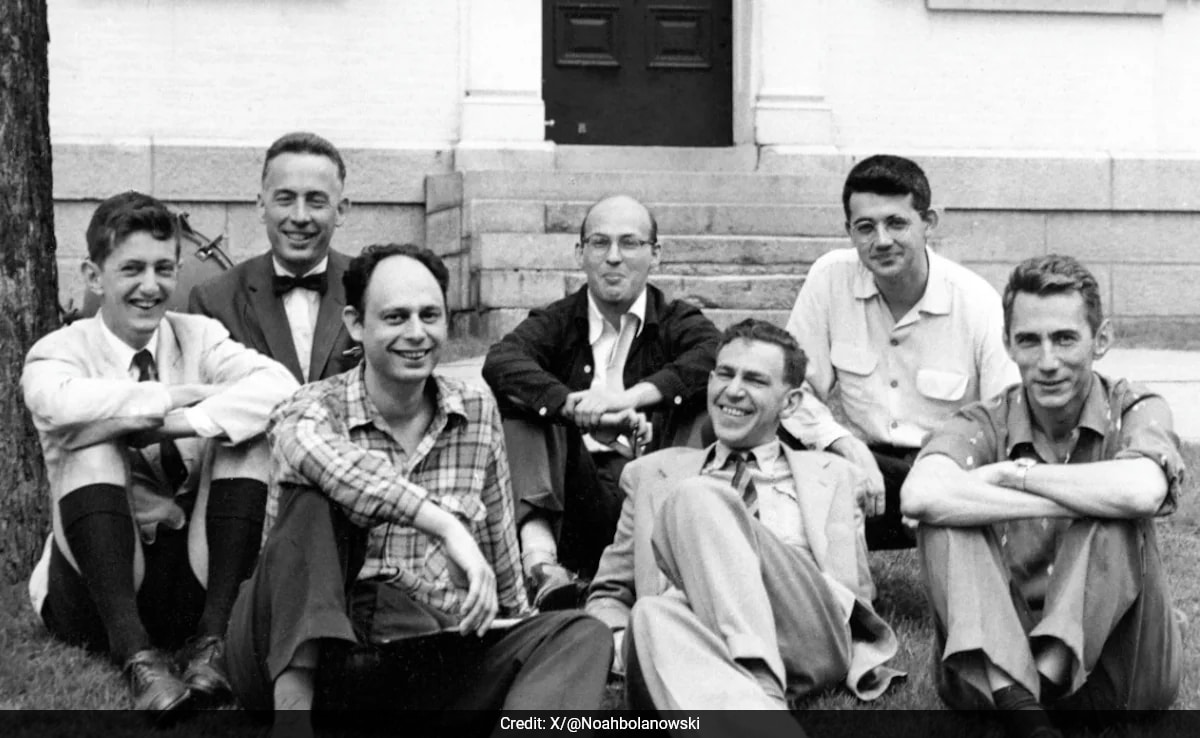
Imagine a group of young men gathered at a picturesque college campus in New England, in the United States, during the northern summer of 1956.

It’s a small casual gathering. But the men are not here for campfires and nature hikes in the surrounding mountains and woods. Instead, these pioneers are about to embark on an experimental journey that will spark countless debates for decades to come and change not just the course of technology – but the course of humanity.

Welcome to the Dartmouth Conference – the birthplace of artificial intelligence (AI) as we know it today.

What transpired here would ultimately lead to ChatGPT and the many other kinds of AI which now help us diagnose disease, detect fraud, put together playlists and write articles (well, not this one). But it would also create some of the many problems the field is still trying to overcome. Perhaps by looking back, we can find a better way forward.

The summer that changed everything

In the mid-1950s, rock’n’roll was taking the world by storm. Elvis’s Heartbreak Hotel was topping the charts, and teenagers started embracing James Dean’s rebellious legacy.

But in 1956, in a quiet corner of New Hampshire, a different kind of revolution was happening.

The Dartmouth Summer Research Project on Artificial Intelligence, often remembered as the Dartmouth Conference, kicked off on June 18 and lasted for about eight weeks. It was the brainchild of four American computer scientists – John McCarthy, Marvin Minsky, Nathaniel Rochester and Claude Shannon – and brought together some of the brightest minds in computer science, mathematics and cognitive psychology at the time.

These scientists, along with some of the 47 people they invited, set out to tackle an ambitious goal: to make intelligent machines.

As McCarthy put it in the conference proposal, they aimed to find out “how to make machines use language, form abstractions and concepts, solve kinds of problems now reserved for humans”.

The birth of a field – and a problematic name

The Dartmouth Conference didn’t just coin the term “artificial intelligence”; it coalesced an entire field of study. It’s like a mythical Big Bang of AI – everything we know about machine learning, neural networks and deep learning now traces its origins back to that summer in New Hampshire.

But the legacy of that summer is complicated.

Artificial intelligence won out as a name over others proposed or in use at the time. Shannon preferred the term “automata studies”, while two other conference participants (and the soon-to-be creators of the first AI program), Allen Newell and Herbert Simon, continued to use “complex information processing” for a few years still.

But here’s the thing: having settled on AI, no matter how much we try, today we can’t seem to get away from comparing AI to human intelligence.

This comparison is both a blessing and a curse.

On the one hand, it drives us to create AI systems that can match or exceed human performance in specific tasks. We celebrate when AI outperforms humans in games such as chess or Go, or when it can detect cancer in medical images with greater accuracy than human doctors.

On the other hand, this constant comparison leads to misconceptions.

When a computer beats a human at Go, it is easy to jump to the conclusion that machines are now smarter than us in all aspects – or that we are at least well on our way to creating such intelligence. But AlphaGo is no closer to writing poetry than a calculator.

And when a large language model sounds human, we start wondering if it is sentient.

But ChatGPT is no more alive than a talking ventriloquist’s dummy.

The overconfidence trap

The scientists at the Dartmouth Conference were incredibly optimistic about the future of AI. They were convinced they could solve the problem of machine intelligence in a single summer.

This overconfidence has been a recurring theme in AI development, and it has led to several cycles of hype and disappointment.

Simon stated in 1965 that “machines will be capable, within 20 years, of doing any work a man can do”. Minsky predicted in 1967 that “within a generation, […] the problem of creating ‘artificial intelligence’ will substantially be solved”.

Popular futurist Ray Kurzweil now predicts it’s only five years away: “We’re not quite there, but we will be there, and by 2029 it will match any person”.

Reframing our thinking: new lessons from Dartmouth

So, how can AI researchers, AI users, governments, employers and the broader public move forward in a more balanced way?

A key step is embracing the differences and utility of machine systems. Instead of focusing on the race to “artificial general intelligence”, we can focus on the unique strengths of the systems we have built – for example, the enormous creative capacity of image models.

Shifting the conversation from automation to augmentation is also important. Rather than pitting humans against machines, let’s focus on how AI can assist and augment human capabilities.

Let’s also emphasise ethical considerations. The Dartmouth participants didn’t spend much time discussing the ethical implications of AI. Today, we know better, and must do better.

We must also refocus research directions. Let’s emphasise research into AI interpretability and robustness, interdisciplinary AI research and explore new paradigms of intelligence that aren’t modelled on human cognition.

Finally, we must manage our expectations about AI. Sure, we can be excited about its potential. But we must also have realistic expectations so that we can avoid the disappointment cycles of the past.

As we look back at that summer camp 68 years ago, we can celebrate the vision and ambition of the Dartmouth Conference participants. Their work laid the foundation for the AI revolution we’re experiencing today.

By reframing our approach to AI – emphasising utility, augmentation, ethics and realistic expectations – we can honour the legacy of Dartmouth while charting a more balanced and beneficial course for the future of AI.

After all, real intelligence lies not just in creating smart machines, but in how wisely we choose to use and develop them.

Sandra Peter, Director of Sydney Executive Plus, University of Sydney

This article is republished from The Conversation under a Creative Commons license. Read the original article.

(Except for the headline, this story has not been edited by NDTV staff and is published from a syndicated feed.)


Source link

World Tags:artificial intelligence, Dartmouth Conference, United States

Post navigation

Previous Post: “Making Fool Out Of Pakistan”: Skipper Shan Masood Lambasted After Horror Bangladesh Show
Next Post: Zaheer Khan Makes IPL Return, Set To Mentor This Franchise

Related Posts

  • Access Denied World
  • Why 35,000 People Took To New Zealand Streets In One Of Biggest Protest For Maori Rights
    Why 35,000 People Took To New Zealand Streets In One Of Biggest Protest For Maori Rights World
  • U.S. birthright citizenship: Indian-American lawmakers oppose President Donald Trump’s executive order
    U.S. birthright citizenship: Indian-American lawmakers oppose President Donald Trump’s executive order World
  • Access Denied World
  • Trump’s Gaza plan: France ‘won’t join’, Canada ‘won’t pay’
    Trump’s Gaza plan: France ‘won’t join’, Canada ‘won’t pay’ World
  • Access Denied World

More Related Articles

Woman Arrested In Hit-And-Run Death Of Indian Student In Connecticut Woman Arrested In Hit-And-Run Death Of Indian Student In Connecticut World
Bangladesh vows to pursue Sheikh Hasina’s return from India, may seek global support Bangladesh vows to pursue Sheikh Hasina’s return from India, may seek global support World
Trump repeats claim that he stopped India-Pakistan war Trump repeats claim that he stopped India-Pakistan war World
Zelenskyy meets Trump at UN, calling for more pressure on Russia Zelenskyy meets Trump at UN, calling for more pressure on Russia World
A Ukrainian drone triggers warehouse explosions in Russia as a war of attrition grinds on A Ukrainian drone triggers warehouse explosions in Russia as a war of attrition grinds on World
Earth’s Photo Of Day And Night Split In Half Released By European Space Agency Earth’s Photo Of Day And Night Split In Half Released By European Space Agency World
SiteLock

Archives

  • May 2026
  • April 2026
  • March 2026
  • February 2026
  • January 2026
  • December 2025
  • November 2025
  • October 2025
  • September 2025
  • August 2025
  • July 2025
  • June 2025
  • May 2025
  • April 2025
  • March 2025
  • February 2025
  • January 2025
  • December 2024
  • November 2024
  • October 2024
  • September 2024
  • August 2024
  • July 2024
  • June 2024
  • May 2024
  • April 2024
  • March 2024
  • February 2024
  • January 2024
  • December 2023
  • November 2023
  • October 2023
  • September 2023
  • August 2023
  • July 2023
  • June 2023
  • May 2023
  • April 2023
  • March 2023
  • February 2023
  • January 2023
  • December 2022
  • November 2022
  • October 2022
  • September 2022
  • August 2022
  • July 2022
  • June 2022
  • May 2022

Categories

  • Business
  • Nation
  • Science
  • Sports
  • World

Recent Posts

  • NEET-UG examination 2026: One suspect arrested from Nashik
  • Islamic State claims deadly attack on Syrian government forces
  • Iran’s Guards hold military drills in capital as ceasefire teeters
  • ‘Hit the streets’: Kejriwal to students on NEET-UG paper leak; protests
  • Ever since Elon Musk took over, banning social media accounts became common: Iltija Mufti

Recent Comments

  1. RaymondKiree on UP Teacher Who Asked Students To Slap Muslim Classmate
  2. Lavernedrums on UP Teacher Who Asked Students To Slap Muslim Classmate
  3. Raymonddow on UP Teacher Who Asked Students To Slap Muslim Classmate
  4. Jeffreyroure on UP Teacher Who Asked Students To Slap Muslim Classmate
  5. AaronPrido on UP Teacher Who Asked Students To Slap Muslim Classmate
  • Access Denied Sports
  • Access Denied
    Access Denied Nation
  • Maharashtra, Uttar Pradesh spearhead India’s post-pandemic growth: SBI report
    Maharashtra, Uttar Pradesh spearhead India’s post-pandemic growth: SBI report Business
  • Science for all newsletterScientists discover a binary star system near Milky Way’s supermassive black hole 
    Science for all newsletterScientists discover a binary star system near Milky Way’s supermassive black hole  Science
  • Video Of People Searching Street For Diamond Is Viral, But Here’s The Twist
    Video Of People Searching Street For Diamond Is Viral, But Here’s The Twist Nation
  • US-Iran conflict: Steve Witkoff reiterates U.S. red lines; Pezeshkian signals optimism
    US-Iran conflict: Steve Witkoff reiterates U.S. red lines; Pezeshkian signals optimism World
  • Access Denied World
  • Bangladesh revokes Sheikh Hasina’s diplomatic passport
    Bangladesh revokes Sheikh Hasina’s diplomatic passport World

Editor-in-Chief:
Mohammad Ariff,
MSW, MAJMC, BSW, DTL, CTS, CNM, CCR, CAL, RSL, ASOC.
editor@artifex.news

Associate Editors:
1. Zenellis R. Tuba,
zenelis@artifex.news
2. Haris Daniyel
daniyel@artifex.news

Photograher:
Rohan Das
rohan@artifex.news

Artifex.News offers Online Paid Internships to college students from India and Abroad. Interns will get a PRESS CARD and other online offers.
Send your CV (Subjectline: Paid Internship) to internship@artifex.news

Links:
Associate Journalism
About Us
Privacy Policy

News Links:
Breaking News
World
Nation
Sports
Business
Entertainment
Lifestyle

Registered Office:
72/A, Elliot Road, Kolkata - 700016
Tel: 033-22277777, 033-22172217
Email: office@artifex.news

Editorial Office / News Desk:
No. 13, Mezzanine Floor, Esplanade Metro Rail Station,
12 J. L. Nehru Road, Kolkata - 700069.
(Entry from Gate No. 5)
Tel: 033-46011099, 033-46046046
Email: editor@artifex.news

Copyright © 2023 Artifex.News Newsportal designed by Artifex Infotech.