


Hong Kong:
China launched an intercontinental ballistic missile (ICBM) from its territory deep into the Pacific Ocean on September 25, the first such test since 1980.
Beijing’s explanation of this extremely rare event was perfunctory, with the Ministry of National Defence (MND) downplaying this hurling of a strategic weapon far across the Pacific. China’s MND described the test thus: “The People’s Liberation Army Rocket Force (PLARF) launched an ICBM carrying a dummy warhead to the high seas in the Pacific Ocean at 08:44 on September 25th, and the missile fell into expected sea areas. This test launch is a routine arrangement in our annual training plan. It is in line with international law and international practice, and is not directed against any country or target.”
Of course, this ICBM launch was anything but “routine,” for China has not conducted such a test for 44 years. So significant was the event that Beijing deemed it necessary to warn select nations in advance, including France and the USA.
Sabrina Singh, Pentagon deputy spokeswoman, acknowledged, “We did receive some advance notification of this ICBM test, and we believe that was a good thing. That was a step in the right direction, and it does lead to preventing any misperception or miscalculation.”
Singh added that the USA had pressed China for “a more regular bilateral notification arrangement when it comes to ballistic missiles and space launches”. She described this as “a common sense, confidence-building measure”.
China has a 2009 agreement with Russia for each side to notify the other of ballistic missile launches, but so far China has rejected all American suggestions for such a mechanism.
Warned in advance, the US Air Force deployed an RC-135S Cobra Ball aircraft–one of only three existing to collect optical and electronic data on the missile and its warhead about halfway along its flight path. The USAF describes the RC-135 as “a national asset uniquely suited to provide America’s leaders and defence community with vital information that cannot be obtained by any other source”.
The missile splashed down near the exclusive economic zone of French Polynesia, not far from the Marquesas Islands. China had sent its Yuan Wang 5 tracking ship near the landing site to collect data. New Zealand described the ICBM test as an “unwelcome and concerning development”. Indeed, nations like Australia, Japan and New Zealand asked China for an explanation.
Importantly, this test came precisely ten years after the DF-31AG achieved its first launch on 25 September 2014. Symbolism and dates are important to the PLA, and at that time the then-new missile used a lofted trajectory to limit its ground range. However, this latest provocative test came at a time of heightened tensions with neighbours like Japan, the Philippines and Taiwan.
Taiwan’s Ministry of Foreign Affairs immediately tweeted, “PLA’s 1st ICBM launch in 44 years exposes the regime’s expansionist ambitions & malign nature. Taiwan vehemently condemns the PRC for its reckless moves destabilising the region & urges China to exercise restraint & cease all actions that undermine global efforts for peace.” This was more than a routine test. China was sending a signal, an intimidating one at that.
China launched this missile from a countryside site in the northern part of Hainan Island, a Chinese island sitting north of the South China Sea. The ICBM flew approximately 12,000km. It is most notable that the distance between Hainan Island and Los Angeles on the west coast of the USA is some 12,100km. China therefore effectively demonstrated its ability to reach the USA with this type of nuclear weapon, even though the newer DF-41 has an even longer range.
Decker Eveleth, an analyst at the American research organization CNA, explained further why China lobbed this missile in the direction it did. “Generally, the PLARF tests ICBMs from the interior of the country, out in the northern desert shooting east to west. This is satisfactory for most system tests (many missile tests are actually conducted to test a specific subsystem). The problem is that this forces you to use a lofted trajectory. The distance from the ICBM test site to the target ranges is around 2,000-3,000 kilometres, so China has to fire their ICBMs very high to compensate. That’s maybe a quarter of an ICBM’s actual range. That means, if the PLARF wanted to test a depressed trajectory, they’re going to need to find another place to test their ICBMs–like the Pacific Ocean.”
Eveleth also identified one possible reason why the missile was fired from Hainan: “Another reason you’d test like this is to test speed and the competence of your missile crews. Launching a missile is complicated, and there are a variety of tasks that, if you mess it up, that missile is going to miss the target, especially considering the ICBM they launched is almost certainly launched from a mobile launcher. By doing it out at Hainan and launching from a launch location the missile crew may be unfamiliar with, you can identify potential pitfalls in the process.”
Eveleth said there is a precedent for this kind of end-to-end test, for China did something similar with a DF-2 in 1966. He said on that occasion the PLA’s launch “was conducted partly to test the entire transportation and launch support infrastructure”. He suggested it was possibly a “similar deal” on this latest occasion.
This was a complex operation for the PLARF, for it entailed transporting a massive HTF5980A 16×16 transporter-erector-launcher (TEL) plus support vehicles from the Chinese mainland across to Hainan Island. A photo circulating on the internet, and others of the launch itself released by the MND, showed that the missile was launched from an unprepared site. Such a procedure with minimal supporting infrastructure makes it much more difficult for an adversary to identify launch sites.
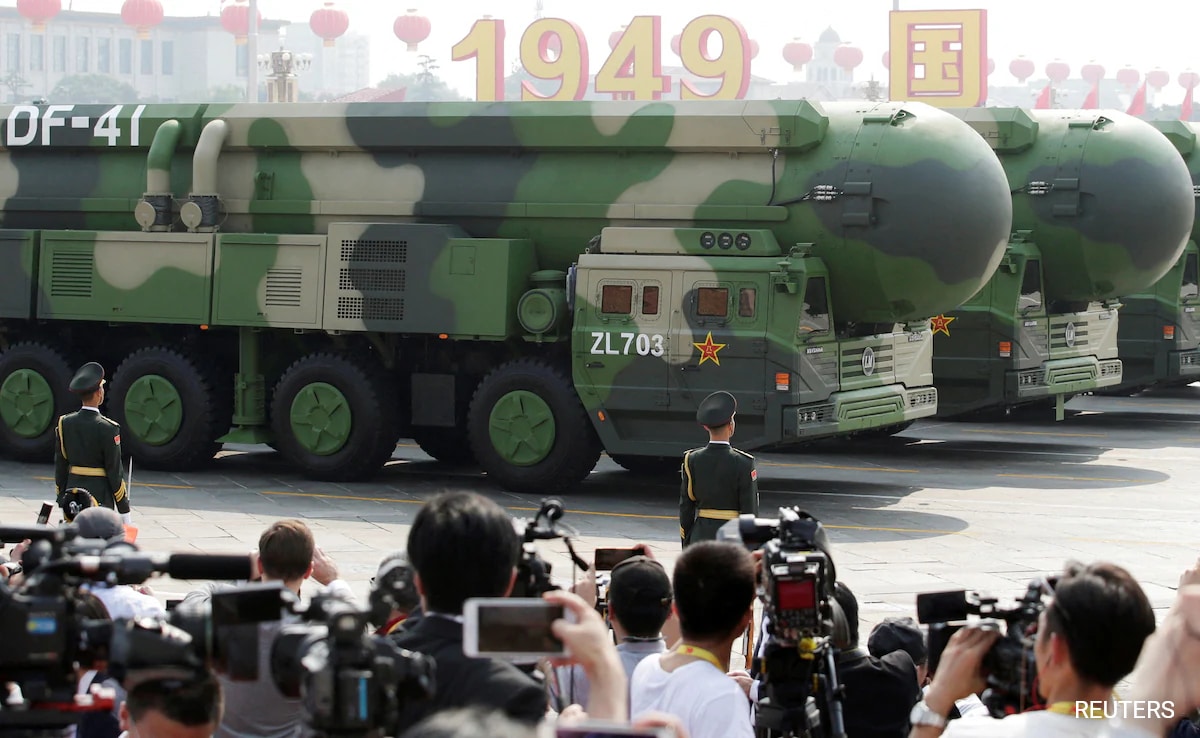
What kind of missile was it? Most analysts agree it was a DF-31AG, a type that publicly debuted in a parade in Beijing on 1 October 2019. The DF-31AG is externally very similar to the earlier DF-31A, suggesting the two ICBMs are not substantially different.
However, the latter uses a truck-and-trailer launcher unit, whereas the DF-31AG is more mobile on an eight-axle truck chassis. Eveleth published a PLARF order of battle in July 2023, where he described the DF-31AG thus: “It is unclear at this point what precisely the difference between the DF-31A and the DF-31AG is, besides the change in transporter and support equipment. PLA military newspapers mention that the AG has upgraded cabling, reducing the number of necessary cables and allowing for faster data transmission times. But what changes, if any, have been made to the missile itself, are still unknown.”
The American researcher added, “The big, big thing they’d want to modernize is the guidance system, which still relies on an antiquated alignment system the US got rid of in the 1990s. As Chinese state media still talk about cable vans and alignment, the AG’s guidance system has likely not been modernized. It’s possible China is working on a new model that updates the guidance system that removes these problems.”
The PLARF’s 624 Missile Brigade is stationed in Hainan, but that unit possesses DF- 21D anti-ship ballistic missiles. In fact, the nearest DF-31AG unit to Hainan is 632 Brigade stationed in Shaoyang (27.2532°N, 111.3859°E). This is approximately 800km away from the Hainan launch site.
Eveleth, in his PLARF order of battle from 2023, estimated China had anywhere from 48-56 DF-31AG TELs. He listed the 621 Brigade in Yibin, the aforementioned 632 Brigade, 642 Brigade in Datong, 643 Brigade in Tianshui and the 664 Brigade in Xiangyang as units operating the DF-31AG.
In a report published by the Bulletin of the Atomic Scientists earlier this year, it estimated China had 64 DF-31AGs. The same document calculated that China currently fields a total of 438 nuclear warheads, plus another 62 warheads that have been produced but not operationalized. This assessment corresponds almost identically to the 500 warheads estimated by the Pentagon’s 2023 report on China’s military capabilities.
The Pentagon predicts the PLARF’s nuclear warhead stockpile will reach 1,000 by 2030. Eveleth also predicted in his report that, by 2028, China will own more than 1,000 ballistic missile launchers. Of these, 507 will be nuclear-capable, 342-432 will be conventional missile launchers, and at least 252 dual-capable launchers.
However, Eveleth offered this opinion: “The most concerning change to China’s nuclear forces is not actually the numerical expansion in launchers, but their apparent shift from a retaliation plan that imagined firing a salvo of nuclear missiles after an adversary had already completed an attack against the Chinese homeland to a posture of launch on warning (LOW). Under launch on warning, an incoming nuclear attack is detected in flight with satellites and ground-based radar, allowing a state to retaliate before the incoming missiles have struck their targets.
“China’s developing LOW capability, combined with solid-fueled missile silos, means that they can quickly launch a nuclear attack at a moment’s notice. A LOW posture presents new challenges in ensuring conventional conflicts stay conventional.”
Senior Colonel Zhang Xiaogang, a Chinese MND spokesperson, said at a 26 September press conference, “China’s nuclear policy is very stable, consistent and predictable. We strictly follow a nuclear policy of ‘no first use’ of nuclear weapons, and pursue a nuclear strategy of self-defence.”
Zhang added, “We’ve promised not to use or threaten to use nuclear weapons against no-nuclear-weapon states or nuclear-weapon-free zones. China will continue to keep its nuclear capabilities at the minimum level required for national security.”
Zhang further noted that “At present, there’s a more stable momentum in the overall defence relationship between China and the US. The two militaries maintain high-level strategic communication, policy communication, institutionalised dialogues and exchanges in specialized fields. These engagements could help enhance mutual understanding, avoid miscalculation and manage and control risks.”
China may well be hoping to solidify its international status as a global power boasting a world-class military. The USA routinely conducts long-range tests of ICBMs and submarine-launched ballistic missiles, so China is demonstrating that it can do so too.
Indeed, Beijing now seems unapologetic about conducting military activities that mirror American ones. Therefore, perhaps a pertinent question to ask is whether this latest test has set a precedent for beyond-border flight tests and whether China will continue to do the same in the future. In 2019-20, China launched multiple DF-21D and DF-26 missiles into the South China Sea. That episode might have been a portent for an ongoing practice of splashing missiles down in extraterritorial waters.
Another purpose for this test across the Pacific may relate to reassuring the Chinese people and demonstrating to the world of the credibility of the PLARF. The aforementioned Bulletin of the Atomic Scientists report noted, “The readiness of the Chinese nuclear missile force was challenged in early 2024 with the disclosure that a US intelligence assessment had found that corruption within the People’s Liberation Army had led to an erosion of confidence in its overall capabilities, particularly when it comes to the Rocket Force.”
Remember too that the PLARF was embroiled heavily in a corruption scandal that saw the force’s top two leaders removed and prosecuted. The Bulletin of the Atomic Scientists report pointed out that “recent dismissals of top defence officials and widespread corruption might chill the Chinese leadership’s willingness to arm missiles with warheads in peacetime.”
The PLARF is a strategic force, but Chairman Xi Jinping has been ruing the lack of loyalty amongst its top leadership, and he was angered by the corruption that appears rife in the organisation. By demonstrating the ability to relocate a sophisticated ICBM and its launch apparatus from the mainland by sea, and by firing a missile thousands of kilometres at a distance sufficient to reach the USA, the PLARF has sharply demonstrated to Xi that this force is politically reliable and that it is combat ready.
(Except for the headline, this story has not been edited by NDTV staff and is published from a syndicated feed.)