



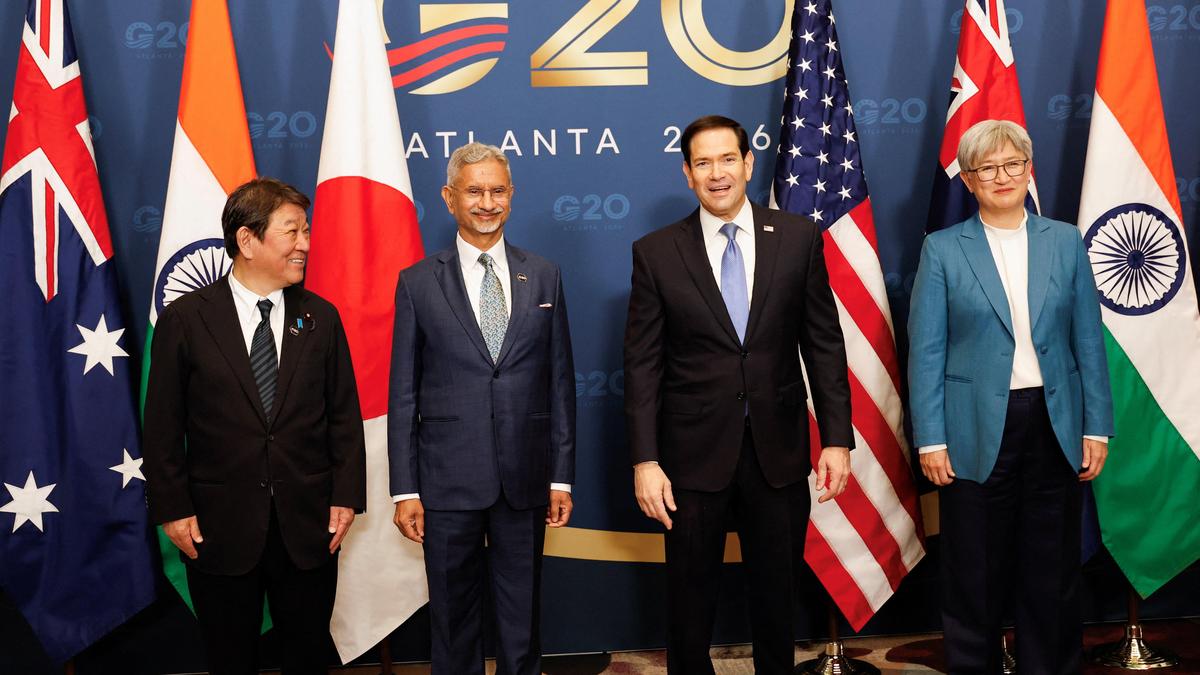
Japan’s Foreign Minister Toshimitsu Motegi, India’s External Affairs Minister S. Jaishankar, U.S. Secretary of State Marco Rubio and Australia’s Foreign Minister Penny Wong pose for photographs at the Quad Foreign Ministers’ Meeting on the sidelines of the G20 foreign ministers’ meeting in Atlanta, Georgia, U.S., on October 31, 2026.
| Photo Credit: Reuters
Foreign Ministers from the United States, India, Japan and Australia on Saturday (October 31, 2026) jointly raised serious concerns about “economic coercion” like export curbs and practices leading to overproduction, in veiled criticism of China.
“The four ministers expressed grave concerns regarding economic coercion, including through arbitrary export restrictions,” said a statement from the Quad alliance in Atlanta, Georgia.
The group, seen as a counterweight to China in the Asia-Pacific region, also took aim at “non-market policies and practices that result in overcapacity,” which they said disrupt global supply chains in critical industries.
While their statement did not name countries, these are criticisms often targeting China, which has faced accusations of over-relying on exports to boost growth.

It is also likely a reference to Beijing’s stringent export controls on rare earths.
The ministers’ gathering early on Saturday (October 31) took place on the sidelines of a G20 meeting hosted by U.S. Secretary of State Marco Rubio.
China, which views the Quad grouping with suspicion, has pushed back against accusations of overcapacity.
The grouping also recognised the “importance of critical sea lanes, the uninterrupted flow of commerce, energy security, and the unhindered passage and safety of maritime crews and vessels without the imposition of tolls.”
It called for “the absolute necessity to protect and preserve navigational rights and freedoms in the Strait of Hormuz, the Red Sea, and the Bab el-Mandeb Strait.”
Published – October 31, 2026 10:05 pm IST