




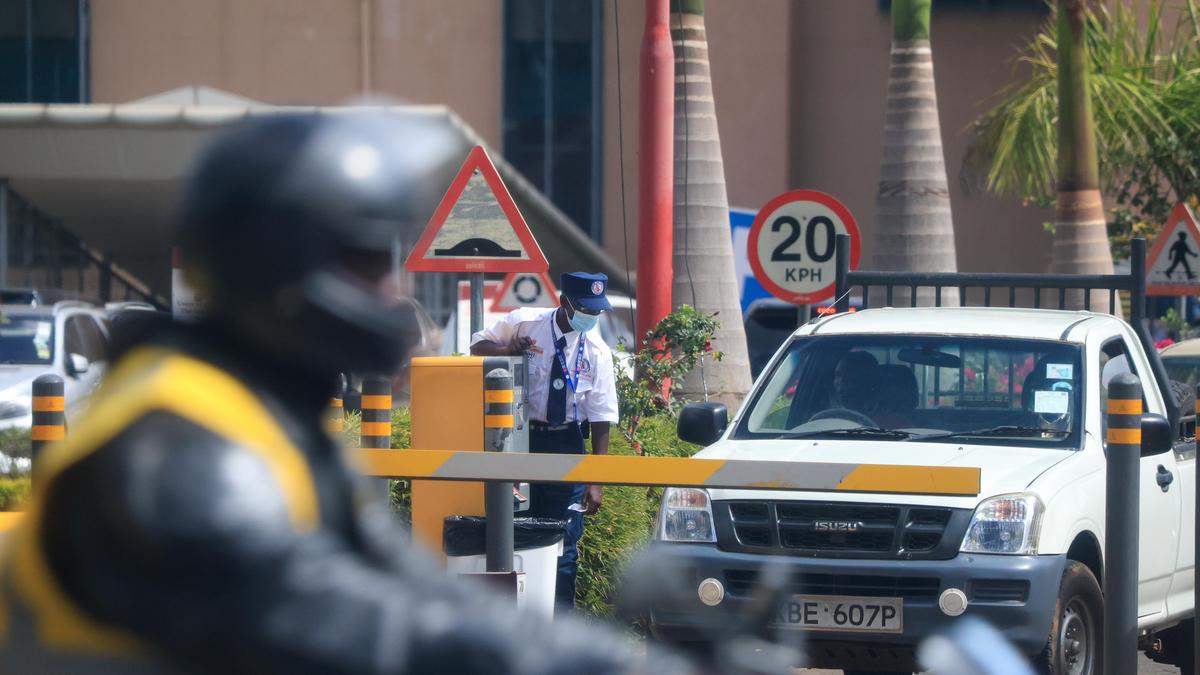
People put on masks at the entrance of The Nairobi Hospital where Kenya’s first Ebola virus patient was treated and died.
| Photo Credit: AP
On Tuesday (October 6, 2026), Kenya confirmed its first Ebola case after a Kenyan national who had returned from the Democratic Republic of the Congo (DRC) died in Nairobi. According to media reports that quoted Kenya’s Health Minister Aden Duale, he had lived in the DRC for years and had travelled back home by road before taking a flight to Nairobi.
After the DRC declared an Ebola outbreak in May, Uganda also reported cases and deaths from Ebola. However, after Uganda was declared free of the disease by the World Health Organisation (WHO), the cases have occurred only in the DRC. This is the first case in which an Ebola death has occurred in another country, raising significant concern regarding transmissibility for public health authorities.

What are the details of the case
According to Mr. Duale, the Kenyan national had been living in the DRC for several years and had fallen ill about a month ago. He had been treated in several hospitals in the DRC and died days after arriving in the capital, Nairobi.
He had travelled by road from DRC to Uganda and then boarded a flight to Nairobi, undergoing public screening with other passengers at the airport, but missed being picked up. He went home and was taken to hospital by a relative when he became sicker. He tested positive for the dangerous Bundibugyo strain, which has neither specialised treatment nor a vaccine until now. (Human trials for a vaccine were started in July, and three other candidates are in the pipeline.)
Eight of the patient’s family members and 21 healthcare workers have been quarantined. Screening at all airports. Another 23 passengers and four crew members who travelled on the flight he took from Uganda are also being traced. The traced individuals will remain in isolation for 21 days and will be allowed to leave if they do not show any symptoms.

Why is this fresh cause for concern?
The virus is highly infectious and spreads through contact with infected bodily fluids. This is the 17th outbreak in the DRC and is said to be its deadliest, having claimed over 4,000 lives since May this year. Over 8,300 cases have been confirmed across the country.
Meanwhile, the WHO has warned that the epidemic will surpass the regional 2014-2016 outbreak, which killed over 11,000 people, primarily in Guinea, Liberia and Sierra Leone.
Despite an outbreak in the region, the global health body has not been in favour of imposing travel and trade restrictions on the affected regions. However, not all international travellers are required to fill out a self-declaration form specifying whether they have been in any of the Ebola-affected countries or if they have suffered any symptoms lately.

In Kenya, health authorities explained that the patient who died had managed to pass through the screening without raising any red flags because the medicines he was on probably masked the symptoms as he walked past.
The course ahead
Now that the virus has entered Kenya, the key task for health authorities in the country is firstly to stop the chain of transmission, beginning with the primary contacts already isolated. As per the outbreak protocol, this includes rapid contact tracing, immediate isolation of anyone who develops symptoms, and testing. Strict infection-control measures must be put in place in Kenya, and targeted information on prevention and control disseminated among communities.
Screening and surveillance have been intensified at airports in Kenya. However, at a time when it is impossible to stop global movement, it’s crucial to make sure that all nations maintain vigilance at their entry ports and pick up patients with detectable symptoms. Port authorities should also stress on the seriousness of honestly declaring travel history and symptoms.
Published – October 07, 2026 10:58 am IST