




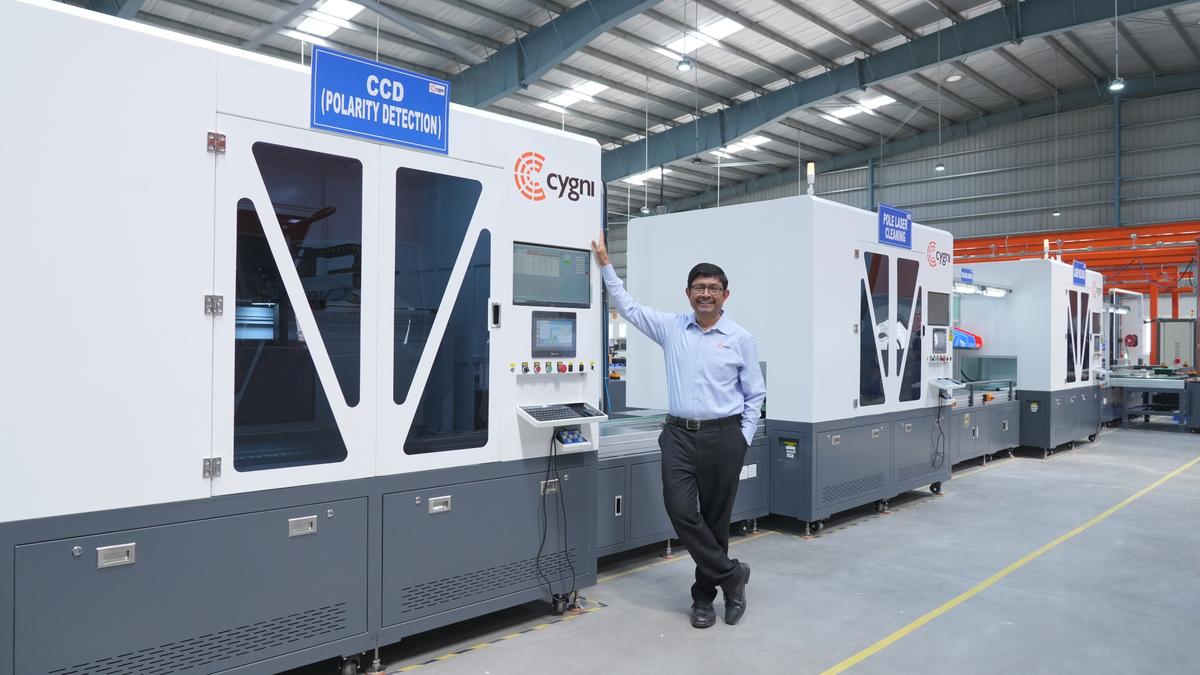
Cygni Energy founder and CEO Venkat Rajaraman
| Photo Credit: Arrangement
Energy-storage technology and manufacturing company Cygni Energy and telecom tower firm Indus Towers have decided to explore collaboration on sourcing energy storage solutions for telecom infrastructure in the country.
The collaboration will include plans to establish Battery Energy Storage System (BESS) manufacturing capacity of up to 1.5 GWh to address the evolving energy requirements of telecom infrastructure, Cygni Energy said on Monday following the signing of an MoU with Indus.
The companies are also expected to evaluate advanced battery technologies for telecom applications, aimed at enhancing reliability, improving energy efficiency and enabling more sustainable telecom operations, the IIT Madras-incubated startup said.
“For us, it is about building scale, technology capabilities and manufacturing readiness required to support the evolving energy needs of one of the world’s largest passive telecom infrastructure companies. We plan to develop capacity of up to 2 GWh, while building a portfolio that can evolve from today’s 100Ah solutions to higher-capacity 314Ah systems and emerging battery technologies,” founder and CEO Venkat Rajaraman said.
Chairman of ITEL Foundation and Institute Professor, IIT Madras Ashok Jhunjhunwala said “collaboration between users, startups, manufacturers and technology institutions can support development and adoption of energy storage solutions in India. Telecom provides an important application for advancing battery technologies and manufacturing capabilities in this space.”
Cygni opened a 4.8 GWh Battery Energy Storage System (BESS) Gigafactory at E-Mobility Valley in the Electronics Manufacturing Cluster, Maheshwaram near Hyderabad in April 2025.
Responding to queries, Mr. Rajaraman said the additional 1.5 GWh of capacity, being considered as part of the collaboration with Indus, is over and above the 4.8 GWh announced at inauguration. “We are currently expanding the Hyderabad facility to meet the Indus Towers requirement. The original 4.8 GWh capacity is intended to serve the utility-scale BESS segment,” he said.
On how much the Hyderabad gigafactory is currently producing, he said “production varies month to month in line with customer demand and delivery schedules. Average capacity utilisation is approximately 50%, excluding the Indus Towers requirement, with production approaching full capacity in some months.”
Published – October 05, 2026 08:14 pm IST