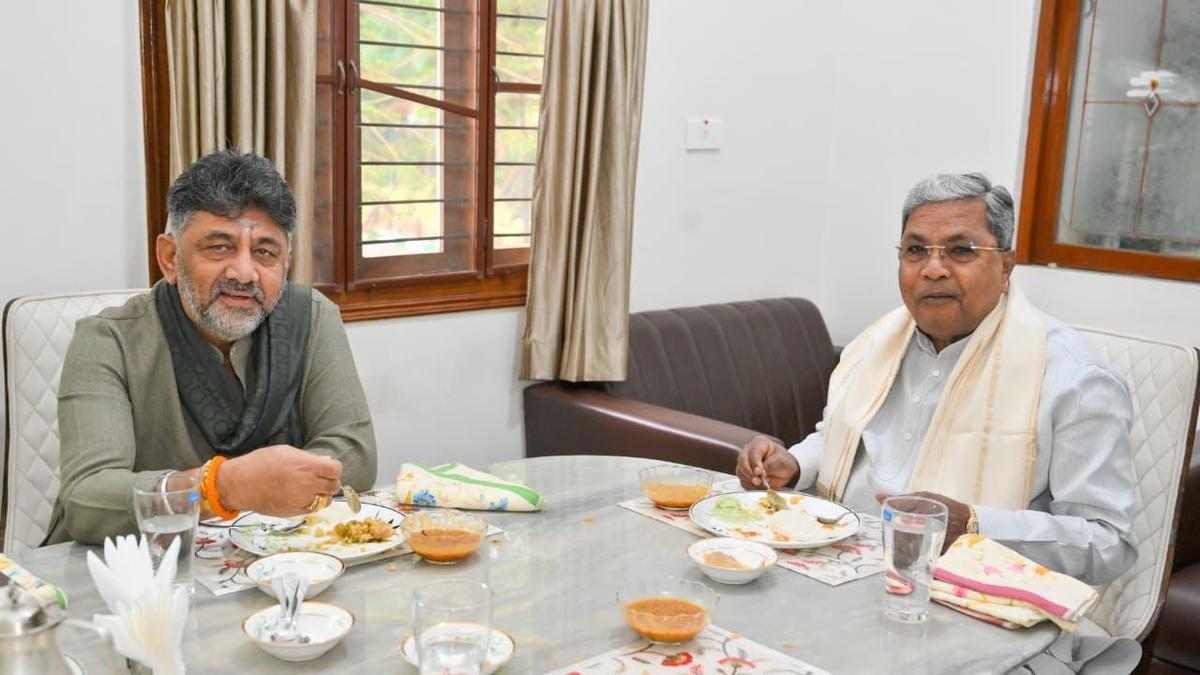


On Teachers’ Day, Karnataka Chief Minister D.K. Shivakumar announced on X that teachers in the State can now use the prefix “Tr.” before their names – a mark of distinction, “to honour their invaluable contribution”.
(Sign up for THEdge, The Hindu’s weekly education newsletter.)
But not everyone sees it that way. Krishnaveni, a teacher with 46 years of experience who now runs a small private school in rural Mandya, Karnataka, calls the move ‘superficial’. She believes addressing the actual problems faced by teachers matters far more than a title.
Join THEdge LinkedIn group
To understand what Dr. Krishnaveni means, it helps to look at the scale of the workforce she represents. As per UDISE+ 2025-26 data, India has 3,41,689 private unaided recognised schools, employing over 41 lakh teachers. Unlike teachers in the government-run schools, whose service conditions are governed by uniform, codified State service rules, private schoolteachers have no such uniformity – their rights depend entirely on which State they work in, what kind of school they work for, whether it is aided or unaided.
Yemuna Sunny, a writer, researcher, and teacher, traces the current crisis back to India’s economic liberalisation. Before that shift, she says, private schools were largely homogeneous. That uniformity has since collapsed into deep stratification, with vast variation today in fees, facilities, and pay.
Stark differences in salary
The stratification plays out starkly in what teachers actually earn. Ms. Sunny says salaries in mid-tier private schools often range between ₹8,000 and ₹15,000 a month, rarely crossing ₹25,000. The oversupply of willing candidates makes teachers easily replaceable. “Teachers are traditionally accorded deep respect, and labour rights are meant to protect them – yet in practice, they gain little of either,” she says, calling it a paradox.
Ram, a 32-year-old Tamil teacher in Tambaram who teaches Classes 11 and 12, says he is paid better than most private schoolteachers in the State – though still not enough – and regularly puts in hours well beyond the school day. Recently, he pushed back against school policies he felt were placing excessive academic pressure on his students, standing by them as they raised their concerns with the management. The school did not take it well. He says he has since faced pressure from the management to resign. “They can terminate me if they want,” he says. “I won’t resign.” His only obligation, he says, is to his students.
Mr. Ram’s situation points to a divide that goes deeper than State borders. In several States with seemingly robust legal frameworks, protection depends on whether a school is aided or not – a distinction many teachers are unaware of. The result is a fragmented system in which a teacher’s rights can depend as much on the kind of school she works in as on the State she lives in. Tamil Nadu is a case in point.
Tamil Nadu’s current law looks robust on paper – but that protection covers only a portion of its private schools. The Tamil Nadu Private Schools (Regulation) Act, 2018, and its accompanying Rules of 2023 have detailed protections against arbitrary dismissal, along with disciplinary procedures, suspension safeguards, and resignation terms, but exclusively for aided private schools. For the State’s much larger number of self-financing, unaided schools – like the one Mr. Ram teaches in – no equivalent protection exists. When his school moved to push him out, he found himself outside the reach of the framework that could have protected another teacher in his position.
Moses Prabhu has spent more than fifteen years teaching mathematics in Tamil Nadu’s private schools. Annual increments rarely crossed ₹300 to ₹500, he says. By the time he resigned in 2023, his salary had climbed to ₹16,000. He moved to a second school after that, where his salary rose to around ₹30,000 a month. But he says the management there resisted basic compliance, such as provident fund contributions, and preferred hiring inexperienced teachers over retaining senior ones, “because experienced teachers ask for basic needs.” When he raised questions, he said he faced scrutiny and pressure, which he believes pushed him to resign. He now supports himself through private tuitions.
Appointment orders, he says, are often not issued to teachers when they join – he himself never received one. He alleged that if a teacher needs to leave mid-year for an emergency or personal reason, schools sometimes withhold their original certificates, releasing them only after the teacher pays the equivalent of three months’ salary.
In Tamil Nadu, a large number of private schoolteachers are hired on a temporary basis. Form VI-B is the State-prescribed contract agreement schools must use for temporary staff under Rule 28(7) of the Tamil Nadu Private Schools (Regulation) Rules, 2023. It states that “the school committee shall have the right to discharge the said employee either at the end of the period for which he has been engaged or even prior to the end of that period without assigning any reason.” Hence, a large number of teachers have no protection against arbitrary dismissal.
Tamil Nadu’s Rules do provide a more detailed process for aided-school staff – covering appointment, probation, seniority, pay, leave, disciplinary inquiry, and resignation – under Rules 27 to 31 of the 2023 Rules.
P. B. Prince Gajendrababu, a Tamil Nadu-based education activist and General Secretary of the State Platform for Common School System- Tamil Nadu (SPCSS-TN), sees Mr. Prabhu’s trajectory as symptomatic of something structural, not incidental. He draws a distinction between a minimum wage and a living wage – one the government fixes as a floor, he argues, and the other what a teacher actually needs to live with dignity and grow professionally. “How can a teacher bring out his or her full potential,” he asks, “on a minimum wage?”
Gaps in Karnataka’s framework
Karnataka presents a more complicated picture. Unlike Tamil Nadu, Karnataka has a broader statutory framework that extends to important service protections to employees of private unaided institutions.
Divya Balagopal, an advocate with Mundkur Law Partners, points out that Karnataka’s framework isn’t new – protections against arbitrary dismissal and a provision for an education tribunal have existed on paper for roughly fifty years. But their staying power, she says, has been limited by design. The tribunal isn’t a standalone body, but functions as part of the district court system, rather than a dedicated forum built for education disputes.
She confirms that a more specific gap exists within this framework – the 2005 Rules governing service conditions in unaided schools exempt CBSE- and ICSE-affiliated institutions. But she points to a set of 2023 rulings, which held that this exclusion does not bar CBSE and ICSE schoolteachers from approaching the tribunal.
20 years experience; ₹17,000 salary
Kerala presents yet another gap. Lily is a well-qualified social science teacher from Kollam district and has been working in a private school for 20 years. She earns ₹17,000 a month at a private unaided school; this year’s increment was ₹500. Beyond her regular teaching hours, she takes extra classes, but she is not paid for it. “I just go by belief in karma,” she says, of what keeps her going.
“The school’s finances are thin. The management’s own family members, several of whom are teachers at the same school, draw considerably higher salaries and increments than me,” she said.
After two decades, she believes she has lasted this long only because the management has been satisfied with her work; she has no illusion that the job comes with any security beyond that. Her advice to anyone considering the profession is blunt: don’t go into private school teaching. “I teach my students about democracy, about political equality,” she said. “And I am the one living without it.
Ms. Lily’s situation is not a matter of one school’s finances. It reflects a specific gap in the law. The Kerala Labour Commissionerate, acting under the Minimum Wages Act, 1948, has issued a minimum wage notification. Private educational institutions appear on this list too, but only in one category: non-teaching staff, such as administrators, accountants, and librarians.
A 2021 notification fixed their minimum pay at roughly ₹11,000 to ₹21,000 a month, depending on the role. No equivalent notification exists for teaching staff. The State that mandates a minimum wage for the person managing a private school’s accounts has never done the same for the person standing in front of its classrooms.
The same divide runs through Kerala’s oldest protections for teachers. The Kerala Education Act, 1958, and the Kerala Education Rules that followed it, do guarantee some job security – but almost entirely for teachers in aided schools, where the government pays part of the salary bill. Ms. Lily’s school receives no government aid. For teachers like her, in Kerala’s unaided private schools, neither the Act’s job-security provisions nor the State’s minimum wage machinery extend any real protection. The law built to shield Kerala’s teachers was written with a different, shrinking category of school in mind.
The details differ, yet the pattern is strikingly similar across Tamil Nadu, Karnataka and Kerala. The protections are uneven, often tied to the type of school, and difficult to enforce – leaving thousands of private schoolteachers with far less security than the profession’s public standing would suggest.
Dr. Krishnaveni’s own verdict on the “Tr.” announcement may be the simplest summary of everything this investigation found: it is easy to offer a teacher a title. It is harder, and far more consequential, to offer her a livelihood.
*Names of the teachers have been changed for privacy
(The Union Ministry of Labour did not respond to a detailed questionnaire sent by The Hindu. The story will be updated once the response is received)