Skip to content
  • Facebook
  • X
  • Linkedin
  • WhatsApp
  • YouTube
  • Associate Journalism
  • About Us
  • Privacy Policy
  • 033-46046046
  • editor@artifex.news
Artifex.News

Artifex.News

Stay Connected. Stay Informed.

  • Breaking News
  • World
  • Nation
  • Sports
  • Business
  • Science
  • Entertainment
  • Lifestyle
  • Toggle search form
  • AAP Sanjay Singh Being Questioned In Delhi Liquor Policy Case, Agency Claims He Received Rs 2 Crore
    AAP Sanjay Singh Being Questioned In Delhi Liquor Policy Case, Agency Claims He Received Rs 2 Crore Nation
  • Access Denied
    Access Denied Nation
  • Access Denied World
  • Akhilesh Yadav Files Nomination Papers From Kannauj Lok Sabha Constituency
    Akhilesh Yadav Files Nomination Papers From Kannauj Lok Sabha Constituency Nation
  • Congress Leader Kantilal Bhuria Sparks Row
    Congress Leader Kantilal Bhuria Sparks Row Nation
  • Indian Trap Shooter Prithviraj Tondaiman Crashes Out Of Olympics Medal Race, Finishes 21st
    Indian Trap Shooter Prithviraj Tondaiman Crashes Out Of Olympics Medal Race, Finishes 21st Sports
  • Labour reforms: Government fully operationalises four new codes by publishing rules
    Labour reforms: Government fully operationalises four new codes by publishing rules Business
  • Ireland To Host Pakistan For Three-Match T20I Series In May
    Ireland To Host Pakistan For Three-Match T20I Series In May Sports
The View From India newsletter: brics a strategic balancer 

The View From India newsletter: brics a strategic balancer 

Posted on September 15, 2026 By admin


(This article is part of the View From India newsletter curated by The Hindu’s foreign affairs experts. To get the newsletter in your inbox every Monday, subscribe here.)

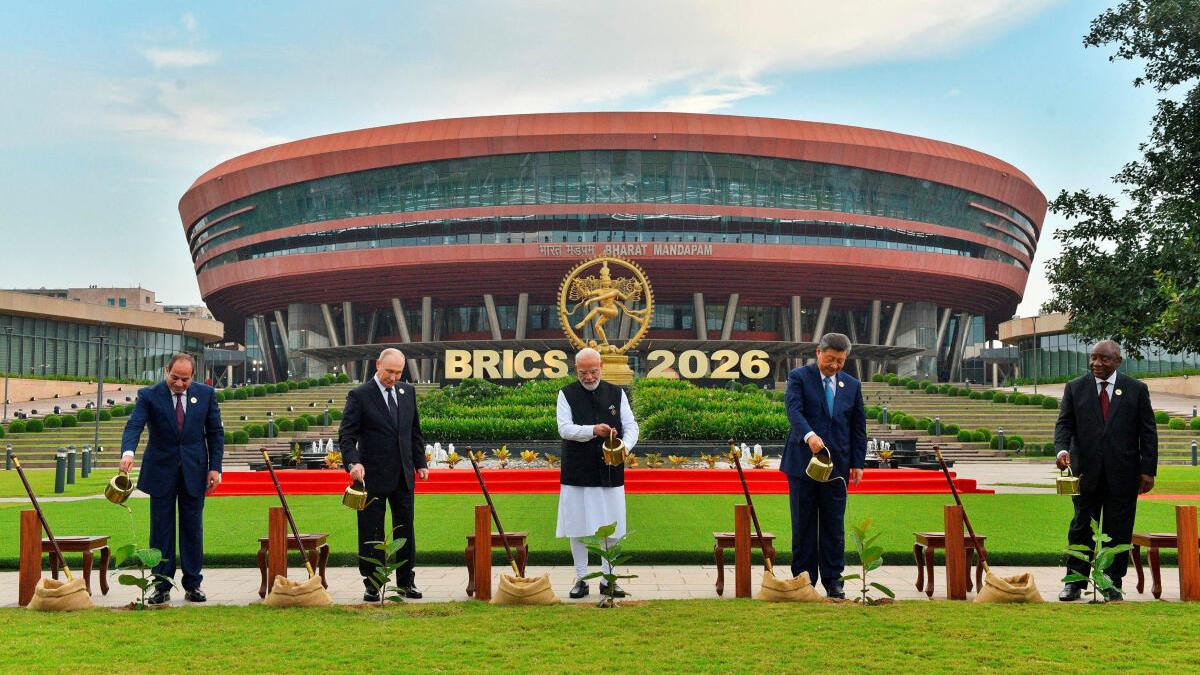
India is a close strategic partner of the U.S. and Israel. But it also positions itself as a key voice of the Global South and maintains close strategic and economic relationships with Russia and China, respectively. This balancing act was on display on September 12-13 when India hosted the 18th BRICS summit in Delhi. Any summit that brings together the leaders of India, Russia and China assumes strategic significance. This time it was even more consequential because it took place amid an ongoing and widening conflict in West Asia, India’s extended neighbourhood.

Prime Minister Narendra Modi was in Israel in February, just days before Israel and the U.S. launched their war on Iran. More than six months into the war, Mr. Modi was seen walking hand in hand with Iran’s President Masoud Pezeshkian in Delhi. India doesn’t see a contradiction in these positions. Rather, they are part of New Delhi’s multi-engagement approach, rooted in both India’s continued rise and in the emergence of a more balanced international order. Groupings such as BRICS play a critical role in shaping the latter.

We atThe Hinduhave been covering the summit rigorously from Delhi. To get a ringside view of the meet and its key takeaway, I turned to Suhasini Haidar, our diplomatic affairs editor. She says there is a growing consensus among BRICS members that the current international order is unfair and unjust and needs to change. Read what she has to say:

What is your main takeaway from the BRICS summit? 

The main takeaway from the BRICS summit is that it’s always possible for diplomacy and as consensus-building to override bilateral narratives and conflicts. This was perhaps the most difficult BRICS summit in recent years at which to forge consensus. That was largely because of the U.S.-Israel war on Iran, which began on February 28. India as the host is in a particular position where it is close to the U.S. and very close to Israel but it also wanted to forge a consensus while maintaining its ties with other BRICS members, particularly Iran. That’s how a consensus was eventually built, through a compromise of positions by all the parties. 

Another big takeaway is that apart from the Big 2 –Russia and China – these are emerging economies that are primarily seeking economic development for their respective countries. Some of the BRICS consensus has been forged around that idea: food, fuel and fertilizer security and trade. These are the areas in which these countries want to work together. 

How did the Delhi Declaration address the conflicts in West Asia? 

Suhasini Haidar: The Delhi Declaration addressed the conflicts in West Asia in great detail, with very strong criticism of Israel, for example, over its actions in Lebanon and Palestine, particularly in Gaza. However, the U.S.-Israel strikes on Iran, the assassination of Ayatollah Khamenei, and Iran’s strikes on its neighbours, particularly the UAE [another BRICS member], found no mention. There was a pointed reference to attacks on civilian infrastructure as well as nuclear installations. 

It is also very clear that the basic difference that held up consensus was between the UAE and Iran. Iran wanted a strong condemnation of the U.S. and Israeli attacks on it, but the UAE wanted an equal condemnation of Iran’s attacks on its neighbours. Iran, of course, has consistently said it cannot agree to this because, as a member state, it cannot be seen criticising itself, and, secondly, it considers these attacks were in self defence. This basic contradiction between the two was resolved through a compromise: both sides were told that brother would get its way. There was a third compromise, and that concerned India’s position on Israel – there are very strong paragraphs criticising Israel, including a reference to South Africa’s case against Israel at the ICJ.

Sceptics argue that BRICS is a China-dominated grouping and that it is internally divided. Were internal divisions apparent in Delhi or would you say the grouping is coming of age as Mr. Modi said?

Unlike G7, where there is a very uniform view of the world, BRICS doesn’t have a uniform vision of how the world should look. But it does have a shared view that the world at present is imbalanced, unfair and unjust. That’s what holds these countries together. The idea that BRICS would not have internal divisions, like the G7, is unfair because BRICS emerged from countries that are not part of the G7, they are not part of the Western consensus. The idea of China dominating BRICS grouping would be true in terms of economics because China is by far the biggest economy among the members. But I don’t think this is just about the size of economies. It is also about countering western sanctions and tariffs, and there is a consensus on this front. 

Where BRICS is divided is on bilateral issues. India and China are the biggest examples, but BRICS provides a platform for the two countries to meet. Remember, Xi Jinping and Prime Minister Modi have not met on bilateral visits to each other’s countries since the [2020] Galwan clashes, but they do meet on the sidelines of summits such as BRICS and SCO. Egypt and Ethiopia have water disputes; Iran and the UAE have a major conflict between them; and there are other differences within the grouping over energy providers and energy consumers. These divisions have only grown since BRICS doubled in size. But the larger thread that holds these countries together is the idea that they feel the present world order needs to change.

West Asia watch

Last week also saw the dramatic Houthi advances in Yemen. The Shia rebels, who ended their four-year ceasefire and started attacking Saudi Arabia and Yemen’s Saudi-backed government in July after a Saudi attack on a Houthi held airport in Sana’a, captured Yemen’s entire Red Sea coast and a strategically important island in the Bab el-Mandeb Strait, which connects the Red Sea with the Gulf of Aden. This is a significant development as it could strengthen the position of Iran in its ongoing war with the U.S. To understand the Houthi advances and its possible impact on the war in West Asia, read this piece: The new lords of the Red Sea
Is BRICS a pillar of multipolarity? 

Published – September 14, 2026 02:15 pm IST


Source link

World Tags:BRICS 2026, Narendra Modi, U.S.-Israel war

Post navigation

Previous Post: U.S. has weapons deployed in orbit, Space Force says
Next Post: U.S. military says Iran war has led to munitions shortfall

Related Posts

  • ‘Now or never’ for pandemic accord, says WHO chief after U.S. pulls out
    ‘Now or never’ for pandemic accord, says WHO chief after U.S. pulls out World
  • Access Denied World
  • Iran turns bombed Karaj Bridge into a symbol of resistance
    Iran turns bombed Karaj Bridge into a symbol of resistance World
  • At least 40 dead in Sudan’s worst cholera outbreak in years: Doctors Without Borders
    At least 40 dead in Sudan’s worst cholera outbreak in years: Doctors Without Borders World
  • Hamas’ Armed Wing Releases New Video Of Gaza Hostage
    Hamas’ Armed Wing Releases New Video Of Gaza Hostage World
  • Who Is Rumy Alqahtani, Saudi Arabia First Miss Universe Contestant
    Who Is Rumy Alqahtani, Saudi Arabia First Miss Universe Contestant World

More Related Articles

North Korea’s Kim threatens to destroy South Korea with nuclear strikes if provoked North Korea’s Kim threatens to destroy South Korea with nuclear strikes if provoked World
U.K. to make refugee status temporary, settlement harder U.K. to make refugee status temporary, settlement harder World
Access Denied World
Iran will treat any attack as ‘all-out war against us,’ says senior official Iran will treat any attack as ‘all-out war against us,’ says senior official World
Trump’s high tariff pledge will provide huge export opportunities for India: NITI Aayog’s Subrahmanyam Trump’s high tariff pledge will provide huge export opportunities for India: NITI Aayog’s Subrahmanyam World
China accuses critics of ethnic unity law of ‘spreading falsehoods’ China accuses critics of ethnic unity law of ‘spreading falsehoods’ World
SiteLock

Archives

  • October 2026
  • September 2026
  • August 2026
  • July 2026
  • June 2026
  • May 2026
  • April 2026
  • March 2026
  • February 2026
  • January 2026
  • December 2025
  • November 2025
  • October 2025
  • September 2025
  • August 2025
  • July 2025
  • June 2025
  • May 2025
  • April 2025
  • March 2025
  • February 2025
  • January 2025
  • December 2024
  • November 2024
  • October 2024
  • September 2024
  • August 2024
  • July 2024
  • June 2024
  • May 2024
  • April 2024
  • March 2024
  • February 2024
  • January 2024
  • December 2023
  • November 2023
  • October 2023
  • September 2023
  • August 2023
  • July 2023
  • June 2023
  • May 2023
  • April 2023
  • March 2023
  • February 2023
  • January 2023
  • December 2022
  • November 2022
  • October 2022
  • September 2022
  • August 2022
  • July 2022
  • June 2022
  • May 2022

Categories

  • Business
  • Nation
  • Science
  • Sports
  • World

Recent Posts

  • North Korea says it tested cruise missiles designed to be fired from submarines
  • Ankita Bhandari murder: Parents released after detention, issue ultimatum to government
  • Air India Frankfurt-Delhi flight diverted to Jaipur after hijack alert, resumes journey after checks
  • Bengaluru October Food Guide: Bar Find residency, Amar Khamar, and more
  • Don’t stand in the way of protesting students, they are voice of India: Rahul tells PM and HM

Recent Comments

  1. WalterBoumn on UP Teacher Who Asked Students To Slap Muslim Classmate
  2. ShawnFeach on UP Teacher Who Asked Students To Slap Muslim Classmate
  3. RobertTes on UP Teacher Who Asked Students To Slap Muslim Classmate
  4. WilliamNek on UP Teacher Who Asked Students To Slap Muslim Classmate
  5. RobertTes on UP Teacher Who Asked Students To Slap Muslim Classmate
  • Access Denied Sports
  • Why the BRICS summit was a major diplomatic win for India
    Why the BRICS summit was a major diplomatic win for India Nation
  • Russia imports record fuel from India as Ukraine strikes hit refineries
    Russia imports record fuel from India as Ukraine strikes hit refineries Business
  • Over 150 Injured In Massive Cracker Accident During Kerala Temple Festival
    Over 150 Injured In Massive Cracker Accident During Kerala Temple Festival Nation
  • Ways to conquer plastic waste and produce useful materials
    Ways to conquer plastic waste and produce useful materials Science
  • Iran’s currency falls to record low after nationwide protests sparked by economic woes
    Iran’s currency falls to record low after nationwide protests sparked by economic woes World
  • 601 IIMB students secure offers during summer internship placement
    601 IIMB students secure offers during summer internship placement Nation
  • Study shows elephants might call each other by name
    Study shows elephants might call each other by name Science

Editor-in-Chief:
Mohammad Ariff,
MSW, MAJMC, BSW, DTL, CTS, CNM, CCR, CAL, RSL, ASOC.
editor@artifex.news

Associate Editors:
1. Zenellis R. Tuba,
zenelis@artifex.news
2. Haris Daniyel
daniyel@artifex.news

Photograher:
Rohan Das
rohan@artifex.news

Associate Journalists
1. Subrata Paul - AN/2020/01
2. Quamruz Zaman - AN/2021/22
3. Ahmed Sha - AN/2021/035
4. Ajay Kumar Shaw - AN/2021/39
5. Tahqiqul Hoda - AN/2021/21

Artifex.News offers Online Paid Internships to college students from India and Abroad. Interns will get a PRESS CARD and other online offers.
Send your CV (Subjectline: Paid Internship) to internship@artifex.news

Links:
Associate Journalism
About Us
Privacy Policy

News Links:
Breaking News
World
Nation
Sports
Business
Entertainment
Lifestyle

Registered Office:
72/A, Elliot Road, Kolkata - 700016
Tel: 033-22277777, 033-22172217
Email: office@artifex.news

Editorial Office / News Desk:
No. 13, Mezzanine Floor, Esplanade Metro Rail Station,
12 J. L. Nehru Road, Kolkata - 700069.
(Entry from Gate No. 5)
Tel: 033-46011099, 033-46046046
Email: editor@artifex.news

Copyright © 2023 Artifex.News Newsportal designed by Artifex Infotech.