



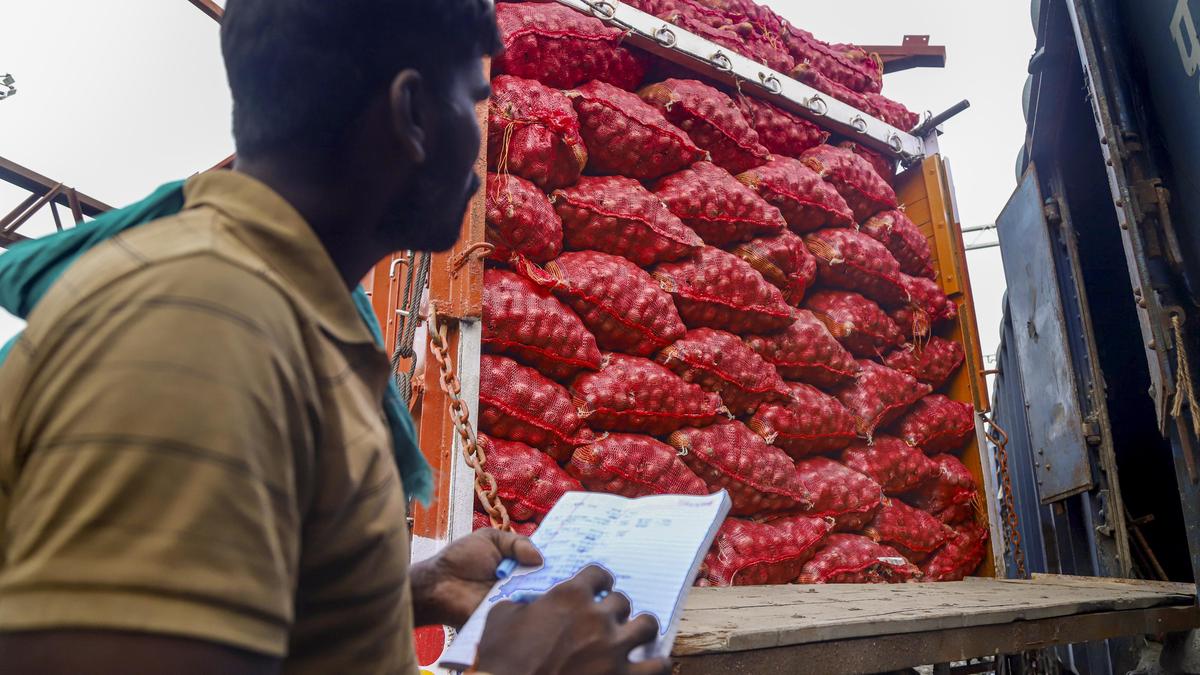
A worker holds a notepad as sacks of onions being unloaded from the “Kanda Express”, a dedicated goods train transporting bulk onion consignments to the capital from Nashik, at Adarsh Nagar railway station, in New Delhi. File
| Photo Credit: PTI
The story so far: Days after a sharp increase was seen in sugar prices, the price of onion, an essential commodity, nearly doubled in the retail prices compared to last year. On September 1, the all-India average price for a kilogram of onions was ₹49.59, registering over 74% increase from ₹28.48 on the same day in 2025.
A month ago, on August 1, the rate of onions was ₹35.47/kg. Meanwhile, in Kolkata and Chennai, the price has now reached ₹60/kg. What has worried the Centre is the fact that over the last two weeks, the price has gone beyond ₹70 in certain retail markets, particularly in the Northern India. This increase is unprecedented, and according to some officials this “sympathetic price rise” along with sugar, has left the Centre searching for reasons behind this surge.

What could be reason for hike in onion prices
The production of onion is estimated at 307.37 lakh metric tonnes (LMT) in 2025-26, which is in line with the previous year’s production of 307.67 LMT. The production is adequate for the domestic consumption and for exporting, which comes to about 15 LMT. However, industry sources claim that the quality of onions, particularly after the delay in rains and the subsequent delay in harvest in Maharashtra (the largest onion producing State), was not up to the standard. The fact that good quality onions are less compared to last year is also considered as a reason for the increase in the price.
Of the total production, the Government has procured about 1.2 LMT through cooperative agencies and estimated that about 28% of the total procurement may not be of the top quality at the time of its release from the buffer stocks.
Historically, according to the Government, onion prices have exhibited seasonal uptick and volatility from August-September onwards owing to increased demand during festive season, weather conditions, supply-chain movements, and other demand conditions during the period.
It is understood that this year, as soon as the price of sugar increased, there was a tendency not to release the onion stocks, particularly among the big traders. Union Agriculture Minister Shivraj Singh Chouhan and Union Secretary of Consumer Affairs Nidhi Khare have outlined hoarding and black marketeering as the reasons for the sudden increase in the prices of onion.
What steps are being taken to ease these prices?
As it is natural for traders and big farmers to look for better prices of what they produce and sell, the Government says that it was expecting such a problem in the case of onions. Since it is a highly perishable crop, big farmers and big traders try to keep the stock in cold storages, expecting that it could be released when the prices are right.
“It happened in the recent days too,” a senior official said adding that the current price hike is completely manipulated. To counter this, the Government has started calibrated release of onion from its buffer stocks so that the prices could be stabilised.
The Government has also started selling onions at a rate of ₹35/kg. “We wanted to give a message to the consumer that the real price of onion is ₹35 and we hope that this will put pressure on those who hoard the commodity,” the official added.
Trains, trucks of onions transported across the country
The Government said in a release on September 1 that two “Kanda [onion] Express” consignments of 450 metric tonnes (MT) have been dispatched from Nashik, Maharashtra to Delhi and of this, 140 MT has been distributed across Varanasi, Lucknow, Chandigarh and Amritsar.
The second rake, carrying 840 MT of onions, reached Chennai on August 31. The State Government of Tamil Nadu had announced that it will distribute these onions through the Public Distribution System against the requirement of one kilogram per card. Around 1,000 MT of onions are being transported by road to major consumption centres.
Meanwhile, farmer organisations have maintained that the increase in retail prices has not helped the onion farmers, who have been forced to sell their produce even at a rate of ₹1/kg.
These organisations have been demanding that the National Agricultural Cooperative Marketing Federation of India Limited (NAFED), and the National Cooperative Consumers’ Federation of India Limited (NCCF) must procure onions from farmers at a better rate, which would ultimately insulate consumers from artificially created price rises.
Published – September 02, 2026 10:35 am IST