





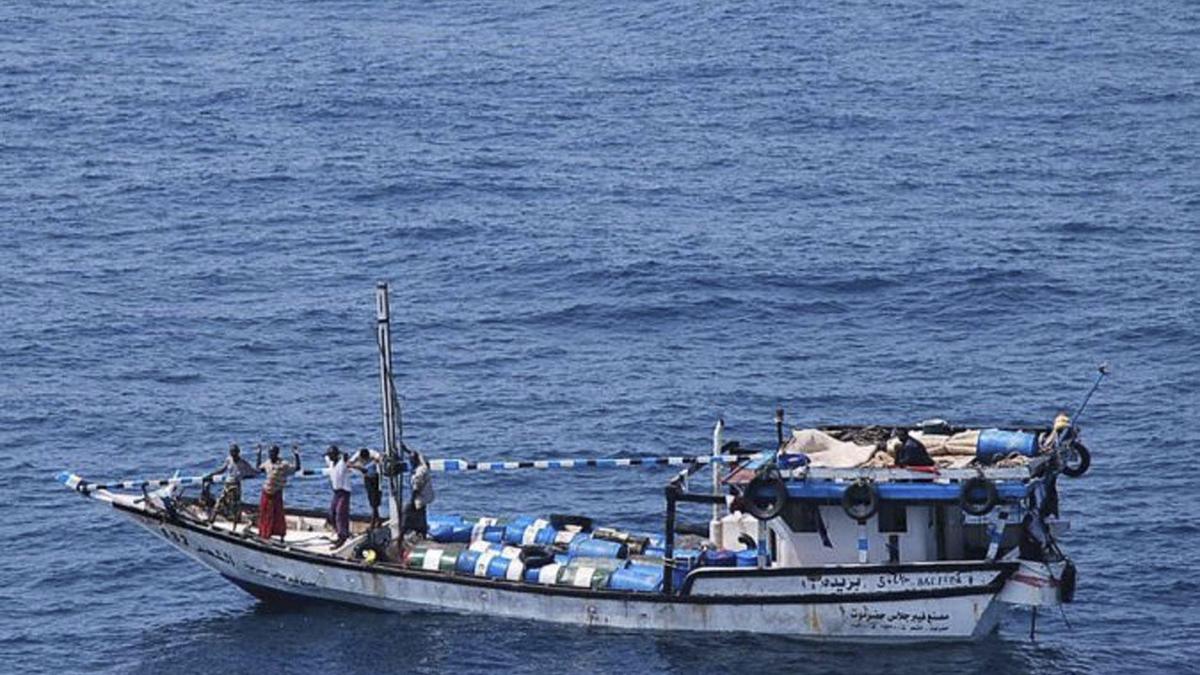
The story so far: On August 21, 2026, a Shipping Ministry official said that pirates have hijacked two commercial vessels, with 22 Indian seafarers onboard, off Yemen and Somalia. While MT Sibu 1, an Eritrea-flagged oil products tanker with 20 crew members including 16 Indians, was hijacked in the Gulf of Aden, a Cameroon-flagged cargo ship, MV Luruf with six Indians among its 10-member crew and carrying Turkish weapons, was hijacked off Somalia’s Puntland coast on August 17.
Officials in New Delhi have maintained that the Indian crew members are safe.
According to FTL Somalia, a new outlet, Somali pirates have “demanded a ransom of approximately $2 million” to release Luruf and its crew. The two hijackings— against the backdrop of the West Asia war, the attack on shipping lines by Iran and the Houthis, and the U.S. and Iranian blockade of the Strait of Hormuz— have given rise to fears of a resurgence of piracy off Somalia.
Who are the pirates?
In 1991, the Somali government collapsed, and with it disappeared the navy and the coastal security apparatus. The resource-rich waters off the Somalian coast was left open for foreign vessels to plunder. ‘The Pirate Trails Study’ by the World Bank in 2013 noted that “the fishermen off the Somali coast could no longer be protected from foreign ships fishing in Somali waters. Illegal international fishing and maritime dumping went unchecked… which in turn undermined the Somali coastal communities’ economic prospects”.
A 2008 report by the UN International Expert Group on Piracy off the Somali Coast identified “poverty, lack of employment, environmental hardship, pitifully low incomes, reduction of pastoralist and maritime resources due to drought and illegal fishing and a volatile security and political situation” as reasons for the rise of Somalian piracy.
The 2013 World Bank study interviewed pirates who recounted their personal stories and said how the skiff and the rifle offered an easy, and perhaps only, way out of poverty. The study quoted a pirate as saying, “I was an unemployed, occasional fisherman and someone approached me… The man promised me money and khat. He explained how he got his wealth. The man was my cousin. He was a successful pirate…”
Another pirate recalled how he struggled during “times (that) got more and more difficult” when a litre of fuel cost more than $100 and his mother was sick. “But as my friends turned to piracy, they started to refuse lending me money. They were saying: We are working to get that money. Why don’t you do the same?”
How Somalian piracy worked?
At the peak of the Somalian piracy, ransom demands ran into millions. According to World Bank study, “$339 million dollars to $413 million dollars was claimed in ransoms between April 2005 and December 2012 for pirate acts off the Horn of Africa.”
The report, which offers a detailed view of 21st century piracy, analysed how ransom amounts were collected and distributed, and how the money was invested.
Acts of piracy are never isolated incidents and follow a network of finances and local logistics. The report said that “pirate financiers” are vital to the network. These “money kingpins” are investors and the biggest beneficiaries of piracy. “On average, they collect from 30% to 50% of total ransom, working individually or as a group,” it said.
Then comes the “low-level pirates” or the “foot soldiers” who get a “standard fee of $30,000 to $75,000 per ship, which only amounts to 1%- 2.5% of an average ransom payment.”
The local community helps the pirates with “goods and services… including food, repair services and khat.” Khat is an evergreen shrub that contains the alkaloid cathinone, which works as a stimulant and has been banned by the World Health Organization since 1980 but is legal to consume in Somalia.
‘The Pirate Trails’ study said the ill-gotten proceeds of piracy are mostly invested within Somalia. Some of these proceeds are recycled into financing criminal activities, including further piracy acts, human trafficking, including migrant smuggling, and investing in militias and military capacities on land in Somalia. Besides, money is invested in the khat trade, particularly in Kenya.
What the resurgence means?
Coordination between the Somalian government that was formed in 2012 and international naval forces brought about a decline in piracy. However, maritime observers have expressed concern that the ongoing conflict in the Persian Gulf, the attack on ships in the Red Sea by the Houthis, and the diversion of marine traffic via the Cape of Good Hope to avoid conflict may be contributing to the resurgence of piracy.
Maritime intelligence firm Lloyd’s List flagged the possible resurgence of Somalian piracy in April. In its analysis, it noted, “What started at the beginning of the year as a series of localised incidents has escalated to the point that there are now two confirmed pirate groups stalking the Somali coastline for targets.”
The U.S.-based Center for Maritime Strategy, in a report this July, noted that pirates have been involved in at least 17 incidents in Somali waters or in the Gulf of Aden between January and May. Somalian pirates struck successfully for the first time in six years in 2023 and “conducted high-profile hijackings of commercial vessels in 2024 and 2025”, the report noted, adding that pirates captured three ships between April and May. The think tank said that three “active pirate groups” may be behind “coordinated operations” from Somalia and are “increasingly targeting vessels sailing hundreds of miles into the Indian Ocean”. This, the report said, is in contrast to previous Somali pirate attacks that were “largely contained to neighboring waterways”.
Is the Iran war helping pirates?
With the Strait of Hormuz virtually shut and the West Asia crisis continuing, elevated oil prices are encouraging pirates to target tanker ships. The Center for Maritime Strategy says that pirates “believe” that they can demand more ransom if they capture oil tankers.
In the last decade, the Somalian pirates approached ships in one or two skiffs, launched from a mothership, and brandished rifles and grenade launchers. A dramatic chase would end with the pirates boarding the ship using a ladder.
But now, they are operating with a “significantly higher level of sophistication previously seen”, using GPS and satellites to track vessels “far from the Somali coastline and using more sophisticated motherships to operate farther offshore”, the U.S.-based think tank said. Its report sad that today’s Somali pirates are more heavily armed because of their “partnerships” with the Houthis and al-Shabaab, an al-Qaeda offshoot active in southern Somalia. The report sees the resurgence of Somalian piracy in the broader context of disrupting regional shipping.
“Al-Shabaab has offered protection and logistical support to pirates in exchange for a share of their plunder, in addition to connecting the pirates with the Houthis who agreed to arm and train them in hopes of further disrupting regional maritime commerce.”
Published – August 25, 2026 09:28 am IST