

Skip to content
  • Facebook
  • X
  • Linkedin
  • WhatsApp
  • YouTube
  • Associate Journalism
  • About Us
  • Privacy Policy
  • 033-46046046
  • editor@artifex.news
Artifex.News

Artifex.News

Stay Connected. Stay Informed.

  • Breaking News
  • World
  • Nation
  • Sports
  • Business
  • Science
  • Entertainment
  • Lifestyle
  • Toggle search form
  • 8-Month-Old Girl Slammed To The Ground By Mentally Challenged UP Man, Dies
    8-Month-Old Girl Slammed To The Ground By Mentally Challenged UP Man, Dies Nation
  • Access Denied Sports
  • Ind vs Australia Melbourne Test: High hopes on Indian batters for Boxing Day contest
    Ind vs Australia Melbourne Test: High hopes on Indian batters for Boxing Day contest Sports
  • Yogi Adityanath Targets Rahul Gandhi
    Yogi Adityanath Targets Rahul Gandhi Nation
  • Google unveils plan to restart U.S. nuclear plant to power AI infrastructure
    Google unveils plan to restart U.S. nuclear plant to power AI infrastructure Business
  • Access Denied Business
  • Access Denied
    Access Denied Nation
  • Heat, monsoon deficit push power demand in Haryana; irate villagers stage protests over outages
    Heat, monsoon deficit push power demand in Haryana; irate villagers stage protests over outages Nation
Using thunderquakes to X-ray earth – a new study shows urban seismology in action

Using thunderquakes to X-ray earth – a new study shows urban seismology in action

Posted on August 24, 2026 By admin


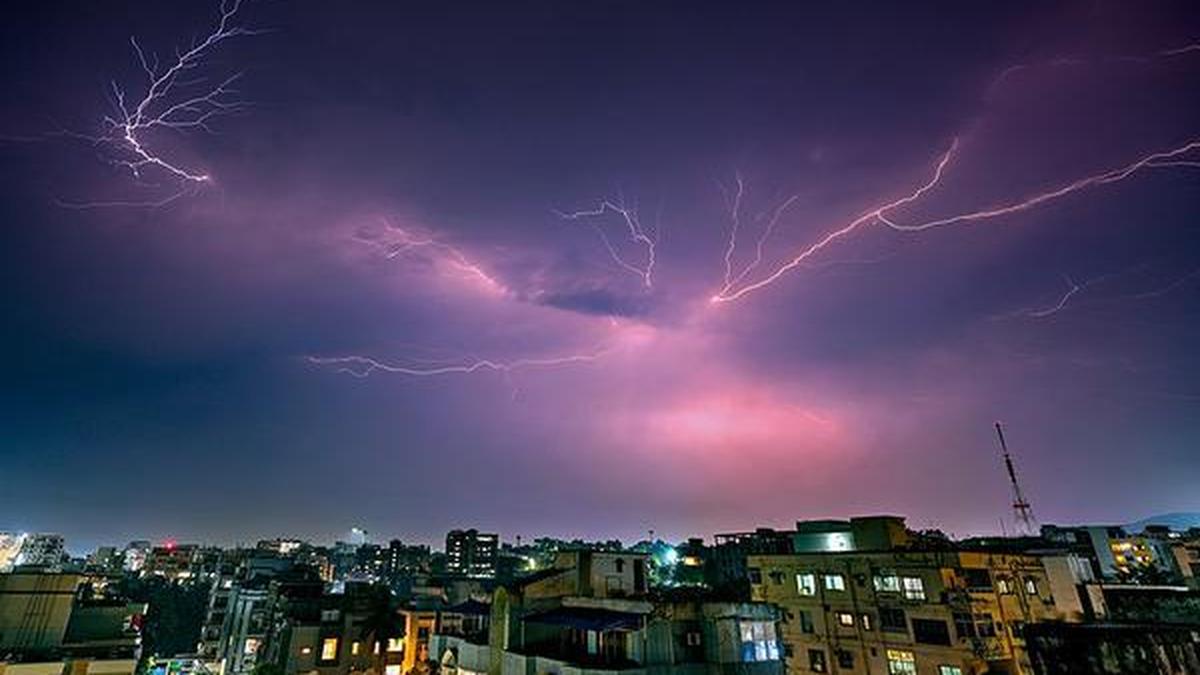
When lightning strikes, it superheats the air around it and creates a shock wave that we hear as thunder. But thunder doesn’t just travel through the atmosphere to our ears.

When that energy reaches the ground, some of it is converted into seismic waves that ripple through the soil and rock beneath. The resulting vibrations are known as thunderquakes.

Until now, scientists haven’t understood these signals well enough to make practical use of them. Our team’s research shows that thunderquakes can be used to map the structure beneath the Earth’s subsurface – such as groundwater movement, environmental contamination, sinkholes, or for evaluating building sites and foundations – just like X-rays image inside the human body.

We discovered this by listening to thunder with something found in communities around the world but unusual as a seismic measuring instrument: fibre-optic cable.

Turning fiber optics into vibration sensors

Using a technique called distributed acoustic sensing, we turned an ordinary fiber-optic cable, the kind used for internet or phone service, into a string of thousands of vibration sensors.

A laser-pulsing computer, called an interrogator, sends light through the cable and measures tiny changes caused by vibrations along its length. In our experiment, part of the Penn State FORESEE project, we used a cable that is over 2 miles (more than 4 kilometers) long. That gave us more than 2,100 sensors, spaced only a few feet apart, all listening to the ground at once.

Over two years, we used an old telecom fiber to record and identify 458 clear, high-quality thunderquakes.

The enormous amount of detail captured by this process has allowed us to see something that had been difficult to observe before: specific types of seismic waves produced when sound from the atmosphere interacts with the ground.

The most important of these seismic waves are what we call air-coupled Rayleigh waves. They are measurable at the surface but can be used to study the subsurface far below, even down 300 feet (around 100 meters).

How a thunderquake ‘X-rays’ the ground below

The trick to this technique is known as seismic dispersion: Waves of different frequencies travel at different depths. By measuring how the thunderquake’s wave speeds changed with frequency, we could reconstruct the seismic wave speed at different depths, which allows us to interpret the properties of the ground beneath the fibre.

The result was the equivalent of an X-ray of the subsurface extending roughly 300 feet underground, without drilling a single hole.

Imaging the subsurface typically requires specialized equipment, such as truck-mounted vibration sources or arrays of sensors that have to be installed for surveys. These approaches can be expensive and difficult to deploy over large areas.

Thunderstorms offer a naturally occurring source of seismic energy that is already spread across the landscape. And fiber-optic cables are buried beneath cities and towns around the world.

Instead of bringing a seismic source to the ground, we can listen to the storms passing overhead. That could eventually make it possible to monitor the shallow subsurface continuously, using infrastructure that is already in the ground and seismic energy that is already coming from the sky.

What we found at our test site

In State College, Pennsylvania, where we conducted the tests, the geology is mostly limestone and dolomite, rocks that can slowly dissolve as groundwater moves through them. Over time, this process creates fractures, caves and sinkholes.

Our thunderquake study revealed four distinct areas where seismic waves travelled much more slowly than through the surrounding rock. These “weak zones” could be caused by fractured or weathered rock or the presence of water or air. Two of them coincide with areas where satellite radar shows that the ground is actively subsiding. The depths of all four are consistent with fractures and voids documented at nearby sites.

These results matter because karst landscapes like the one beneath State College are widespread. They cover roughly 20% of the world’s continental land area and affect nearly a quarter of the global population. Sinkholes, groundwater contamination and other hazards associated with these landscapes can threaten buildings, infrastructure and public safety. Knowing where these hazards are allows for better construction and planning.

Our results demonstrate a fundamental process: Sound waves in the atmosphere can be converted into useful seismic waves in the solid Earth. But thunder is only one example.

Not just for thunder, and not just on Earth

Sonic booms, volcanic eruptions and meteor airbursts can produce similar atmospheric shock waves, potentially creating other natural seismic sources.

The idea may even extend beyond Earth. Earth-like tectonic earthquakes are not expected to be common on some other planets and moons, but atmospheric disturbances may still be present.

Titan, Saturn’s largest moon and the destination of NASA’s upcoming Dragonfly mission, is one intriguing possibility. If lightning and thunder occur there as models predict, atmospheric energy could potentially provide another way to investigate its subsurface.

Back on Earth, the atmosphere is constantly interacting with the ground beneath our feet. Our work suggests that this interaction could be a source of information about the hidden world below us.

Nolan Roth, The Ohio State University and Tieyuan Zhu, Penn State. Republished from The Conversation via PTI.

Published – August 24, 2026 02:17 pm IST


Source link

Science

Post navigation

Previous Post: SC to hear Delhi Race Club plea against eviction on August 25
Next Post: ‘Economic D-Day’: U.S. threatens Iran with new sanctions, Tehran fires back

Related Posts

  • Mandyam Srinivasan of bee studies fame faces misconduct allegations
    Mandyam Srinivasan of bee studies fame faces misconduct allegations Science
  • Understanding of Earth’s flowering plants blossoms in genome study
    Understanding of Earth’s flowering plants blossoms in genome study Science
  • How jumping genes and RNA bridges promise to shake up biomedicine
    How jumping genes and RNA bridges promise to shake up biomedicine Science
  • Russia’s Luna-25 spacecraft suffers technical glitch, space agency says
    Russia’s Luna-25 spacecraft suffers technical glitch, space agency says Science
  • Scientists propose warming up Mars using heat-trapping ‘glitter’
    Scientists propose warming up Mars using heat-trapping ‘glitter’ Science
  • SHAR expo at Andhra Loyola College on August 29
    SHAR expo at Andhra Loyola College on August 29 Science

More Related Articles

Rare caracals spotted in Thar Desert near India-Pakistan border Rare caracals spotted in Thar Desert near India-Pakistan border Science
U.K. to rejoin Europe’s Horizon science programme U.K. to rejoin Europe’s Horizon science programme Science
35% doctors in India feel unsafe while at work, study shows 35% doctors in India feel unsafe while at work, study shows Science
India not to host COP 33 in 2028, Government confirms India not to host COP 33 in 2028, Government confirms Science
Global study reveals how psychedelics dissolve the brain’s hierarchy Global study reveals how psychedelics dissolve the brain’s hierarchy Science
Uttarakhand flood maps may be underestimating risk, study warns Uttarakhand flood maps may be underestimating risk, study warns Science
SiteLock

Archives

  • August 2026
  • July 2026
  • June 2026
  • May 2026
  • April 2026
  • March 2026
  • February 2026
  • January 2026
  • December 2025
  • November 2025
  • October 2025
  • September 2025
  • August 2025
  • July 2025
  • June 2025
  • May 2025
  • April 2025
  • March 2025
  • February 2025
  • January 2025
  • December 2024
  • November 2024
  • October 2024
  • September 2024
  • August 2024
  • July 2024
  • June 2024
  • May 2024
  • April 2024
  • March 2024
  • February 2024
  • January 2024
  • December 2023
  • November 2023
  • October 2023
  • September 2023
  • August 2023
  • July 2023
  • June 2023
  • May 2023
  • April 2023
  • March 2023
  • February 2023
  • January 2023
  • December 2022
  • November 2022
  • October 2022
  • September 2022
  • August 2022
  • July 2022
  • June 2022
  • May 2022

Categories

  • Business
  • Nation
  • Science
  • Sports
  • World

Recent Posts

  • Three newborns die in fire at government hospital in Amravati, Maharashtra
  • South Korea says U.S. cancels joint marine drill over Iran war
  • Sugar prices fall in the domestic market; concerns remain on price volatility
  • India coach Fulton rues poor start after team’s exit
  • Assad-era’s grand mufti sentenced to life in prison by court in Damascus

Recent Comments

  1. Ronnienarge on UP Teacher Who Asked Students To Slap Muslim Classmate
  2. KevinBak on UP Teacher Who Asked Students To Slap Muslim Classmate
  3. Jasonkap on UP Teacher Who Asked Students To Slap Muslim Classmate
  4. Davidlot on UP Teacher Who Asked Students To Slap Muslim Classmate
  5. Ronnienarge on UP Teacher Who Asked Students To Slap Muslim Classmate
  • Access Denied Sports
  • Uday Bhanu Chib Appointed Indian Youth Congress Chief, Srinivas BV Replaced
    Uday Bhanu Chib Appointed Indian Youth Congress Chief, Srinivas BV Replaced Nation
  • Access Denied World
  • Access Denied
    Access Denied Nation
  • Rupee drops 13 paise to all-time low of 84.73 against U.S. dollar
    Rupee drops 13 paise to all-time low of 84.73 against U.S. dollar Business
  • Frequent Extreme Weather Events Behind Food Inflation In India: Economic Survey
    Frequent Extreme Weather Events Behind Food Inflation In India: Economic Survey Nation
  • Public inputs sought for Income Tax Act review
    Public inputs sought for Income Tax Act review Business
  • Supreme Court pulls up Maharashtra govt. over ‘disturbing’ delays in criminal trials
    Supreme Court pulls up Maharashtra govt. over ‘disturbing’ delays in criminal trials Nation

Editor-in-Chief:
Mohammad Ariff,
MSW, MAJMC, BSW, DTL, CTS, CNM, CCR, CAL, RSL, ASOC.
editor@artifex.news

Associate Editors:
1. Zenellis R. Tuba,
zenelis@artifex.news
2. Haris Daniyel
daniyel@artifex.news

Photograher:
Rohan Das
rohan@artifex.news

Artifex.News offers Online Paid Internships to college students from India and Abroad. Interns will get a PRESS CARD and other online offers.
Send your CV (Subjectline: Paid Internship) to internship@artifex.news

Links:
Associate Journalism
About Us
Privacy Policy

News Links:
Breaking News
World
Nation
Sports
Business
Entertainment
Lifestyle

Registered Office:
72/A, Elliot Road, Kolkata - 700016
Tel: 033-22277777, 033-22172217
Email: office@artifex.news

Editorial Office / News Desk:
No. 13, Mezzanine Floor, Esplanade Metro Rail Station,
12 J. L. Nehru Road, Kolkata - 700069.
(Entry from Gate No. 5)
Tel: 033-46011099, 033-46046046
Email: editor@artifex.news

Copyright © 2023 Artifex.News Newsportal designed by Artifex Infotech.