
Skip to content
  • Facebook
  • X
  • Linkedin
  • WhatsApp
  • YouTube
  • Associate Journalism
  • About Us
  • Privacy Policy
  • 033-46046046
  • editor@artifex.news
Artifex.News

Artifex.News

Stay Connected. Stay Informed.

  • Breaking News
  • World
  • Nation
  • Sports
  • Business
  • Science
  • Entertainment
  • Lifestyle
  • Toggle search form
  • Oil India plans to spend ₹15,000 crore for deepwater exploration over three years: CMD
    Oil India plans to spend ₹15,000 crore for deepwater exploration over three years: CMD Business
  • Access Denied World
  • Access Denied
    Access Denied Nation
  • Data centres will not touch Visakhapatnam’s drinking water, Lokesh tells Andhra Assembly
    Data centres will not touch Visakhapatnam’s drinking water, Lokesh tells Andhra Assembly Nation
  • Mohamed Amaan Shines As India Beat Japan By 211 Runs In Under-19 Asia Cup
    Mohamed Amaan Shines As India Beat Japan By 211 Runs In Under-19 Asia Cup Sports
  • Access Denied Sports
  • Access Denied
    Access Denied Nation
  • Fresh Case Filed Against Haldwani Violence Mastermind Abdul Malik, Wife
    Fresh Case Filed Against Haldwani Violence Mastermind Abdul Malik, Wife Nation
What’s China’s new ethnic unity law? | Explained

What’s China’s new ethnic unity law? | Explained

Posted on July 11, 2026 By admin


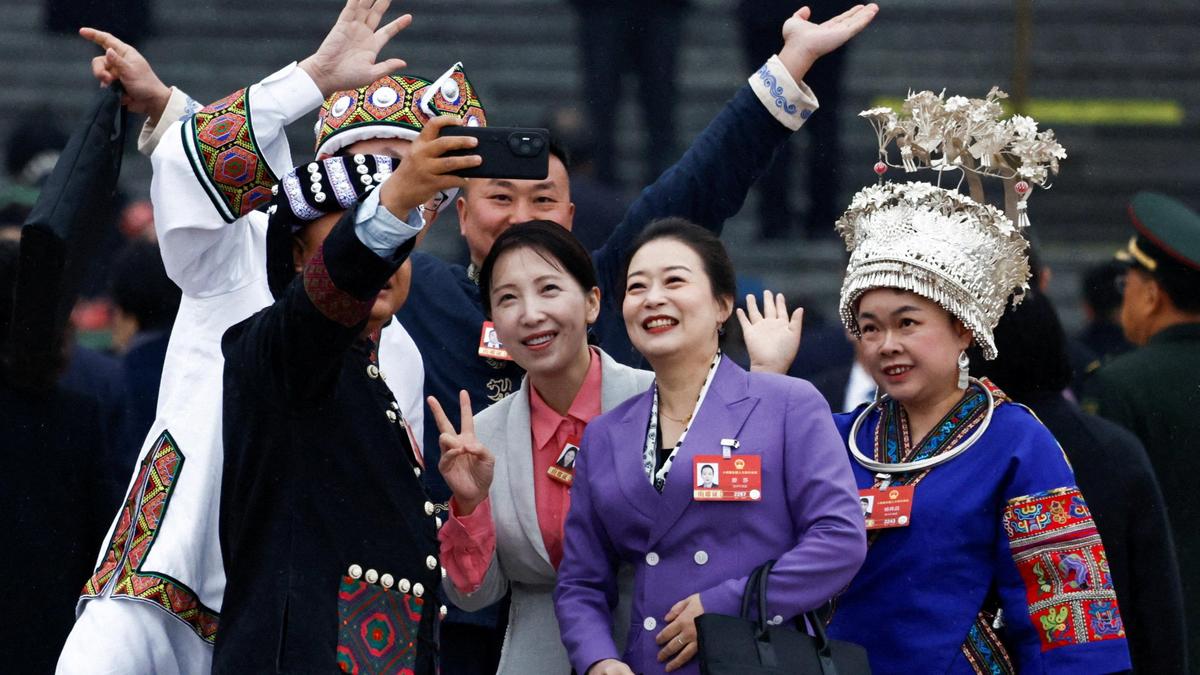
China officially recognises 56 ethnic groups. According to the 2020 census, the ethnic minority population crossed 125 million, or 8.89% of the national total. This includes around 11 million Uyghurs and 7 million Tibetans.
| Photo Credit: Reuters

A new ethnic unity law, the Law on Promoting Ethnic Unity and Progress, came into effect in China on July 1. The Chinese government said the law aims to create a “shared” national identity among China’s ethnic groups by strengthening what is called the “community of the Chinese nation”. The law also gives legal backing to policies promoting Mandarin, ideological education and the ‘Sinicisation’ of religion, or aligning religious practices to Chinese laws. The UN Human Rights Office of the High Commissioner (OHCHR) expressed concerns that the law could threaten freedoms, especially for minorities and lead to forced assimilation.

What is the new law about?

China passed the Law on Promoting Ethnic Unity and Progress on March 12 to create a “shared” national identity among ethnic groups. China officially recognises 56 ethnic groups. The majority Han Chinese make up more than 90% of the population. According to the 2020 census, the ethnic minority population crossed 125 million, or 8.89% of the national total. This includes around 11 million Uyghurs and 7 million Tibetans.

The legislation is the culmination of a policy trajectory that has been building for over a decade, beginning with the 2014 Central Ethnic Work Conference under President Xi Jinping. Since then, provinces and municipalities, including Xinjiang (2015) and Inner Mongolia (2021), have enacted local “ethnic unity and progress” regulations. The new law elevates that approach into a nationwide legal framework. According to Article 1, the law was enacted to “promote national unity and progress”, strengthen “the sense of community of the Chinese nation”, and advance the “great rejuvenation of the Chinese nation.” The law, approved by the National People’s Congress, the country’s ceremonial legislature, is designed to foster “a stronger sense of community among all ethnic groups in the Chinese nation,” said Lou Qinjian, a delegate to the NPC who introduced the proposal.

Several provisions have drawn particular attention. According to Article 15 in the new law, Mandarin Chinese is mandated to be taught to all children before kindergarten and throughout the rest of compulsory education up to the end of high school. Article 46 requires religious organisations, schools and places of worship to promote the “Sinicisation” of religion and strengthen the sense of a shared Chinese national identity. “Sinicisation” of religion refers to aligning all religious practices within China to local laws and regulations. The law’s ambit even extends beyond China’s orders. Article 63 states that any organisation or individual outside the territory of China that engages in acts that undermine national unity or create national division shall be held legally responsible, leading critics of the law to see it as enabling “transnational repression”.

What are the implications?

Human rights groups have expressed concerns about the law’s impact on religious freedoms. According to the law, it is formulated in accordance with China’s Constitution in order to promote national unity and progress. However, the Chinese Constitution states that “each ethnicity has the right to use and develop their own language” and “the right to self-rule”, while the Law on Regional Ethnic Autonomy promises limited autonomy to those groups, including allowing them to create flexible measures to develop their economies. Rights groups have pointed to provisions prohibiting acts that “undermine national unity” or “create national division”, warning that because these terms are broad and undefined, the law could be used to suppress peaceful expression, activism or cultural practices.

Is the law about unity or assimilation?

Sarah Brooks, Amnesty International’s Deputy Regional Director, said the law “does the opposite” of protecting minority communities. “Rather than celebrating difference, it is about pushing ethnic groups such as Uyghurs, Tibetans and Mongolians to adopt a single, state-defined national identity dominated by Han Chinese culture,” she said. “’Unity’ in this context is not harmony between different communities – it is political and ideological alignment with the Chinese Communist Party.”

Critics see the law as a final step in a years-long evolution of Chinese policy to emphasise national identity over ethnic autonomy. Critics have viewed that policy shift as being aimed at assimilation. That shift has accelerated over the past decade under President Xi Jinping. Authorities have expanded Mandarin-medium education, increased oversight of religious institutions and promoted the “Sinicisation” of religion. Rights groups have also cited widespread arbitrary detention and restrictions on religious and cultural practices in the Muslim-majority Xinjiang region, allegations that the Chinese authorities have denied.

Published – July 11, 2026 04:53 pm IST


Source link

World Tags:china ethnic minority, china ethnic unity law, china minority rights, Sinicisation of religion in china

Post navigation

Previous Post: Alcaraz’s drop shot reminds me of my short-arm jab: Gill
Next Post: Gopalapuram junction lacks ‘overseers’ at crucial hour

Related Posts

  • Rafah crossing reopening: Palestinians wait at Gaza-Egypt border as uncertainty clouds
    Rafah crossing reopening: Palestinians wait at Gaza-Egypt border as uncertainty clouds World
  • Access Denied World
  • At least two dead, one million evacuated as Typhoon Fung-wong slams into the Philippines
    At least two dead, one million evacuated as Typhoon Fung-wong slams into the Philippines World
  • Access Denied World
  • North Korea dismantles facility near border for separated families
    North Korea dismantles facility near border for separated families World
  • NATO chief discusses ‘global security’ with Trump
    NATO chief discusses ‘global security’ with Trump World

More Related Articles

Trump threatens Iran with power plant strikes over Hormuz blockade Trump threatens Iran with power plant strikes over Hormuz blockade World
Access Denied World
Access Denied World
Israel Orders 1.1 Million Gazans To Move South “Within 24 Hours”: UN Israel Orders 1.1 Million Gazans To Move South “Within 24 Hours”: UN World
Body of Pakistani climber recovered from Broad Peak 2 weeks after avalanche killed 10 Body of Pakistani climber recovered from Broad Peak 2 weeks after avalanche killed 10 World
China Gives Tourism Push To Economy With Extended 10-Day Visa Free Transit China Gives Tourism Push To Economy With Extended 10-Day Visa Free Transit World
SiteLock

Archives

  • September 2026
  • August 2026
  • July 2026
  • June 2026
  • May 2026
  • April 2026
  • March 2026
  • February 2026
  • January 2026
  • December 2025
  • November 2025
  • October 2025
  • September 2025
  • August 2025
  • July 2025
  • June 2025
  • May 2025
  • April 2025
  • March 2025
  • February 2025
  • January 2025
  • December 2024
  • November 2024
  • October 2024
  • September 2024
  • August 2024
  • July 2024
  • June 2024
  • May 2024
  • April 2024
  • March 2024
  • February 2024
  • January 2024
  • December 2023
  • November 2023
  • October 2023
  • September 2023
  • August 2023
  • July 2023
  • June 2023
  • May 2023
  • April 2023
  • March 2023
  • February 2023
  • January 2023
  • December 2022
  • November 2022
  • October 2022
  • September 2022
  • August 2022
  • July 2022
  • June 2022
  • May 2022

Categories

  • Business
  • Nation
  • Science
  • Sports
  • World

Recent Posts

  • Free mega medical camp promotes Health and Legal awareness in Gajuwaka
  • After October 1, only smaller 5 or 10 kg LPG refills await non-eKYC households
  • Pakistan forces kill five terrorists, rescue 23 abductees in Balochistan
  • Asian Games 2026: Smriti Mandhana surpasses Suzie Bates to become women’s T20I cricket’s leading run-scorer
  • Hope flows anew with revival of Andhra’s Veligonda project

Recent Comments

  1. Glennalbub on UP Teacher Who Asked Students To Slap Muslim Classmate
  2. PhilipLog on UP Teacher Who Asked Students To Slap Muslim Classmate
  3. DennisDum on UP Teacher Who Asked Students To Slap Muslim Classmate
  4. DonaldFrosy on UP Teacher Who Asked Students To Slap Muslim Classmate
  5. DonaldFrosy on UP Teacher Who Asked Students To Slap Muslim Classmate
  • Access Denied Sports
  • Israel to present highest civilian honour to U.S. President Donald Trump
    Israel to present highest civilian honour to U.S. President Donald Trump World
  • Man Poses As Matrimonial Site Representative, Dupes A Person Of Rs 5 Lakh
    Man Poses As Matrimonial Site Representative, Dupes A Person Of Rs 5 Lakh Nation
  • Will Ending ‘Impact Player’ Rule Reduce IPL High Scores? DC Head Coach Ricky Ponting Says…
    Will Ending ‘Impact Player’ Rule Reduce IPL High Scores? DC Head Coach Ricky Ponting Says… Sports
  • U.K. air traffic control glitch prompts nearly 300 cancellations, monitor says
    U.K. air traffic control glitch prompts nearly 300 cancellations, monitor says World
  • After 19 Million New Users, Netflix Announces Price Hike
    After 19 Million New Users, Netflix Announces Price Hike World
  • TB vaccine offers clue to retrain immune system against Alzheimer’s
    TB vaccine offers clue to retrain immune system against Alzheimer’s Science
  • New invasive moth threatens Ladakh’s farm-based economy
    New invasive moth threatens Ladakh’s farm-based economy Business

Editor-in-Chief:
Mohammad Ariff,
MSW, MAJMC, BSW, DTL, CTS, CNM, CCR, CAL, RSL, ASOC.
editor@artifex.news

Associate Editors:
1. Zenellis R. Tuba,
zenelis@artifex.news
2. Haris Daniyel
daniyel@artifex.news

Photograher:
Rohan Das
rohan@artifex.news

Artifex.News offers Online Paid Internships to college students from India and Abroad. Interns will get a PRESS CARD and other online offers.
Send your CV (Subjectline: Paid Internship) to internship@artifex.news

Links:
Associate Journalism
About Us
Privacy Policy

News Links:
Breaking News
World
Nation
Sports
Business
Entertainment
Lifestyle

Registered Office:
72/A, Elliot Road, Kolkata - 700016
Tel: 033-22277777, 033-22172217
Email: office@artifex.news

Editorial Office / News Desk:
No. 13, Mezzanine Floor, Esplanade Metro Rail Station,
12 J. L. Nehru Road, Kolkata - 700069.
(Entry from Gate No. 5)
Tel: 033-46011099, 033-46046046
Email: editor@artifex.news

Copyright © 2023 Artifex.News Newsportal designed by Artifex Infotech.