



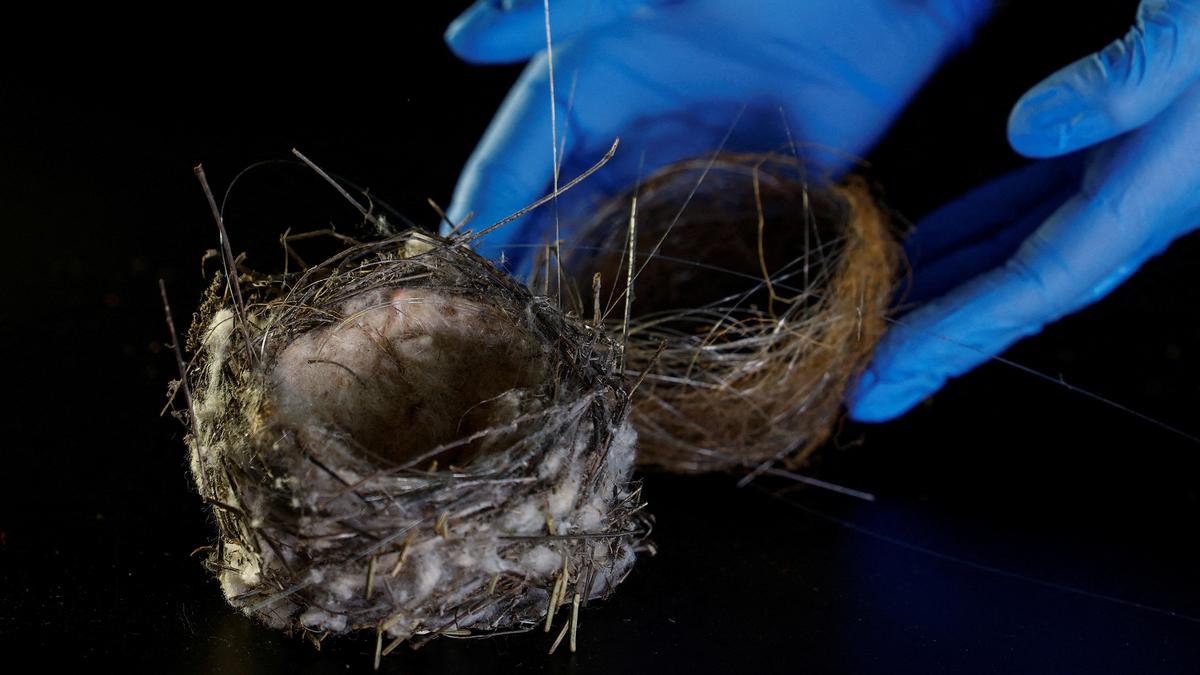
A researcher shows a bird’s nest containing fragments of fibre-optic cable collected near the front line during Russia’s war against Ukraine, in Kyiv.
| Photo Credit: Reuters
cienceA bird’s nest found near Ukraine’s front line has caught the attention of researchers, not because of the bird that built it but because of what it was made from. Mixed in with the usual twigs, grass and small branches were strands of fibre-optic cable, the same kind now used by military drones flying over some of the most fiercely contested parts of the battlefield.
Also read | Ukraine’s vast forests devastated in hellscape of war
Birds have always built nests with whatever they can find. Plastic bags, bits of cloth, fishing line and electrical wire have all been found woven into nests in different parts of the world. But military-grade fibre-optic cable is something researchers have not seen before.
The nest was first reported by Reuters, and while it looks like an unusual wildlife story at first glance, it also raises a much bigger question. Once military technology has done its job, what happens to everything it leaves behind? In many parts of eastern and southern Ukraine, the answer is already scattered across the landscape. Fields, forests and abandoned villages are now littered with broken drones, damaged batteries, shattered propellers, pieces of carbon fibre and long strands of fibre-optic cable left behind after drone missions. It is a kind of battlefield waste that did not exist on this scale before the war, reflecting how quickly drones have transformed modern combat.

When Russia invaded Ukraine in February 2022, drones were already being used to monitor enemy positions, gather intelligence and direct artillery fire. But as the war settled into a long and grinding conflict, drones became much more than flying cameras.
Cheap first-person-view, or FPV, drones fitted with explosives quickly became one of the most effective weapons on the battlefield. They could be flown directly into tanks, bunkers and military vehicles, giving soldiers a relatively inexpensive way to destroy equipment worth millions of dollars. Almost overnight, drones became essential to both armies.
That also meant finding ways to stop them became just as important. Instead of trying to shoot every drone out of the sky, both Russia and Ukraine invested heavily in electronic warfare, which focuses on disrupting the connection between a drone and its operator. Radio signals can be jammed, satellite navigation can be interfered with and communication links can be cut, making it much harder for drones to complete their missions.

As electronic jamming became more effective, drone operators looked for another solution. That is where fibre-optic drones came in. Unlike conventional FPV drones, these drones carry a spool of ultra-thin fibre-optic cable that slowly unwinds as they fly. Instead of receiving commands through radio waves, they remain connected to the operator through the cable itself, making them far more resistant to electronic jamming.
The technology itself is not entirely new. Fibre-optic guidance has existed in military systems for years. What is new is how widely it is now being adapted for drones in Ukraine, where both armies are constantly searching for an advantage. The system solves one problem but creates another.
Unlike radio signals, fibre-optic cable does not disappear once a mission is over. Every drone leaves a trail behind. Some cables remain stretched across open fields, others become tangled in trees or wrapped around bushes, while many simply lie where they fall after a drone is destroyed or reaches its target. After thousands of drone missions, those cables have become another part of the landscape.
That is how some of them eventually found their way into a bird’s nest. The birds were not looking for military equipment. Like birds anywhere else, they were simply collecting material lying on the ground around them. Researchers are now trying to understand whether those cables create new risks for wildlife or whether birds are simply treating them like any other synthetic material. The cables are lightweight and strong, which could help hold nests together, but they could also create problems such as entanglement or remain in the environment for years before breaking down.

For now, there are very few answers because this is something scientists have only just begun to study. What is clear is that the war is leaving behind more than destroyed buildings and damaged infrastructure. It is also leaving behind materials that are slowly becoming part of the environment itself.
The First World War left behind trench systems and contaminated land across Europe. In Vietnam, Agent Orange devastated forests and caused environmental damage that lasted for decades. In countries such as Cambodia and Bosnia, landmines and unexploded ammunition continue to threaten people and wildlife years after peace agreements were signed. The environmental impact changes with every conflict because the way wars are fought keeps changing. Ukraine could eventually add something new to that list.
Published – July 09, 2026 07:34 am IST