
Skip to content
  • Facebook
  • X
  • Linkedin
  • WhatsApp
  • YouTube
  • Associate Journalism
  • About Us
  • Privacy Policy
  • 033-46046046
  • editor@artifex.news
Artifex.News

Artifex.News

Stay Connected. Stay Informed.

  • Breaking News
  • World
  • Nation
  • Sports
  • Business
  • Science
  • Entertainment
  • Lifestyle
  • Toggle search form
  • 19-Year-Old Allegedly Kills, Buries Pregnant Woman’s Body In Haryana, Arrested
    19-Year-Old Allegedly Kills, Buries Pregnant Woman’s Body In Haryana, Arrested Nation
  • Access Denied Business
  • Wholesale Inflation Stays In Negative For Fifth Month At -0.52% In August
    Wholesale Inflation Stays In Negative For Fifth Month At -0.52% In August Business
  • Internet Reacts To Viral Donald Trump Dance Video
    Internet Reacts To Viral Donald Trump Dance Video World
  • PM Modi assures more support to Telangana, asks CM Revanth to collaborate with him
    PM Modi assures more support to Telangana, asks CM Revanth to collaborate with him Nation
  • Bangladesh Law Adviser slams PM Modi’s Vijay Diwas post, says India was merely an ally in 1971 victory
    Bangladesh Law Adviser slams PM Modi’s Vijay Diwas post, says India was merely an ally in 1971 victory World
  • CBI arrests accused in ‘Digital Arrest’ case
    CBI arrests accused in ‘Digital Arrest’ case Nation
  • Access Denied Sports
What did SCOTUS rule on birthright citizenship? | Explained

What did SCOTUS rule on birthright citizenship? | Explained

Posted on July 5, 2026 By admin


The story so far:

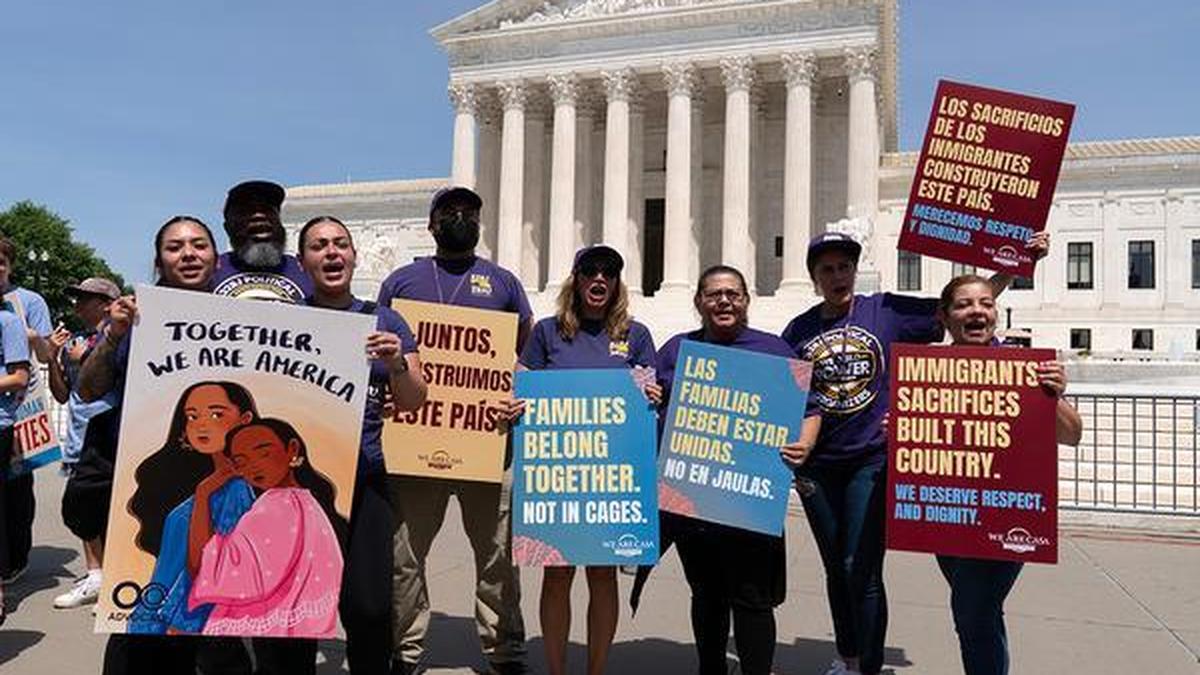
On June 30, 2026, the Supreme Court of the United States (SCOTUS) upheld birthright citizenship provided under the 14th Amendment to the U.S. Constitution. The SCOTUS struck down President Donald Trump’s Executive Order (E0) 14160, which sought to end unconditional birthright citizenship that the U.S. grants. With the 6-3 judgment, anyone who is born on U.S. soil becomes a citizen, regardless of the status of their parents. Exceptions include children of foreign diplomats and invading militaries.

What did Trump’s executive order say?

Mr. Trump’s EO directed federal agencies to stop issuing citizenship-recognising documents — social security numbers and passports — to children born after February 19, 2025 (i) to mothers unlawfully present when the father was not a citizen or lawful permanent resident, or (ii) to mothers lawfully but temporarily present (students, tourists, guest workers) when the father was not a citizen or permanent resident.

What provisions of the U.S. legal system allow and protect birthright citizenship?

The 14th Amendment to the U.S. Constitution, ratified in 1868, says “all persons born or naturalised in the United States, and subject to the jurisdiction thereof, are citizens of the United States and of the State wherein they reside.” The Immigration and Nationality Act (INA), 1952, is the foundational body of U.S. citizenship and immigration law, which draws from the above constitutional provision with regard to birthright citizenship. The INA declares that a person born in the U.S. and subject to its jurisdiction is a citizen “at birth.” Among the questions that SCOTUS examined was whether birthright citizenship is only a statutory guarantee or both statutory and constitutional. One of the judges who struck down the EO — Justice Brett Kavanaugh — limited it as a statutory question.

How and when did birthright citizenship become a political issue in the U.S.?

It was Mr. Trump’s 2016 presidential campaign that put the spotlight on birthright citizenship as a question of population management. This was in the broader context of the anti-immigration politics, a central concern of the politics of the ‘Make American Great Again’ (MAGA) movement. In fact, when the Court heard the oral arguments in the case on April 1, 2026, Mr. Trump was personally present. This showed how critical this was to his politics of influencing the population composition of the country.

But before it was adapted by Mr. Trump, birthright citizenship was more a concern of Democrats, who are traditionally more anti-immigrant than Republicans. Democratic Senator Harry Reid’s 1993 Immigration Stabilization Act proposed a narrower reading of the 14th Amendment. The argument against birthright citizenship is based on the assumption that a large number of non-citizens — both authorised residents (such as visa holders) and unauthorised residents (including illegal immigrants) — were having children who would automatically become citizens at birth.

What do numbers suggest about children born to non-citizens in the U.S.?

It has been estimated that births to unauthorised immigrant mothers rose from roughly 1.2 lakh in 1990 (about 3% of all U.S. births) to a peak of approximately 3.7 lakh-3.9 lakh in 2006-2007 (roughly 9% of all U.S. births.) This growth mirrored the tripling of the unauthorised immigrant population between 1990 and 2007.

After the 2008 financial crisis, the trend reversed. By 2016, births to unauthorised immigrant mothers had fallen about 36% from the 2007 peak, to roughly 2.5 lakh (about 6% of that year’s U.S. births in total).

Pew Research Center’s most recent analysis found that births to unauthorised or temporary-status immigrant mothers grew rapidly again between 2019 and 2023, reaching an estimated 9% of all U.S. births in 2023.

What is the argument against birthright citizenship?

Apart from its place within the broader anti-immigration politics of the MAGA movement, opposition to birthright citizenship is also rooted in allegations of its misuse. An entire industry of ‘birth tourism’ facilitates expectant foreigners to give birth in the U.S. Opponents also say the 14th Amendment provision was meant to address the citizenship status of freed slaves; it cannot apply universally and unconditionally in the changed circumstances. The SCOTUS held that the text of the Constitution is clear, and changes in circumstances can’t justify new meanings to it.

What is the link between slavery and birthright citizenship in the U.S.?

The evolution of the U.S. citizenship regime is closely linked to slavery and racism in the country. In the original Constitution of the U.S., there was no definition of the word citizen; instead, citizenship was guided by multiple factors. In practice, citizenship depended on the laws of individual States governing civil and political rights, including voting and property ownership. The Federal Naturalisation Act, 1790, made it clear that only “free white persons” can be eligible. The result was varied practices across the U.S.: in northern States, free Black residents had some rights including voting rights, but in southern States, citizenship was denied to them.

This changed in 1857, when the Supreme Court held that no Black person can ever be a citizen of the U.S; and that the political community established by the Constitution did not include them at all. . This followed a plea by an enslaved Black man, Dred Scott, for freedom. In 1865, the 13th Amendment abolished slavery, but the 1857 judgment stood as law, making the citizenship status of freed slaves ambiguous.

In 1866, the Civil Rights Act was passed by Congress, legislating that any person born in the country is a citizen. President Andre Johnson vetoed it; and Congress overturned the veto. To pre-empt a future Congress or a future President from overturning it, the principle of birthright citizenship was written into the Constitution in 1868, as part of the 14th Amendment.

How did that link play in the current case?

The Trump administration argued that birthright citizenship was a remedy for the specific situation of former slaves, and the provision must be read with that narrow view.

The majority judgment took the position that the framers deliberately chose sweeping, universal language so the promise wouldn’t be limited to one group or vulnerable to a future court narrowing it the way the judgment in Dred Scott had narrowed citizenship before.

What can we expect next?

The Trump administration has said it will pursue a legislative path to end birthright citizenship, but the move will not have enough support for a constitutional amendment in the U.S. Congress. The administration argues that an ordinary statute can achieve the objective but that is contested. For now, birthright citizenship will continue, but so will the political slugfest over it.

Published – July 05, 2026 06:35 am IST



Source link

World Tags:Birthright Citizenship, birthright citizenship ruling, birthright citizenship United States, donald trump

Post navigation

Previous Post: Kylian Mbappé scores again and France reaches World Cup quarterfinals with 1-0 win over Paraguay

Related Posts

  • US To Impose Fresh Visa Curbs On Hong Kong Officials Over Rights Crackdown
    US To Impose Fresh Visa Curbs On Hong Kong Officials Over Rights Crackdown World
  • ‘No embargo’ on Imran Khan’s sons meeting him in jail, says Pakistan
    ‘No embargo’ on Imran Khan’s sons meeting him in jail, says Pakistan World
  • US YouTuber YourFellowArab Kidnapped In Haiti While Trying To Interview Gang Leader
    US YouTuber YourFellowArab Kidnapped In Haiti While Trying To Interview Gang Leader World
  • Access Denied World
  • Somalis vote in the first one-person, one-vote local election in decades
    Somalis vote in the first one-person, one-vote local election in decades World
  • 30 Years On, Remembering How Rwanda Genocide Unfolded
    30 Years On, Remembering How Rwanda Genocide Unfolded World

More Related Articles

U.S. denies ending South Africa G20 boycott U.S. denies ending South Africa G20 boycott World
Israel Hamas War Hostages Free Hamas Chief In Gaza Says Ready For Immediate Prisoner Swap With Israel Israel Hamas War Hostages Free Hamas Chief In Gaza Says Ready For Immediate Prisoner Swap With Israel World
Azerbaijan plane crash: Russian President Vladimir Putin apologises to Azerbaijani leader for ‘tragic incident’ Azerbaijan plane crash: Russian President Vladimir Putin apologises to Azerbaijani leader for ‘tragic incident’ World
In Pictures | Northern Lights: sightings across Europe In Pictures | Northern Lights: sightings across Europe World
3 killed in firing and teargas shelling by security forces in Pakistan-occupied Kashmir 3 killed in firing and teargas shelling by security forces in Pakistan-occupied Kashmir World
Iraq Passes Bill Criminalising Same-Sex Relations, Jail Upto 15 Years Iraq Passes Bill Criminalising Same-Sex Relations, Jail Upto 15 Years World
SiteLock

Archives

  • July 2026
  • June 2026
  • May 2026
  • April 2026
  • March 2026
  • February 2026
  • January 2026
  • December 2025
  • November 2025
  • October 2025
  • September 2025
  • August 2025
  • July 2025
  • June 2025
  • May 2025
  • April 2025
  • March 2025
  • February 2025
  • January 2025
  • December 2024
  • November 2024
  • October 2024
  • September 2024
  • August 2024
  • July 2024
  • June 2024
  • May 2024
  • April 2024
  • March 2024
  • February 2024
  • January 2024
  • December 2023
  • November 2023
  • October 2023
  • September 2023
  • August 2023
  • July 2023
  • June 2023
  • May 2023
  • April 2023
  • March 2023
  • February 2023
  • January 2023
  • December 2022
  • November 2022
  • October 2022
  • September 2022
  • August 2022
  • July 2022
  • June 2022
  • May 2022

Categories

  • Business
  • Nation
  • Science
  • Sports
  • World

Recent Posts

  • What did SCOTUS rule on birthright citizenship? | Explained
  • Kylian Mbappé scores again and France reaches World Cup quarterfinals with 1-0 win over Paraguay
  • Kimi Antonelli wins sprint race and takes pole at F1’s British Grand Prix
  • Arias’ goal enough to send Colombia into pre-quarters
  • BJP will register a decisive victory in U.P., says party chief Nitin Nabin

Recent Comments

  1. Thomasned on UP Teacher Who Asked Students To Slap Muslim Classmate
  2. Richardeduro on UP Teacher Who Asked Students To Slap Muslim Classmate
  3. MichaelTus on UP Teacher Who Asked Students To Slap Muslim Classmate
  4. Zacherypem on UP Teacher Who Asked Students To Slap Muslim Classmate
  5. Randylem on UP Teacher Who Asked Students To Slap Muslim Classmate
  • Relief For AAP Before Polls, Court Turns Down BJP Plea Over Central Audits
    Relief For AAP Before Polls, Court Turns Down BJP Plea Over Central Audits Nation
  • Access Denied Sports
  • India’s weight in key MSCI equity index hits another high, to boost inflows
    India’s weight in key MSCI equity index hits another high, to boost inflows Business
  • Transworld Holdings revises buy back price to ₹375 for Shreyas Shipping shares
    Transworld Holdings revises buy back price to ₹375 for Shreyas Shipping shares Business
  • Access Denied World
  • CBI arrests accused in ‘Digital Arrest’ case
    HMT revival package at final stage, says Union Minister Nation
  • Access Denied World
  • Access Denied Sports

Editor-in-Chief:
Mohammad Ariff,
MSW, MAJMC, BSW, DTL, CTS, CNM, CCR, CAL, RSL, ASOC.
editor@artifex.news

Associate Editors:
1. Zenellis R. Tuba,
zenelis@artifex.news
2. Haris Daniyel
daniyel@artifex.news

Photograher:
Rohan Das
rohan@artifex.news

Artifex.News offers Online Paid Internships to college students from India and Abroad. Interns will get a PRESS CARD and other online offers.
Send your CV (Subjectline: Paid Internship) to internship@artifex.news

Links:
Associate Journalism
About Us
Privacy Policy

News Links:
Breaking News
World
Nation
Sports
Business
Entertainment
Lifestyle

Registered Office:
72/A, Elliot Road, Kolkata - 700016
Tel: 033-22277777, 033-22172217
Email: office@artifex.news

Editorial Office / News Desk:
No. 13, Mezzanine Floor, Esplanade Metro Rail Station,
12 J. L. Nehru Road, Kolkata - 700069.
(Entry from Gate No. 5)
Tel: 033-46011099, 033-46046046
Email: editor@artifex.news

Copyright © 2023 Artifex.News Newsportal designed by Artifex Infotech.