




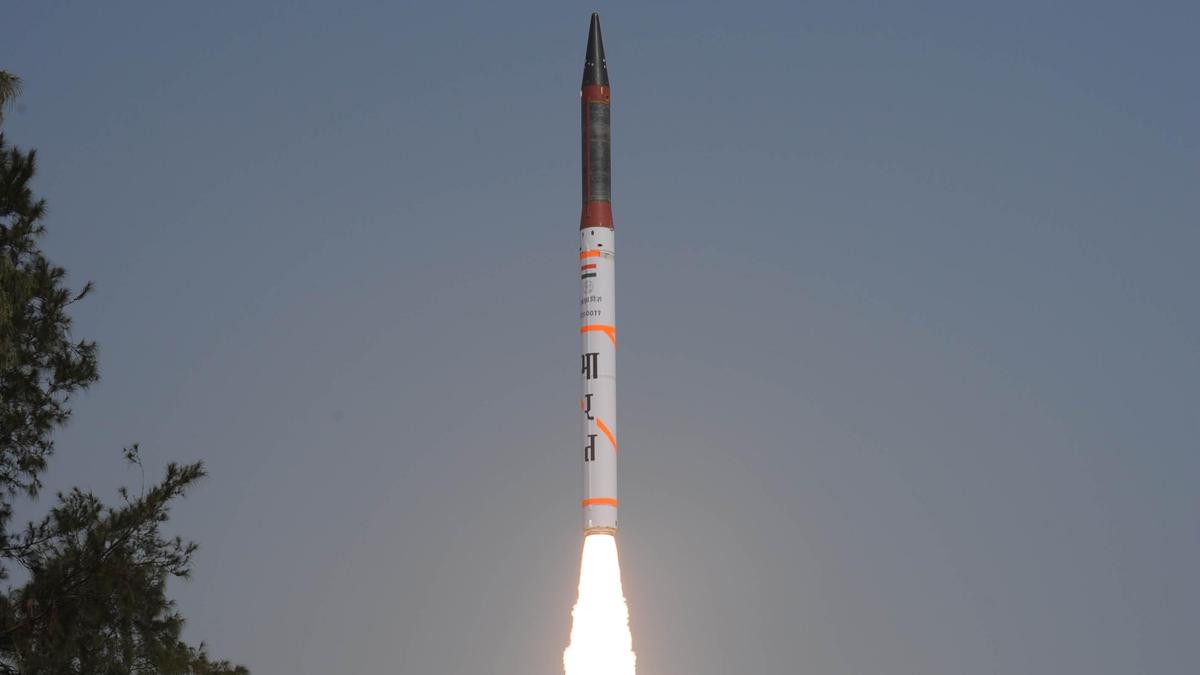
The Stockholm International Peace Research Institute (SIPRI) released its annual yearbook in June. For the first time, it classified 12 of India’s estimated stockpile of 190 nuclear warheads to be operationally deployed, i.e., positioned with active military forces mated with delivery systems and ready for use.
This sounds alarming — but the alarm itself may not be warranted. The reason is that India has neither crossed a strategic threshold nor has it abandoned its decades-old ‘no first use’ policy.
India’s promise
India’s ‘no first use’ (NFU) policy is a pillar of its nuclear doctrine and its credible minimum deterrence posture. At the UN High-Level Meeting commemorating the International Day for the Total Elimination of Nuclear Weapons in September 2025, India’s representative Sibi George reaffirmed India’s commitment to NFU and to the non-use of nuclear weapons against non-nuclear-weapon states.
The political foundations of the doctrine are intact even as some analysts within India have periodically called for a conditional or hybrid first-use posture. Those calls have not prevailed.
Under NFU, India commits to not launching a pre-emptive nuclear strike. What it needs is the absolute certainty that even after absorbing a nuclear first strike, enough of its nuclear arsenal will survive to deliver a devastating retaliatory blow. This survivability guarantee is what strategists call a second-strike capability, and without it, NFU is not a doctrine but a liability. In other words, the doctrine depends on a force that can survive and retaliate.
The SIPRI report does not indicate a shift towards first use, a lowering of the threshold for nuclear employment or indeed any revision of the political controls that govern India’s nuclear weapons. Instead, it documents the maturing of India’s ability to credibly deliver the second strike.
Stockpile v. Deployment
This distinction is significant. Possessing a nuclear warhead and deploying it as part of an operational deterrent is not the same thing. For most of its nuclear history, India has kept its warheads in a de-mated state, meaning the warheads were stored separately from their delivery vehicles, in a central storage site and under strict civilian and political oversight. The idea was to maximise safety, reduce the risk of accidental use, and signal restraint to the international community.
Deployment, on the other hand, means a weapon has been paired with a delivery system — a missile, aircraft, or submarine — and positioned with operational military forces in a state of readiness. Again, this does not mean the weapons are about to be used; it means they are configured for use if authorised. A de-mated weapon requires time to prepare and deploy; a mated weapon can, in principle, be launched more quickly.
What SIPRI has recorded when it classified 12 Indian warheads as being deployed is that a small — but no doubt significant — fraction of India’s arsenal now is being maintained in a state of operational readiness. And SIPRI has linked this assessment to the maturation of India’s nuclear triad, particularly its sea-based deterrent, suggesting that a small number of warheads may now be deployed aboard a nuclear ballistic missile submarine (which are also called SSBN) conducting occasional deterrence patrols.
India’s Arihant-class submarines have steadily strengthened the survivability of the country’s second-strike capability, with additional platforms expected to further consolidate this leg of the triad. SIPRI also noticed India’s increasing reliance on canisterised Agni-series missiles. This means the missiles are kept ready with fuel in a sealed cylinder, from which they can be directly fired without further preparations. Canisterisation thus indicates a greater level of operational readiness.
Overall, it seems India’s long-envisioned deterrent posture is becoming increasingly operational across land and sea-based delivery systems — but not that the country is on a war footing.
NFU architecture
Bearing in mind India’s pursuit of a doctrine of credible minimum deterrence centred on assured retaliation, the maturation of its submarine-based deterrent doesn’t depart from NFU but is a means of strengthening it.
A doctrine that relies on retaliation requires forces capable of surviving an adversary’s first strike. Land-based missiles, however capable, sit at known and mappable locations. An adversary confident in its intelligence could, in theory, target them in a disarming first strike before a retaliatory order is ever issued. On the other hand, a stealth submarine operating in the ocean can’t be found, tracked or destroyed in time.
This is a fundamental difference — and in fact, ballistic missile submarines provide the most secure second-strike capability available. As the scholar Vipin Narang has written, states pursuing assured retaliation postures must, above all, solve the survivability problem, and sea-basing is the most robust solution available.
India has now done that. With three operational SSBNs sufficient to keep at least one submerged and on patrol at all times, India has closed the central vulnerability any NFU doctrine faces.
Manpreet Sethi, distinguished fellow at the Centre for Aerospace Power and Strategic Studies, New Delhi, said, “With the operationalisation of tri-SSBNs, it is not surprising that some of India’s nuclear warheads now stand mated with delivery platforms. This in no way implies a doctrinal shift. Rather, it makes assured retaliation more credible and, hence, India more confident in its commitment to ‘no first use’.”
Wider warning
SIPRI’s documentation of India’s deployment milestone lies within a broader, more concerning global trend. The organisation’s 2026 Yearbook observed that states are “increasingly relying on nuclear weapons as instruments of national power”, signalling a reversal of decades of gradual progress in disarmament.
As of January this year, the world’s nine nuclear-armed states collectively possessed an estimated 12,187 nuclear warheads. China’s arsenal has grown to approximately 620 and continues to expand at a pace unmatched by any other nuclear power. In this context, India’s reported deployment of 12 operationally assigned warheads is strategically significant.
India’s nuclear choices must be understood from within this evolving security environment. SIPRI has noted that India’s modernisation programme is increasingly focused on developing long-range delivery systems capable of reaching targets throughout China — while continuing to account for Pakistan.
With China’s arsenal now more than three times the size of Pakistan’s estimated stockpile, and Beijing simultaneously expanding its sea-based nuclear deterrent, India’s SSBN programme appears directed as much towards maintaining credible deterrence against China as towards preserving stability with Pakistan.
The world that the SIPRI report has described is one in which the post-Cold War nuclear order is under mounting strain. Arms-control agreements have weakened or collapsed while competition in areas such as hypersonic delivery systems, artificial intelligence-enabled decision support, missile defence, and anti-submarine warfare continues to intensify.
The risk of miscalculation is correspondingly increasing. India’s evolving deterrent posture should therefore be seen not as an isolated development but as part of a wider transformation in the global strategic environment. Policymakers should treat this as a warning that the institutions designed to manage nuclear risk must adapt quickly enough to keep pace with the capabilities now being fielded.
(Shrawani Shagun is a researcher focusing on environmental sustainability and space governance)