


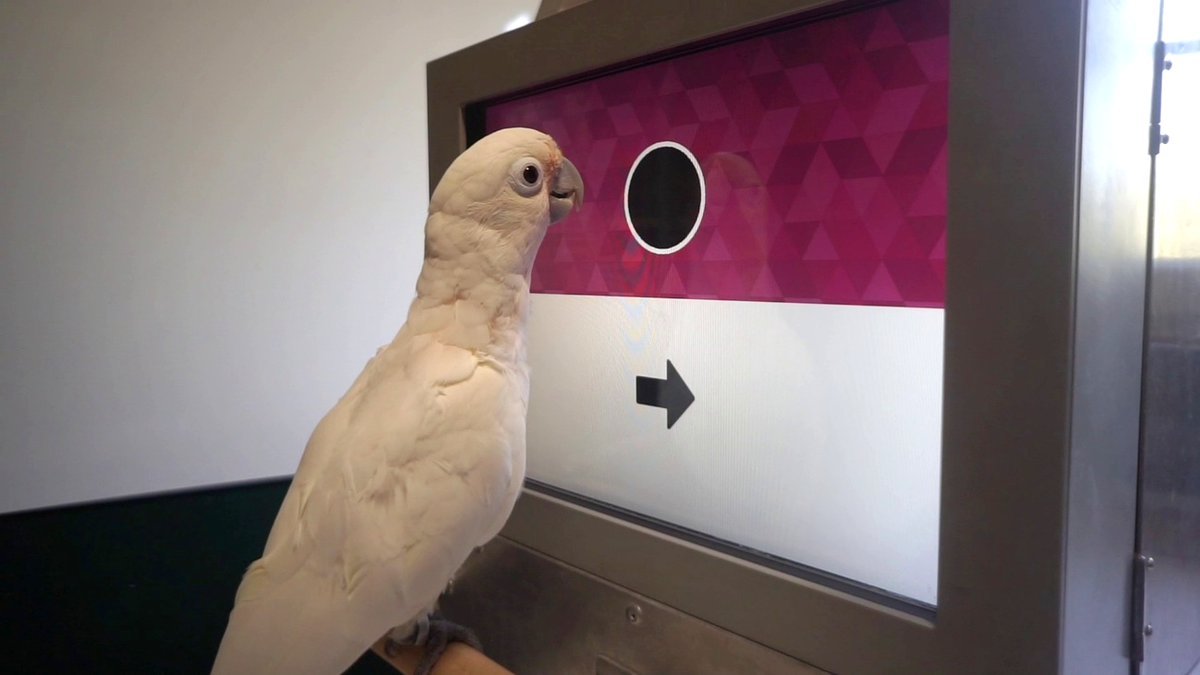
One day in 2025, Jane perched facing a computer screen. The screen’s top half displayed a black circle on a magenta background. The bottom half had a black arrow on white. After what appeared to be a moment of deliberation, Jane extended her neck and touched the circle. Small pellets of food appeared in the tray before her. Then, the magenta was replaced by green.
When she touched the circle this time, the screen flashed a bright red before reverting to green. This time, no food appeared. Jane looked at the screen, checked the tray, and looked at the screen again. Then, she touched the arrow. A new background appeared, and with that came the renewed possibility of obtaining more food.
Jane is a Goffin’s cockatoo housed at the Messerli Research Institute, University of Veterinary Medicine (UVM), Vienna. With 14 of her peers, she has helped researchers demonstrate that the parrots can recognise and adapt to permanent non-functionality — the notion of something that previously worked ceasing to be functional in a specific context.
This might be the first step in testing experimentally whether an animal has the cognitive requirements to understand death, according to the researchers who conducted the study, published in Scientific Reports earlier this month.
But before that, people have to redefine what it means to understand death.
‘Minimal death’
For many philosophers and anthropologists, the ability to understand death has been a defining feature of humanity. For example, the German philosopher Martin Heidegger declared in a 1939 seminar that “mortals are they who can experience death as death. Animals cannot do this.”
“Only man dies. The animal perishes,” he added in his 1971 book Poetry, Language, Thought. By that, he meant that only human beings possessed the ability to understand death’s significance.
Philosopher Susana Monsó, associate professor at the National University of Distance Education, Madrid, disagreed. In a 2020 paper with UVM cognitive scientist Antonio J. Osuna-Mascaró, she argued that two forms of anthropocentrism — the belief that human beings are superior to all others — undergird humans’ reluctance to acknowledge animals’ ability to understand death.

A black kite tries to ward off a crow chasing it across the sky, in Ahmedabad, February 20, 2026. Crows are among the world’s most intelligent animals. They use tools, recognise human faces, solve complex puzzles, plan ahead, remember locations, and even teach or learn behaviours across generations.
| Photo Credit:
PTI
One: the framing of death as an abstract concept, “as something that we know will inevitably befall all of us, but which we cannot point to or perceive with any of our senses.” The duo called this intellectual anthropocentrism. The second they called emotional anthropocentrism: “the excessive focus on grief as a reaction to death”.
These might be the reasons why existing accounts of animals’ reactions to their kin’s deaths are limited to those deemed exceptionally intelligent — chimpanzees, elephants, orcas, and crows — and focus overtly on their human-like displays of grief and rituals.
Instead, Dr. Monsó proposed in 2019 the “minimal concept of death”: the bare minimum that would be required for an animal to understand what happens when an individual dies.
“It does not require a human-like concept of eternity, or a sophisticated understanding that another individual’s mind is gone,” Dr. Osuna-Mascaró, her collaborator, explained. It requires only that an animal recognise death as the irreversible loss of the characteristic functions of a living body,” he added.
Recognising permanent non-functionality would be one of the cognitive components relevant to such an understanding.

Testing the bird
While Dr. Monsó thought about how they could test animals’ ability to recognise and adapt to permanent non-functionality, Dr. Osuna-Mascaró and his colleagues’ work had already shown that Goffin’s cockatoos are able to recognise and discard non-functional tools.
“So they were a great candidate species for testing whether animals can understand when something is irreversibly broken,” Dr. Monsó said.
To test whether Goffin’s cockatoos could comprehend permanent non-functionality, the team designed a touchscreen-based task. They trained parrots to learn that if they touched the round button on the screen, they received a food reward. The parrots could also touch an arrow to proceed to the next trial.
Then, the researchers tested the birds on a slightly more complex task. At times, when the birds touched the round button, the screen would flash and the button would stop working — but only against a particular background. Against other backgrounds, the button still worked.

A common reef octopus is waiting in the shallow coral reef at Ko Haa Archipelago, Andaman Sea, Thailand. Octopuses can solve puzzles, open containers, use tools, learn through observation, remember solutions, and display remarkable problem-solving — despite having brains organised very differently from vertebrates.
| Photo Credit:
Getty Images/iStockphoto
The question was whether the cockatoos could learn more than “this button no longer works,” Dr. Osuna-Mascaró explained.
In fact, they had to learn that a flashing event meant that the “particular context was no longer useful”, he added.
Further, the cockatoos had to distinguish the non-functional background from new ones in later trials.
The researchers found that as the trials proceeded, the cockatoos learned to skip the backgrounds in which the button had stopped working. However, they continued to touch it when it appeared against other backgrounds.
That is, “they had not simply lost trust in the touchscreen, but were adjusting their behaviour to the specific context,” Dr. Osuna-Mascaró said.
Thus, they concluded the cockatoos had “acquired flexible sensitivity to permanent non-functionality,” the authors wrote in their paper.

‘One cognitive capacity’
Some birds reacted strongly to the button’s dysfunction. Rose, a juvenile female, called out in a manner typically used to obtain food or attention. Renki, a juvenile male, displayed aggression.
Even though these displays were not a part of the study’s analysis, they “made the task feel very real from the birds’ perspective. Something that had just worked suddenly no longer did,” Eleonora Rovegno, one of the study’s lead authors, said.
That said, all (independent) animal cognition researchers this reporter spoke to were reluctant to take this as evidence for cockatoos’ understanding of death — minimal or otherwise.
While calling the study “cool” and worthy of applause, Anindita Bhadra, professor of biology at the Indian Institute of Science Education and Research, Kolkata, cautioned that the “study shows only that the cockatoos can learn the non-permanence of rewards and cues.”
Dr. Bhadra works on the social lives of free-ranging dogs.
“Being able to recognise non-permanence of inanimate objects is very different from understanding non-permanence of a living being,” she added. “Food rewards are very different from social interactions with other individuals.”
Similarly, Anindya Sinha, a cognitive ethologist and professor at the National Institute of Advanced Studies, Bengaluru,, said the cockatoos’ actions are “truly significant in terms of their mechanical problem-solving abilities” but added that there is still “no empirical evidence yet of any conceptualisation of inactivity following the death of a living being”.
Dr. Osuna-Mascaró agreed that the study “does not show that cockatoos understand death.” However, he added, “it does suggest that they possess at least one cognitive capacity that contributes to such an understanding.”
Sayantan Datta is an independent science journalist and a faculty member at Alliance University, Bengaluru.