





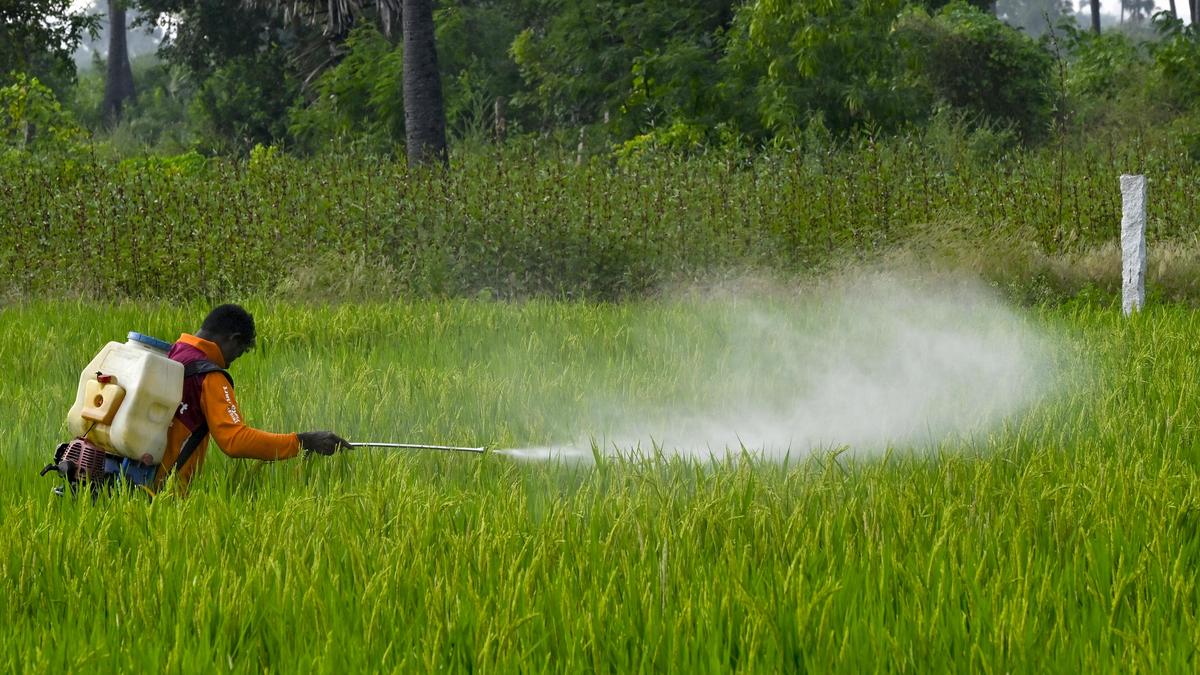
Pesticide residues do not arrive as a single dose. They arrive in a vegetable, a glass of water, and the air of a home, often on the same day, and none of India’s three major monitoring systems is built to add them up.
In 2008, in the Orissa village of Sindhikela, village residents used pesticides to kill street dogs and discarded the leftovers in a drain that ran above a damaged water pipeline. Overnight, negative pressure in the pipe drew the pesticide in; the next morning, it came out of household taps. Sixty-five people fell ill, and two died, an outbreak later investigated and documented in Journal of Toxicology. It was, on paper, an isolated incident, a single contaminated pipe in a single village. But isolated incidents are exactly how India’s three pesticide-exposure pathways, food, water, and air, have been understood and regulated for decades: as separate, occasional events rather than a single, nationwide condition of chronic, cumulative exposure that current regulation cannot see.
A handpump in Punjab’s Malwa region draws water shaped by decades of agricultural inputs; in Bhuttiwala village, what residents call a “cancer village,” a local health survey identified 20 cancer patients, and within eight months, 18 of them had died, media reports indicated in 2015. In Kerala’s Kasaragod, a 2018 study found endosulfan residues in the soil twenty years after spraying stopped. In Bihar and eastern Uttar Pradesh, agricultural runoff feeds rivers that double as drinking water sources. Four States, no obvious link between them, except that each shows the same pattern: exposure has moved beyond the farm and the single spraying event into a continuous presence in everyday life. In urban homes now, repellents and aerosol insecticides keep indoor air carrying a steady chemical load.
From our food
What this means for human health is harder to quantify. According to the survey report of the Monitoring of Pesticide Residues at National Level scheme run in 2017-18, 23,660 food samples were tested, and pesticide residues turned up in 19.1%, while 2.2% of the samples breached the Food Safety and Standards Authority of India’s Maximum Residue Limits (MRL). A more recent government count of 86,000-plus samples between 2022 and 2025 found 2.8% over the limit, the Union Health Ministry told the Rajya Sabha in 2025. Both read as reassurance, since only a small fraction exceeds the threshold. But MRLs are set per item, and diets are not eaten one item at a time: a meal draws on several commodities at once, each contributing a load that may be individually under the threshold but collectively untracked. The exposure that matters is the sum, not the single exceedance.

From fields to water systems
Water is the second, and in many regions larger, pathway. According to the National Compilation on Dynamic Ground Water Resources of India, 2024, India draws 245.64 billion cubic metres of groundwater a year. This amounts about a quarter of global extraction, and a bulk of the country’s drinking water supply comes from it. In Punjab and Haryana, decades of fertiliser- and pesticide-intensive farming have left their mark: the Central Ground Water Board’s 2024 Annual Groundwater Quality Report found nitrate contamination in close to a third of samples nationally, and 46% in Bathinda district alone. Pesticide residues turn up alongside the nitrates in the same belts, and the Ganga basin shows a parallel pattern, with runoff carrying residues into rivers that serve irrigation and drinking water alike.
Kasaragod’s endosulfan residue, persisting two decades after the ban, shows this is a problem of time as much as geography. A 2011 report on the health effects of endosulfan, by the Kerala government’s health department, found significantly higher rates of neuro-behavioural disorders and congenital malformations in the exposed population than in a comparable, unexposed one nearby. Two decades on, surveys have recorded over 3,000 children in the district with congenital disabilities, alongside elevated cancer, epilepsy, and cerebral palsy. Chlorpyrifos, atrazine, and organochlorines have also been logged in water bodies across several other States, evidence that this pathway, from field to tap, and from contamination to diagnosis, remains active well beyond one State’s headlines. The Ministry of Agriculture and Farmers Welfare in 2023, said 46 pesticides have been banned or phased out on safety and efficacy grounds.

Air and indoor environments
Air is the least monitored of the three. Pesticides volatilise after application and drift past the field boundary, an exposure routine air-quality monitoring does not capture. Indoors, the load is more direct: repellents, aerosol insecticides, vaporisers, fumigants for stored grain, even pesticidal paints engineered to release insecticide for months at a stretch. The U.S. Environmental Protection Agency notes that indoor pollutant concentrations can run two to five times higher than outdoors, a significant factor in populations that spend a majority of their time indoors. Comparable Indian data is sparse, itself part of the problem: a pathway nobody measures is a pathway nobody can regulate.

Three pathways, one body
India treats these three pathways as separate problems, each with its own laws and its own ceilings. The Insecticides Act of 1968 governs manufacture and application; the Central Insecticides Board and Registration Committee handle approvals; FSSAI sets food MRLs against international benchmarks and the Water (Prevention and Control of Pollution) Act, 1974 governs groundwater contamination, apart from State-specific laws. Each piece does its job for a single chemical and a single route of entry. None asks what happens when food, water, and air all carry the same compounds into the same person on the same day.
The health data is no longer abstract. A 2023 ICMR-funded biomonitoring study of 493 Telangana adults, comparing 341 long-exposed farmers against 152 unexposed controls, found significantly lower acetylcholinesterase activity among the exposed, a biomarker linked to Parkinson’s and Alzheimer’s risk. A 2025 ICMR case-control study of 808 West Bengal residents aged 50-plus found 22.3% screened positive for cognitive impairment, depression, or movement disorders, with pesticide exposure carrying nearly three times the risk (odds ratio 2.9); 12.5% had cognitive impairment alone, higher than in many urban elderly populations. Much of this goes unrecorded at the point of care: a farmer with neurological symptoms is rarely asked about pesticide history, so the chemical link never enters the record.

The cost of measuring in parts
None of this requires a new contamination event to become urgent. It is already the condition most Indians live in. These pathways do not affect three different populations; they converge on the same body, often on the same day. A system built around a single chemical and single routes of entry was adequate when exposure was occasional. It is not adequate now that exposure is constant.
What would change this is not more alarm but better arithmetic: monitoring that adds food, water, and air exposures together instead of clearing each in isolation, and toxicology that accounts for mixtures rather than one compound at a time. Until that arithmetic exists, the absence of a breached limit will keep being mistaken for the absence of risk. A residue that stays below every threshold is still a residue the body has to process, and right now, it is the one number nobody in India’s regulatory system is required to add up.
(Dr. Sudheer Kumar Shukla is an environmental scientist and sustainability expert. He currently leads the think tank at Mobius Foundation, New Delhi. sudheerkrshukla@gmail.com; Dr. Neha Tyagi is a QC microbiology scientist and environmental health researcher. neha.tyagi107@gmail.com)
Published – July 08, 2026 01:31 pm IST