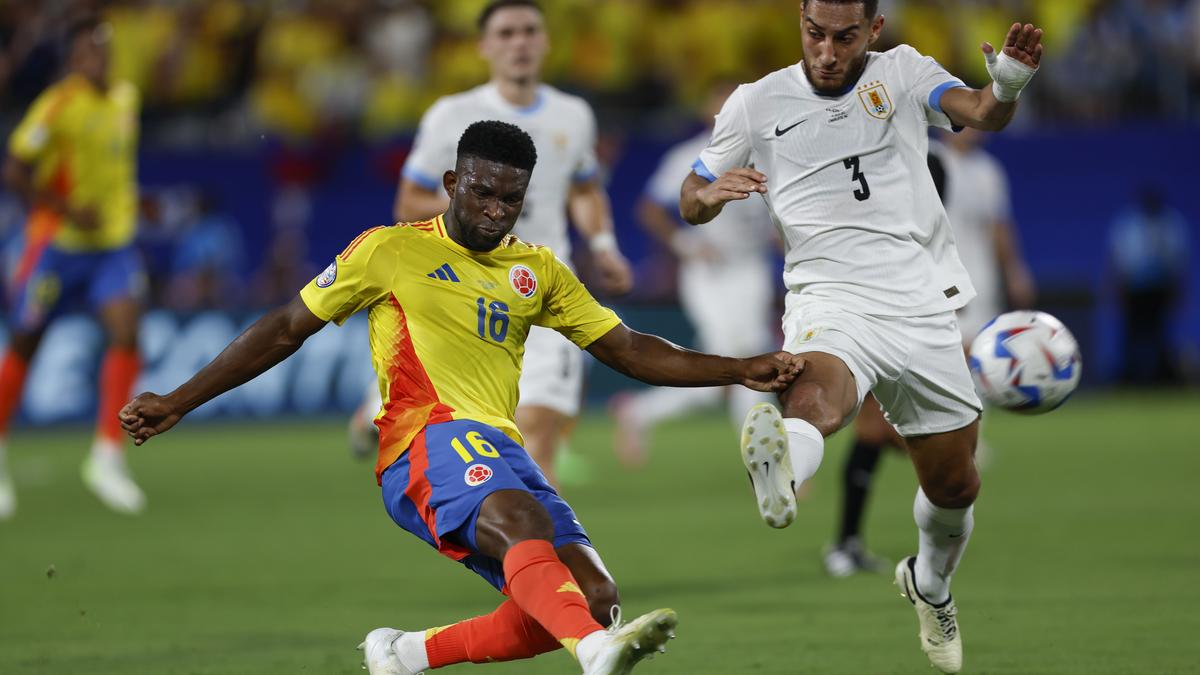

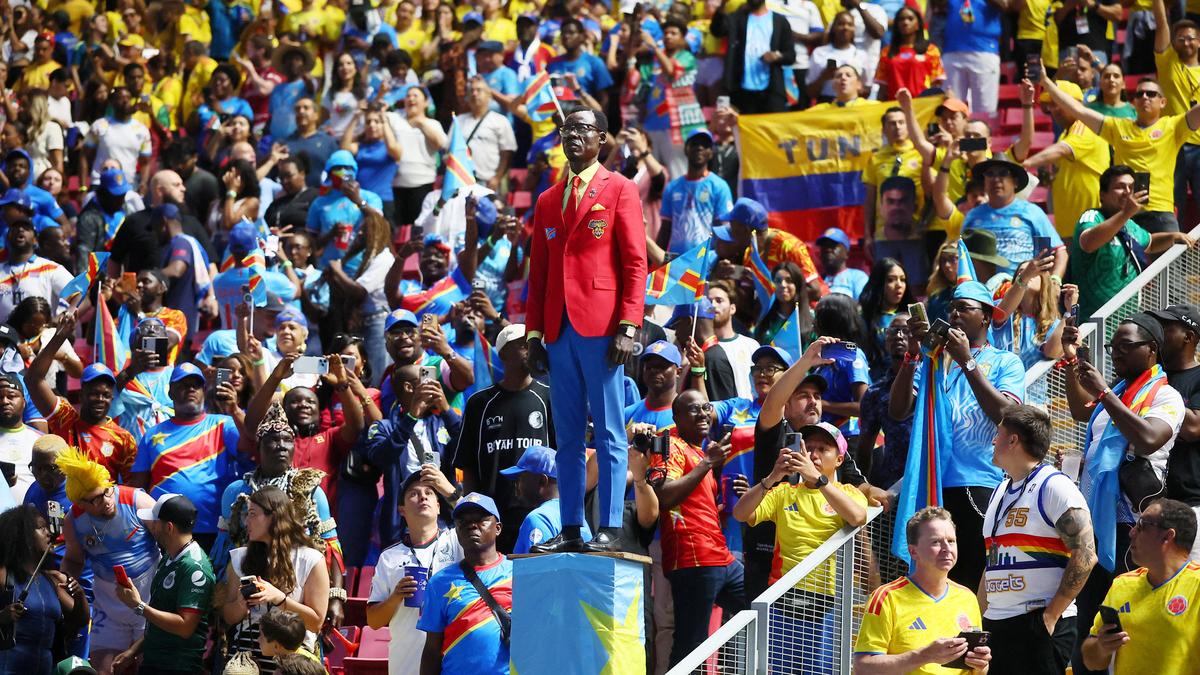
It was just another group match in the FIFA World Cup 2026 on the outskirts of Guadalajara, Mexico, where Colombia and Democratic Republic of Congo (DRC) were fighting out to be better poised to come out of their groups. Stakes were low, and the atmosphere normal for a World Cup match. But one man stood out, a living statue. By then most of the footballing world had heard about him and his quiet and literally still demonstration. Dressed in bright colours, hair combed clean, and holding a serious expression behind the glasses meant to bring out a resemblance, Michel Kuka Mboladinga stood on a makeshift podium for the whole duration of the match, his right hand stretched out and his eyes fixed to the sky. Some would find it difficult to figure out the posture, but for the people of DRC, Mr. Mboladinga’s act is just another reminder of their most revered leader: Patrice Lumumba, the country’s first elected Prime Minister who was assassinated seven months into its independence.
Also read | DR Congo fan who stands as living statue of independence leader Lumumba makes it to World Cup
The mineral-rich nation in the heart of Africa was colonised by Belgium under King Leopold II in the 19th century, and generations of Congolese grew up seeing their lands dug up in search of gold, diamond, nickel, cobalt, and even uranium (some of which ended up in Hiroshima and Nagasaki as fissionable cores of the atomic bombs used by the U.S.) and forced to take part as ‘bonded labourers’. Lumumba was born on July 2, 1925, in an ethnic minority tribe in Kasai Province. He received missionary education and went on to begin his career as a postal clerk, a feat only few people of colour achieved in the colonial DRC, given the exploitation and violations the masses were subjected to. A young Lumumba, who was inspired by the writings of Voltaire and Victor Hugo, started his social life with the club ‘evolves’, a group of western-educated Africans, where he would publish poems and articles which evolved into contributions to the press. In 1955, aged 30, Lumumba became active in trade unions but remained largely sidelined in the independence movement that was slowly taking shape. Lumumba had a brief prison stint in 1956 when he was arrested on charges of embezzlement from the post office and spent a year behind bars. While not a political prisoner, jail changed Lumumba and the man who came out of prison was more political than ever. He started the Mouvement National Congolais, or Congolese National Movement (MNC), the country’s first national political party which was not aligned with the Belgian regime, now under King Baudouin. Inspired by the independence of neighbouring Ghana under Kwame Nkrumah, Lumumba and MNC made stronger demands for independence, which managed to move the Belgian masters who sought compromise with local elections. The MNC boycotted the election, and polling saw violence erupting with bloodshed in the city of Stanleyville which led to the arrest of Lumumba. The MNC shifted stands following the violence and decided to contest elections, which it won in a landslide.
The rising demands for independence and the desire to avoid more bloodshed, at least while it was still in control of the region and thus accountable too in front of a changing bi-polar world order and the United Nations, Belgium agreed for a roundtable in Brussels to discuss the situation. The MNC refused to attend while its leader was in jail, and Lumumba was released. At the meeting, Belgium agreed to move out of the country, setting June 30 as the date for independence which would follow a general election in May. MNC comfortable won the election, paving the way for Lumumba to become Prime Minister.
On June 30, at the event to mark independence, Belgian diplomats, in presence of King Baudouin, took pride on the contributions of the imperial state in the nourishment of the colony as the Congolese, bent under the weight of being second class in their home, looked on in silence. President Joseph Kasavubu, a Belgium admirer, echoed the sympathy and thanked the benevolent masters for granting the country independence. All looked and sounded diplomatic enough for the King when Lumumba got up to speak. Lumumba’s speech was not part of the programme schedule, and his words had not been vetted by the colonisers. But his speech was distributed to congolese press in the crowd and some had an idea of what was about to come.
“Morning, noon and night, we were subjected to jeers, insults, and blows because we were ‘Negroes.’ We shall show the world what the black man can do when working in liberty, and we shall make the Congo the pride of Africa,” Lumumba, just 35 then, roared to the Congolese crowd. “Although this independence of the Congo is being proclaimed today … no Congolese will ever forget that independence was won in struggle,” he declared.
The speech, that moved Congolese in the new-born country with overwhelming emotions of unity and fraternity while reminding them of the wounds that the benevolent-looking Belgians had inflicted on them for generations, marked the path for Lumumba that ended up in a vat of sulphuric acid.
What Belgium expected to be peaceful handover of power while still experiencing loyalty for the colonial development of the DRC turned into an outright dismissal of its influence after Lumumba’s speech, and off a chain reaction that ignited a civil war. Katanga Province, one of the richest regions in the country, soon declared secession under Moise Tshombe, a Belgian loyalist whom American civil rights activist Malcom X once referred to as “the worst African ever born”. Claiming concern over the security situation in the country and safety of Belgians remaining there, the European power sent troops into Katanga for the protection of its citizens, which also enabled Tshombe, who welcomed the troops, to consolidate power in the region. Lumumba turned to the UN, which sent of the largest peacekeeping mission to Congo. But the UN ended up limiting Lumumba’s options. Conor O’Brien, an Irish diplomat who later led UN operations in Congo, had noted that Dag Hammarskjold, the UN chief then, shared the “sometimes unconscious European assumptions that order in Africa is primarily a matter of safeguarding European lives”. The UN mission was reluctant to enter Katanga, which they inferred might be seen as a move against Belgium with its troops in the region, and neither were they keen on seen as being used by Lumumba, rendering them effective bystanders in the crisis. Lumumba, growing increasingly alienated in his own country, reached out to the U.S. in vain and then turned to the Soviet Union, which sealed Lumumba’s fate.
With the Cold War at its peak, an African leader, that too of a mineral-rich nation, turning to Soviet Union was not feasible for the U.S., and the Dwight D. Eisenhower government, as reported by several outlets quoting declassified documents of the Central Intelligence Agency, authorised a scheme to “replace the Lumumba government”. Congo became the training ground of the same playbook that the CIA used in Chile. With the country becoming fragmented President Kasavubu ordered the dismissal of the Prime Minister on September 5, a decision Lumumba immediately contested on constitutional ground. While the President and the Prime Minister locked horns, the country’s Army Chief, Colonel Joseph Mobutu seized power in a coup on September 14. Lumumba was subsequently placed in house arrest while in November, the UN recognised Kasavubu’s claims to the government. Lumumba managed to escape from his house arrest, but was captured by Mobutu’s forces in December, and with the knowledge of the CIA and amid UN inactivity, transferred to Katanga province where the rival faction waited. On January 17, 1961, Lumumbu, along with two close associates, Joseph Okito and Maurice Mpolo, were handed over to secessionist troops in Katanga, where they were subjected to torture and executed by a firing squad. Their bodies were initially disposed in a shallow grave, but were later dug up and dissolved in sulphuric acid. A Belgian police officer involved in the disposal of the leader took a tooth with him, which was initially handed over to the Belgian authorities and later, after legal proceedings in the European country, returned Lumumba’s descendants in DRC in 2022 for a symbolic funeral.
While Malcom X called out the ‘worst African’ in Tshombe, the American activist called Lumumba “the greatest Black man who ever walked the African continent”. While several accounts also suggest Lumumba to be in the grey, with the sin of ambitions invoked by Mark Anthony on Julius Ceaser and an unpredictable nature refusing to trust anyone but himself, later revolutionaries and leaders on the continent like Thomas Sankara of Burkina Faso and even Nelson Mandela would draw inspiration from the postal clerk who stood against a European power.
On Saturday (June 27, 2026), Mr. Mboladinga is expected to visit Atalanta the U.S. where DRC would play Uzbekistan in hopes of advancing from the group. In the same country which planned the removal of Lumumba, Mr. Mboladinga would stand a living statue with his hand raised in solidarity and tribute to the leader who at the end of the day, was all black and nothing but an anti-imperialist.
Published – June 27, 2026 08:57 am IST