



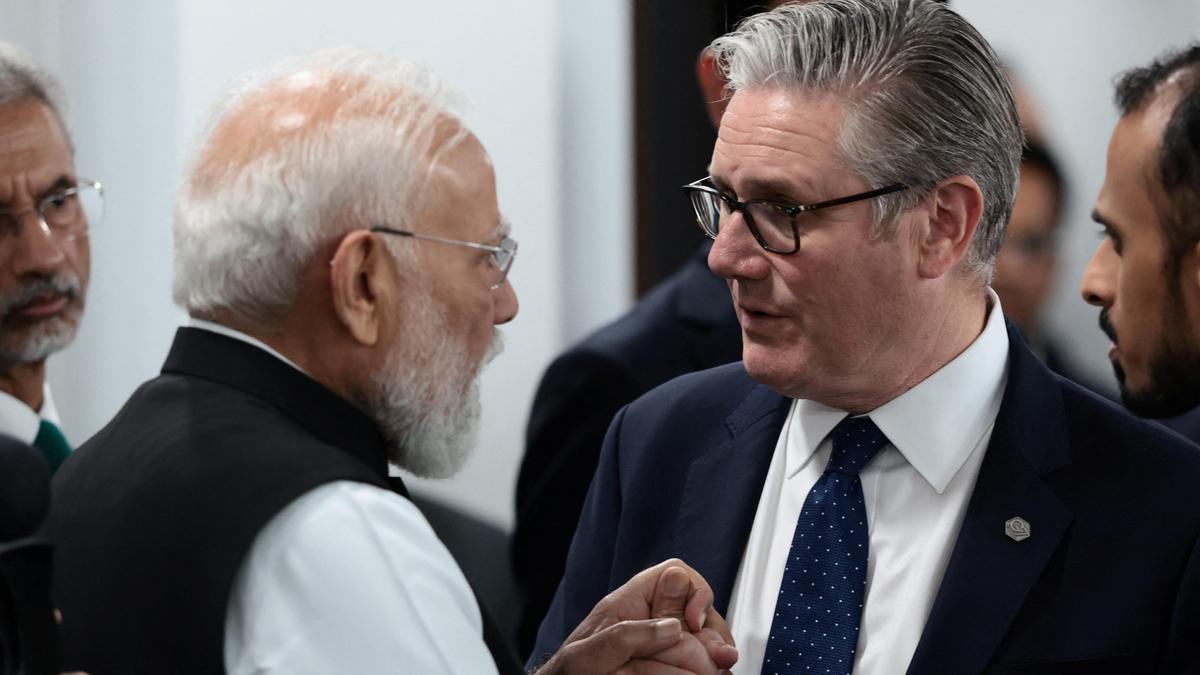
British Prime Minister Keir Starmer speaks with Prime Minister Narendra Modi as they arrive for a working session with G7 leaders and outreach partners on promoting economic growth during the G7 Summit in Evian-les-Bains, France, onJune 17, 2026.
| Photo Credit: Reuters
India and the United Kingdom have overcome last-minute differences over steel import duties to finally announce July 15 as the implementation date for the trade deal between the two countries, the two governments announced on Wednesday (June 17, 2026).
The Comprehensive Economic and Trade Agreement (CETA) was signed by the two countries in July 2025 and was all set to be implemented by April or early May 2026.
However, a fresh regulation by the U.K. announced in May and applicable to all countries cut the quota for duty-free steel imports by 60% and doubled the tariff on above-quota imports to 50%. These new rules are to come into effect from July 1, 2026.
These tariffs and quotas were not part of the trade deal negotiations and suddenly halted the implementation process. According to Commerce Secretary Rajesh Agrawal, a team from India has been in the U.K. over the last few days to move things along.
“Delighted to note that the India-UK Comprehensive Economic and Trade Agreement will enter into force on 15th July 2026,” Prime Minister Narendra Modi posted on X following the announcement. “This agreement will significantly boost our bilateral trade and investment.”
The implementation of the trade deal, under which the U.K. will remove tariffs on 99% of its product lines, will be accompanied by the implementation of the Agreement on Social Security, also referred to as the Double Contribution Convention (DCC), on July 15.
Through the DCC, India is set to secure several mobility and competitive concessions for Indian professionals in the United Kingdom.
“Demonstrating the collaborative strength of the India-UK Comprehensive Economic Partnership Agreement (CETA), India and the United Kingdom have successfully reached a landmark consensus to safeguard and promote bilateral steel trade,” the Ministry of Commerce and Industry said in a release.
Without revealing details on what exactly the solution to the UK steel tariff issue would entail, the release added that “both sides mutually agreed to protect commercial interests, minimise market disruptions, and ensure an overall balanced and stable trading environment for exporters”.
It further said that such protections would be through a mix of country-specific quotas, residual quotas and access under an Authorised Use Scheme (AUS).
Published – June 17, 2026 09:32 pm IST