



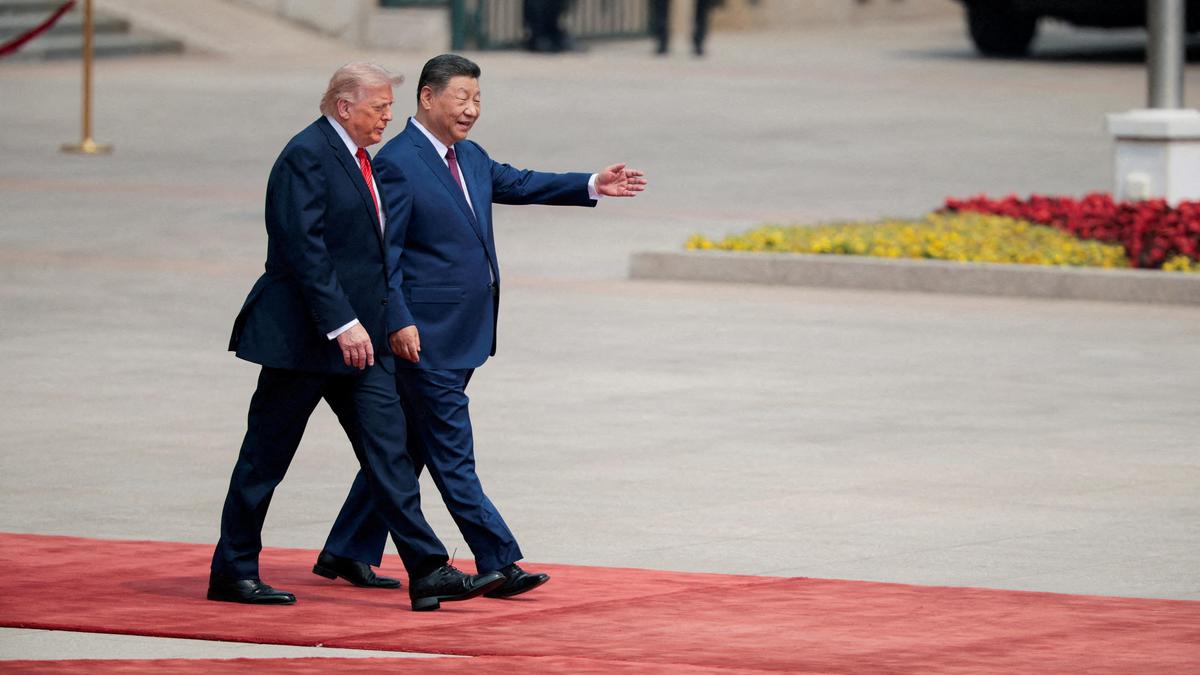
After a nine-year hiatus, United States President Donald Trump once again set foot on Chinese soil, and the “Beijing Moment” immediately went viral around the world. Why did this historic meeting draw such widespread attention? What were the important outcomes achieved? And what does it mean for the future development of China-India relations? I would like to share my observations and thoughts with our Indian friends.
First, why has the China-U.S. Summit captured the world’s attention? The world today is fraught with turmoil and instability. The more complex and grave the global situation becomes, the greater the need for a stable and constructive China-U.S. relationship.
Just as Robert Kuhn, President of the Kuhn Foundation of the U.S. said, “In an uncertain world, a handshake between Chinese and American leaders is the ‘hard currency’ the global market needs most.” This statement captures the shared aspirations of the international community. As noted by some Indian media outlets, this leaders’ meeting could be the most significant encounter between Chinese and American leaders since Chairman Mao Zedong met President Richard Nixon in 1972.
Support for a new vision
Second, what are the outcomes of the China-U.S. handshake? A key outcome of this summit is that the two leaders agreed on a new vision of building a constructive China-U.S. relationship of strategic stability, providing strategic guidance for bilateral relations over the next three years and beyond. Both sides will support this new vision with tangible cooperation.
Economic and trade cooperation is the “ballast stone”. Among those accompanying Mr. Trump on his visit to China were 17 American business titans, including Tesla CEO Elon Musk, Apple CEO Tim Cook and Citi Chair and CEO, Jane Fraser. During the interviews with the media at the Great Hall of the People in Beijing, they stated that the successful meeting between the two leaders has injected new impetus into U.S.-China economic and trade cooperation and provided certainty for the global economy.
After multiple consultations, the two economic and trade teams produced generally balanced and positive outcomes, including establishing a board of trade and a board of investment, addressing each other’s concerns regarding market access for agricultural products, and expanding two-way trade within the framework of reciprocal tariff reductions. These efforts have stabilised economic and trade ties as well as market expectations.
Sci-tech cooperation is the “bellwether”. During this visit, the news that “NVIDIA founder and CEO Jensen Huang made a dramatic, last-minute entry into Beijing aboard Air Force One” spread far and wide. This intriguing detail precisely illustrates that “decoupling and severing of supply chains” is unworkable, mutual support and common progress are the right way forward.
The New York Times columnist Thomas Friedman also wrote an article calling on China and the U.S. to work together to address the first era in human history in which common development and prosperity can only be achieved through global governance, innovation, and cooperation. Coordination between China and the U.S. on Artificial Intelligence (AI) is crucial to the future of both countries and the destiny of humanity. It is hoped that the U.S. will work in the same direction with China, making AI a new frontier for China-U.S. cooperation and a new ladder for human progress.
People-to-people exchanges are the “lubricant” of bilateral relations. During the summit, both leaders emphasised the importance of promoting such exchanges. This reflects not only the consensus between the two leaders, but also the shared aspirations of the two societies. President Xi Jinping had announced an important initiative in 2023 to invite 50,000 young Americans to China over a five-year period. Over the past three years, more than 40,000 American youths have participated in exchange and study programmes, significantly boosting interactions between the two peoples, especially among young people. A poll by the Chicago Council on Global Affairs showed that 53% of Americans favour friendly cooperation and engagement with China.
The Taiwan question
Sensitive issues are the “red line”. The Taiwan question was an important topic taken up at the summit. President Xi emphasised that the Taiwan question is the most important issue between China and the U.S. If it is handled properly, the overall relationship will be stable. Otherwise, the two countries will have clashes and even conflicts, and the entire relationship will be in great jeopardy. “Taiwan independence” and cross-Strait peace are as irreconcilable as fire and water. China and the U.S. both agree on the vital importance of safeguarding cross-Strait peace and stability. The U.S. must exercise the utmost prudence in handling the Taiwan issue. In an exclusive interview with Fox News, Mr. Trump made it clear that “we are not looking at somebody say ‘let’s go independent because the United States is backing us’. I’m not looking to have somebody go independent and we’re supposed to travel 9,500 miles to fight a war.” This demonstrates that the U.S. has understood China’s position and responded to China’s concerns.
China-U.S. stability supports Asia
Third, what does the China-U.S. rapprochement mean for China-India relations?
Some people worry that the rapprochement between China and the U.S. may compress India’s diplomatic and strategic space. Such concerns are unwarranted. The remarkable achievements of China and India are built on the hard work and wisdom of their own peoples, and are by no means the result of others’ generosity, much less subject to the ups and downs of any single bilateral relationship.
The strategic stability of China-U.S. relations provides positive and stable expectations for the world, which will benefit India, Asia, and the world as a whole.
China deeply understands India’s aspiration for national rejuvenation and sincerely supports India’s foreign policy of strategic autonomy. We stand ready to work with the Indian side to strengthen high-level exchanges, deepen mutually beneficial cooperation, enhance people-to-people exchanges and promote multilateral coordination within mechanisms such as BRICS, so as to achieve the sustained, healthy and stable development of bilateral relations.
The way for major countries to get along well lies in seeking common ground while reserving differences and coexisting peacefully. The path to regional prosperity lies in common progress and shared flourishing. Perhaps this is the very lesson drawn from this China-U.S. summit.
Xu Feihong is Chinese Ambassador to India
Published – May 20, 2026 12:16 am IST