


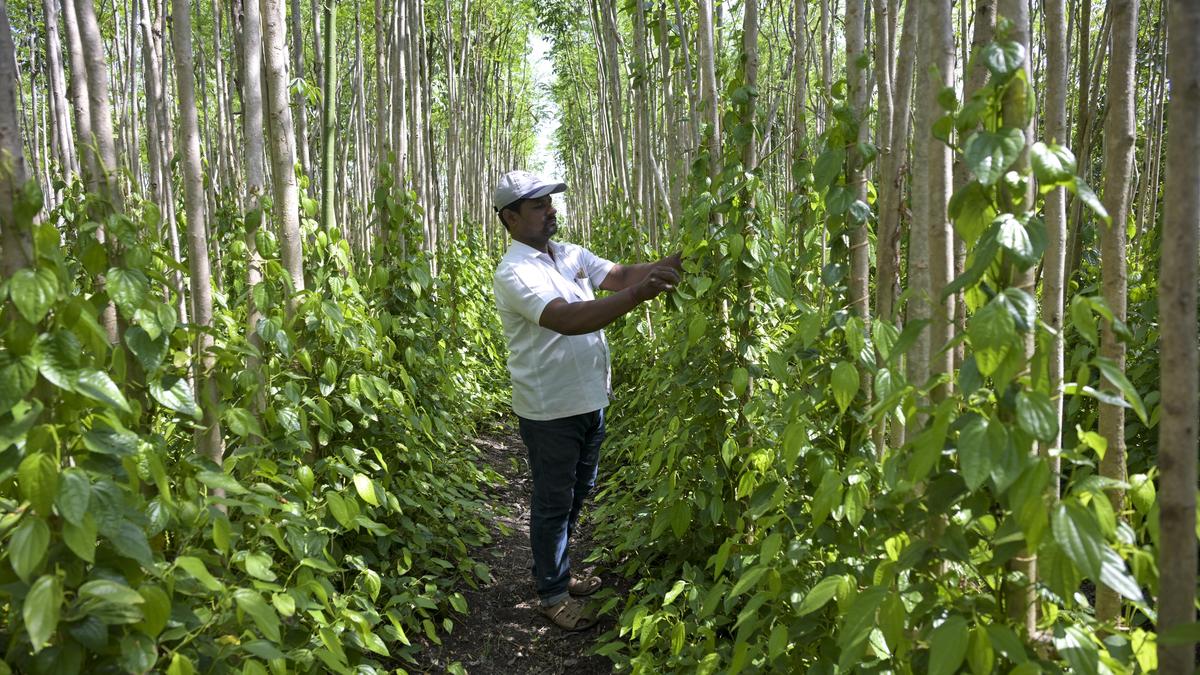
Nagubai Chaudhary, 52, had always believed that the land would take care of her, and it did. For as long as she can remember. But in 2025, unseasonal rains lashed parts of western and central Maharashtra. The flash floods that ensued devastated the kharif crop.
When the land began to dry, Nagubai and her husband, Malinath, 60, had to quickly think of how to survive the season. “We paid to level the damaged topsoil, and sowed onions. They usually give a quick yield. But the crop failed. It created more debt,” said Nagubai, wiping her tears with the end of her floral pink saree.
Then, her husband died. She needed to clear a debt of ₹14 lakh, taken to fund farming and the bills from Malinath’s hospitalisation.
Nagubai and her husband owned 1.5 acres of land in Chincholi village in Maharashtra’s Dharashiv district. She was forced to sell an acre to repay the debts. “I have lost my husband, the land, and a crop,” she says.
Maharashtra’s Agriculture Department estimated that last year 3 million farmers were affected by floods that devastated 6.5 million hectares of crop area through August and September. The rains flattened soyabean fields in Vidarbha, rotted onions in Nashik, destroyed pulses in Marathwada, and flooded paddy plots across the low-lying belts.
The Maharashtra government announced a ₹31,628-crore relief package on October 7. In the following months, several farmers say they have no clear idea of how much they are due, despite a government assessment. Nagubai says she was promised only ₹2,500 two months before her husband died. Sitting in a pink small room, one corner of which is designated as a kitchen, she explains: “Even this money is stuck as I still don’t have my husband’s death certificate.”
According to the State Relief and Rehabilitation Department, the compensation for crop loss was ₹18,500 per hectare (1 hectare is 2.5 acres) for rainfed land, ₹27,000 per hectare for irrigated land, ₹32,500 per hectare for horticulture or perennial land (like orchards). In addition, if the topsoil had been washed away, a farmer was to get ₹47,000 per hectare.

To help restore the topsoil, the government promised to employ people through the Mahatma Gandhi National Rural Employment Guarantee Act (MNREGA) scheme that guarantees 100 days of work to the unemployed.
Nagubai is now surviving on money left from the land deal, ₹1,500 per month from the Sanjay Gandhi Niradhar Anudan Yojana for those below the poverty line, and paid work under MNREGA. A part of the topsoil of her land was washed away, she says, but she has spent ₹14,000 to restore it. There has been no government help. Several farmers from Marathwada’s six most impacted districts, as well as from western Maharashtra’s Solapur, say they have not received the whole compensation. Many farmers have now paid from their pockets or taken another loan to improve their lands and get ready for rabi crops.
In Dharashiv, the Maharashtra government identified 7.03 lakh farmers affected by the floods. So far, 5.2 lakh have been compensated, says Collector Keerthi Kiran Pujar. “The rest will receive the funds after the e-KYC (Know Your Customer) is done. Most of the farmers have received relief. The relief under MNREGA and topsoil-replacement money will be given as per the claims raised by farmers with the grama panchayat.” Mantralaya, Maharashtra’s administrative headquarters located in Mumbai, has not responded to queries on data from across the affected areas.

During the relief package announcement, Chief Minister Devendra Fadnavis had said, “The package will be distributed to the farmers in 29 (out of 36) districts, covering 253 (out of 358) talukas and over 2,000 revenue circles before Deepavali (in 2025). However, no one can provide 100% compensation to farmers’ financial and mental crisis.”
From January to April, 2026, in Dharashiv, 36 farmers took their lives, while from July to December 2025, up to 78 farmers died by suicide, according to the Collector’s office.
The lost farms
A group of farmers from Rajegaon village have gathered at one of the classrooms of the government zilla parishad school. Narayan Deshmukh,52, sits on a chair in front of a wall with photographs of India’s leaders from different eras: Fatima Shaikh, Savitribai Phule, Indira Gandhi. “Time is ticking. Slowly my land size will shrink. The rain caused heavy damage. What about our lost farmland? The restoration will cost more than the government’s aid,” he says, then concedes, “But every little amount counts.”
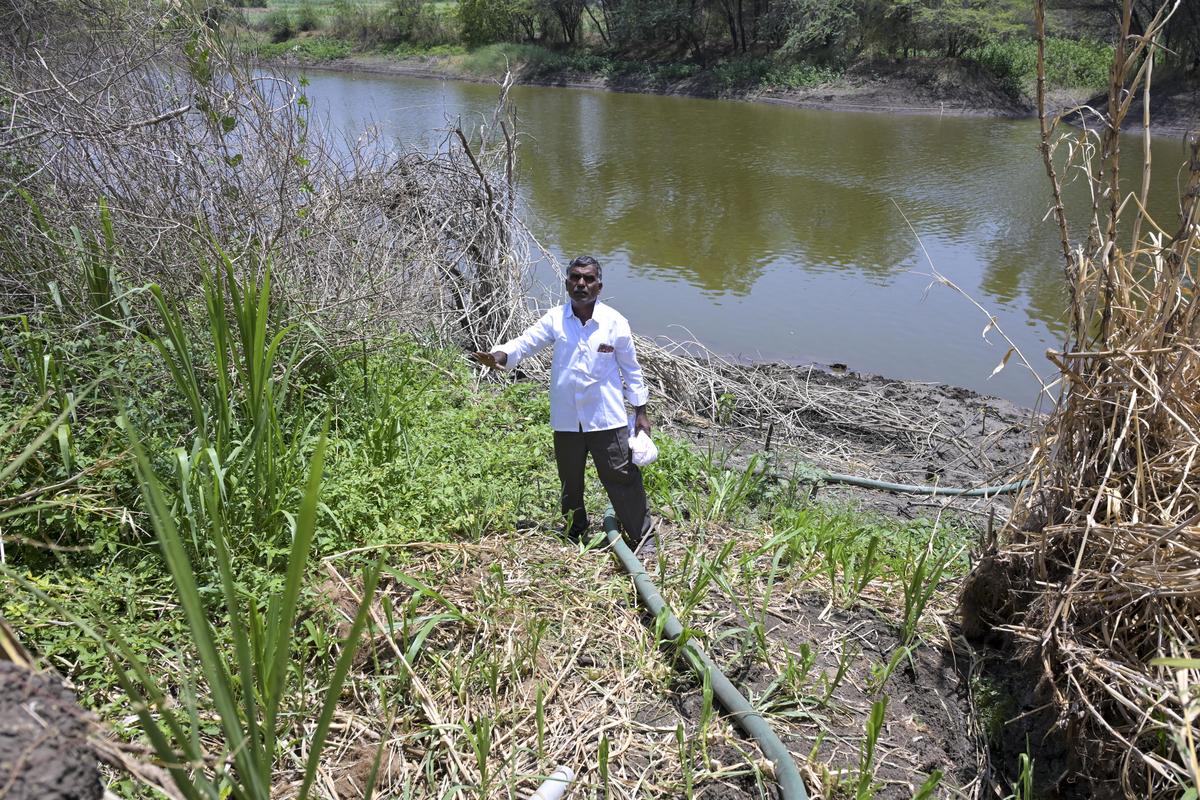
Narayan Deshmukh shows the part of his farm that was swept away after heavy rains.
| Photo Credit:
Emmanual Yogini
Narayan’s farm is on the banks of the Terana river, and during the unseasonal rainfall, at least 30 guntas of his 5-acre land were washed away. He says, “It is now becoming a yearly occurrence, as rainfall increases. The government opens the gate of the Terana dam unannounced, and water enters the field.” The other farmers in the group highlighted the same issue.
Dharashiv district comprises eight talukas, including Umarga, where Rajegaon is located. It spans 7,569 sq. ksm and is characterised by semi-arid terrain with hilly plateaus and river valleys. The Manjara, Terna, and Sina rivers overflowed last year, with the excess water entering fields, affected 159 villages across six talukas.
Solapur too experienced this, with soil erosion, sand deposition, and fertility loss, particularly along the river basins. About 186 km from Rajegaon is Beed’s Mazalgaon taluka, where Baliram Gholap, 30, who owns 5 acres of land, also says he has not received assistance for the restoration of topsoil.
“I received just ₹1,000. I don’t want money. Can the government get the restoration work done?” says Gholap, adding that renting an earth mover costs a minimum of ₹8,000, and 1 brass costs ₹3,000 to 6,000, depending on the quality of soil and the labour.
Gholap incurred a loss of ₹1.5 lakh, used to sow cotton due to unseasonal rainfall.

“If the cotton had been harvested, I would have earned at least ₹3 lakh. I borrowed ₹1 lakh, and now I can’t pay the instalments,” he says. He cannot afford to farm any more, and now works in a sugar factory for a salary of ₹10,000 per month. If he takes no leave, he gets ₹2,000 more. “I will farm next year, when conditions are favourable.”
Another farmer, Samadhan Mhaske from Solapur’s Undargaon, which is near the Sina river, wipes his face, and says, “Where is the ₹47,000 per hectare or MNREGA help? At least 1.5 hectares of topsoil were washed away and huge dunes emerged.”
He, along with his extended family members, owns 4 hectares of irrigated land and has received ₹35,000 via a direct bank transfer so far. He also claims that 150 farmers like him have not received any compensation for the restoration of topsoil. There are 17 more villages near the Sina river, including Keval, where the Sina river water entered the fields and took away a portion of the fertile soil, leaving the silt.
Low response to MNREGA
Under the MNREGA scheme, facial recognition is compulsory while logging in and logging out on the National Mobile Monitoring System (NMMS) app. It takes digital attendance, geo-tags assets, has an Aadhaar-based payment system, and real-time monitoring of works. Many farmers are facing problems due to delays in Aadhaar verification and bank linking, leading to pending wage payments among elderly workers, women, and people in remote villages struggling with biometric authentication and smartphone-based attendance.
Nagubai, who also has a job card under MNREGA, says, “The payment is irregular. I started working in January and got paid in March. That too ₹312 per day. I could have earned ₹500 if I worked outside the government scheme.”
Government officials have acknowledged that due to irregular payments, the uptake is poor.
Vidhyasagar Gaikwad, 47, from Chincholi village in Dharashiv works as an ad hoc assistant maintaining the attendance for MNREGA workers on the app. He and the members of the Maharashtra Gram Rozgar Sahayak Sanstha, a citizen group established in 2016 for the rights of MNREGA workers, are on a protest.
They say thumb imprints and facial recognition is not a reliable technology. “At a time, 70 works are going on in the village. I have to visit every single place twice a day. And now with two shifts in place, almost four times a day, I cover at least 15 km. The government says to spend two hours on this, but we spend almost half a day trying to register attendance,” he says.
The hope for insurance
After the unseasonal rainfall and flash floods, the crops vanished overnight and insurance survey teams appeared. In Dharashiv alone there were 49,601 claims amounting to over ₹2,226 crore, as per the Agriculture Department. Many farmers say they are awaiting insurance money.
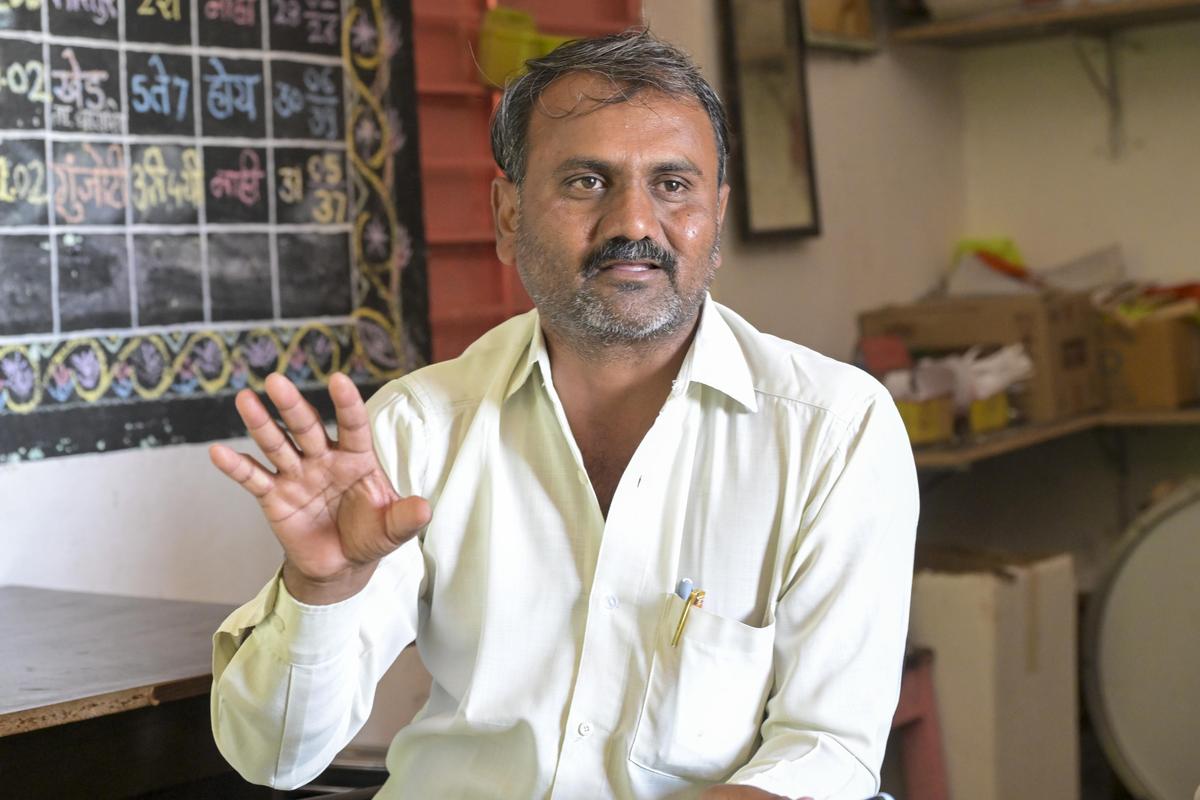
Avinash Deshmukh, a farmer from Rajegaon.
| Photo Credit:
Emmanual Yogini
In Rajegaon, a sun-scorched farmer in a clean white shirt and brown trousers, Avinash Deshmukh,42, points to the river flowing near his farm, saying, “It has been nine months and I am still not able to restore the ditches. I did everything by the book: got insurance, paid premiums on time, reported the damage, yet I am still waiting for the insurance money.”
To calculate insurance claims, the Maharashtra government uses a combination of the crop cutting experiment (CCE) and satellite imagery. Under CCE, the State conducts sample harvests in selected farms of a village or insurance unit area. They cut crops, weigh the produce, and estimate average yield per hectare, giving them the actual yield (AY) for that area. This AY is compared with the yield threshold (YT), which is calculated beforehand using historical production data. If AY is below YT, farmers become eligible for compensation.
Officials in the Agriculture Department, who do not want to be named, claim that the insurance company says there is a discrepancy between satellite-based yield assessments, which are showing greater crop damage, and CCE data that reflect lower losses.
As farmers wait for the next monsoon, they hope that this time there will be no extreme weather conditions.
snehal.mutha@thehindu.co.in
Edited by Sunalini Mathew