

The air in Iran’s holy city of Qom carries many scents these days — smoke from recent attacks, dust from restless streets, and the sharp bitterness of a nation living under the shadow of war. But amid the tension, another fragrance quietly drifts through the crowds gathering every evening: chilled Indian sharbat.
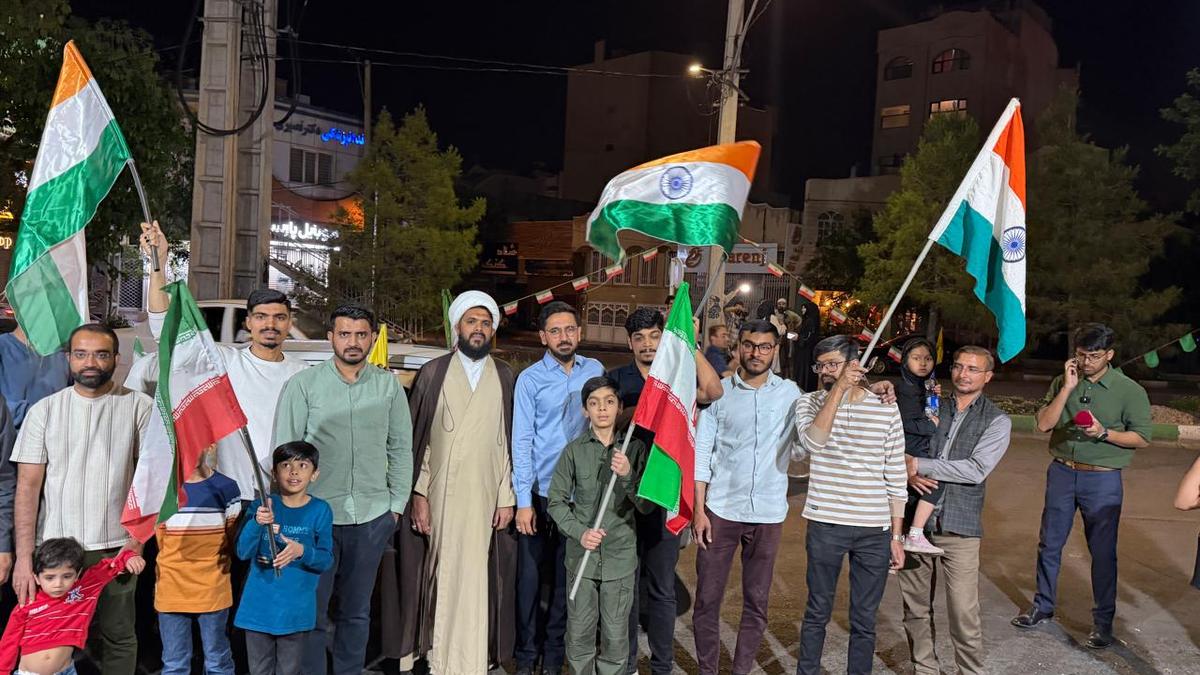
As thousands of Iranians pour onto the streets after sunset — some protesting, some mourning, some simply searching for solidarity — a small roadside stall has begun drawing unusual attention. Above it flutters the Indian tricolour. Behind it stand young Indian students, researchers, and businessmen, handing out glasses of pineapple sharbat to exhausted strangers under the blazing summer heat.
Iran-Israel war LIVE updates – May 13, 2026
In a city shaken by political uncertainty and emotional exhaustion, this modest stall has become something larger than a refreshment counter. For many here, it is a symbol — that while governments may change positions and diplomacy may fluctuate, ordinary people can still choose compassion.
Qom is home to one of the largest Indian communities in Iran. Nearly 3,000 to 3,500 Indians live in the city, many of them students enrolled in religious seminaries and universities. Others are researchers, traders, or retirees who have spent years building lives here.
When tensions escalated and advisories urged Indian nationals to consider leaving, several members of the community decided to stay back.
Some stayed because Qom had become home. Others believed leaving during a crisis would send the wrong message to the people among whom they had lived for years.
Every evening now, many of these Indians gather funds among themselves, buy drinks and supplies, and set up makeshift stalls across protest routes and crowded public spaces.
The scene is striking. Young Indian volunteers stand shoulder to shoulder with Iranian civilians, serving drinks to people chanting slogans against America and Israel, while children wave Iranian flags nearby.
“We wanted people to know they are not alone,” says Haider Abbas, a student from Ahmedabad. “We came here to express grief over the martyrdom of our leaders and to show that we are standing firm. Service is the least we can do in these times.”
Strategic blunder: On the U.S., the Iran war
‘Not just a war between two countries’
For many Indians in Qom, the conflict is not viewed merely through the lens of geopolitics.
Abid Raza Naushad Rizvi, a research scholar living in the city, describes it in deeply moral terms. “This is not just a war between two countries,” he says. “People here see it as a battle between truth and falsehood, oppression and resistance, humanity and cruelty. Anyone who believes in justice cannot remain emotionally distant from what is happening.”
Such views are common among sections of Qom’s deeply ideological atmosphere, where religion, politics, and identity often merge into one emotional narrative.
Yet, despite the charged rhetoric, the Indian volunteers insist their work is focused on humanitarian support, not political mobilisation. Most evenings, the stalls simply provide cold drinks, water, and moments of human interaction in a city living through anxiety.
The letter that changed perceptions
In recent months, certain diplomatic developments had created unease among some Iranians regarding India’s political positioning. Conversations in cafes and markets occasionally reflected disappointment and suspicion. But those emotions, several locals say, softened after seeing Indian volunteers actively participating in relief and solidarity efforts on the streets.
Nazar Abbas Rizvi, a research scholar originally from Lucknow, recalls receiving a handwritten letter from an Iranian woman.
“She wrote that when the war began and India’s official position appeared to change, she became upset with Indians,” he says. “But after seeing Indian stalls on the streets and watching Indians serve people every evening, she realised that ordinary Indians still stood with the people of Iran.”
For the volunteers, that letter became deeply symbolic.
“It showed us that people separate governments from societies,” Nazar says. “Human connections still matter.”

The sharbat itself has unexpectedly become part of the symbolism.
On crowded evenings in Qom, volunteers carry giant steel containers filled with pineapple syrup and ice. Plastic cups are passed rapidly from hand to hand as crowds move through the streets.
Many Iranians stop first because they notice the Indian flag.
Others stay back to talk.
Some ask questions about India. Some thank the volunteers for staying during dangerous times. Others simply smile, take a drink, and move on into the crowd.
In a region where diplomacy is often discussed through oil pipelines, military alliances, and sanctions, the scene unfolding in Qom presents another layer of international relations — one built not by states, but by ordinary citizens.
“These are civilisational ties,” says Abid Rizvi. “India and Iran have centuries of cultural connection. Our country also fought colonial rule and understands the value of independence and resistance.”
Shadow of uncertainty
Although a ceasefire currently holds, fear has not disappeared from Qom.
People still speak in hushed voices about the possibility of renewed attacks. Security remains tight in sensitive areas. Political speeches continue to dominate public life. Funeral gatherings and religious commemorations remain frequent.
And yet, amid all this, life continues.
Markets reopen every morning. Seminaries conduct classes. Children play in narrow alleyways. And each evening, Indian volunteers return to their stalls with coolers full of sharbat.
The Indian tricolour fluttering over a sharbat stall in Iran may not alter the course of geopolitics. But on the streets of Qom, where fear, grief, and uncertainty currently define daily life, it has managed to create something equally powerful: trust.
Saurabh Shukla and Saurabh Shahi are senior editors with The Red Mike