


India’s announcement of its revised Nationally Determined Contributions (NDCs) to the Paris Agreement — the term applied to the mitigation and other climate action targets that countries voluntarily commit to under the agreement — represents a considered step forward when India’s energy and development policies are encountering serious headwinds. It is clear that the government has opted for continuity and incremental advance with respect to India’s earlier NDCs. It is also clearly confident that its commitments will nevertheless be more than adequate in relation to its equitable share of global climate action, in keeping with climate justice and within its expected commitments as a developing nation.
Three climate goals
As the press communique after the Cabinet approval of the updated NDCs noted, there are three specific enhancements that have been committed. The first is an increase in the reduction of emissions intensity of its GDP, from 45% below 2005 levels by 2030 to 47% below 2005 levels by 2035. The second is ensuring that 60% of installed capacity for power generation is from non-fossil fuel sources, while the third is the enhancement of forest and tree cover carbon sinks to 3.5 – 4 billion tonnes of carbon dioxide equivalent above 2005 levels.
India’s climate policies are best understood in the context of its structural constraints as a lower middle income developing country, that determine its available choices for climate action. Over the last three decades, these constraints have not substantially changed, which is also why India continues to insist on the relevance of the United Nations Framework Convention on Climate Change (UNFCCC). But apart from these, given the structure of the Paris Agreement that requires renewed and enhanced commitments to climate mitigation every five years, short-term considerations have also begun to have a considerable weight in the formulation of the NDCs. The rapid deterioration of the global environment for climate action over the last year has undoubtedly brought this issue to the fore.
Enthusiasm for climate action
Structural constraints have not, however, dampened enthusiasm for climate action in India, both at the level of the Centre and the State governments. There is a considerable range of activities designed to set India on the path to low-carbon development, drawing significant public and private sector efforts and resources, including electric vehicles, enhancement of energy efficiency, promotion and deployment of non-fossil fuel sources of electricity generation, new technologies such as green hydrogen and more recently, the active promotion of carbon capture and storage efforts.
But given India’s developmental levels today, it is clearly premature for India to convert all such efforts into the significantly more onerous and accountable commitments that are the NDCs, the progress towards which is to be reported every two years in the Biennial Transparency Report (BTR) to the UNFCCC.
A section of global and domestic public opinion has raised the issue of the adequacy of India’s NDCs relative to a global temperature goal of 1.5 degree warming above pre-industrial levels (the more ambitious part of the Paris Agreement’s goals). Some have downplayed the new targets, one commentator going so far as to call it “a walk in the park”. Others call for increased generation from renewables as the metric and not installed capacity. Even some sections of opinion that have welcomed the NDCs, appear nevertheless to be uncertain on whether these new commitments are genuinely the best that India can make at this time.
The cost of going green
All the above variants of the “India can (must) do more argument” ignore some critical realities that contextualise India’s climate actions. Given that India’s natural energy source is overwhelmingly coal, it is inaccurate to view improvements in emissions efficiency of GDP and the corresponding bending of its emissions trajectory as a “natural” corollary of India’s growth story. Priority to electricity from renewable sources comes with significant costs, including backing down readily available and often cheaper or comparably priced coal-based thermal power, further tilting a playing field that privileges renewable energy to sustain our climate commitments.
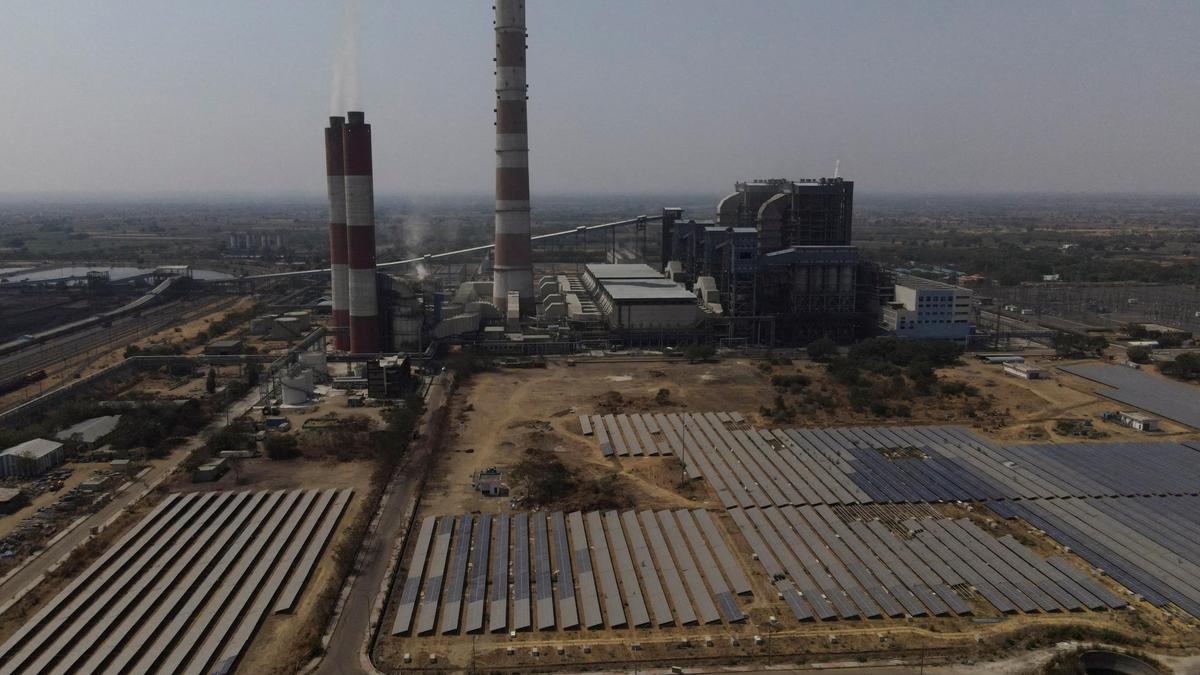
Renewable energy (RE) projects including utility scale battery storage have begun to make their appearance in India’s power sector. But the corresponding scaling up of India’s battery storage capacity, required for ensuring the stability of generation even from the proposed 2030 RE targets will run into a few trillion rupees at least. Part of such expansion would have to be funded by the government, deploying resources that would have been utilised in other sectors. At the very least, the deployment of such large-scale battery systems is not immediately feasible. The most globally widespread option of energy storage in reverse pumped hydropower systems, has very limited scope in India at present. Additionally, environmental concerns, and water needs for competing uses such as irrigation, as well as the regulatory challenges faced by all large hydro projects are likely to preclude any rapid expansion.
Optimistic RE projections, not only in India but even globally, have run into the lack of transmission capacity and the challenges of grid balancing, with the associated costs often omitted when referring to the cost-effectiveness of RE power.
Since, for India, coal is the mainstay of power generation when solar and wind cease, unlike the large-scale gas and hydro available elsewhere, the full utilisation of the available RE capacity will inevitably have to be “curtailed”, while adding to the operation and maintenance costs for thermal power operated in this cyclical fashion. These add further to the true cost that India bears for the pursuit of its climate commitments.
Improving energy efficiency in other sectors is also being pursued vigorously, including the introduction of mandatory emissions intensity targets in key industries. The early ramp up of electric vehicles, while the jump from BSIV to BSVI vehicle emissions standards was just coming into place, was another leap-frog moment, whose cost to the economy must not be underestimated. Since the 26th Conference of Parties of the United Nations Framework on Climate Change at Glasgow, every Central government budget has seen a range of initiatives and resource commitment across various aspects of climate mitigation. Indeed, a major knowledge gap today is that while future costs of increased mitigation action are routinely calculated, the cost burden attached to India’s mitigation initiatives undertaken so far, in the absence of any significant climate finance, have yet to be estimated in a reliable manner.
Accounting for India’s developmental future
At a more over-arching level, India’s mitigation challenge cannot be based on a simple extrapolation of the current structural features and trends of its economy.
India’s developmental future needs room for further large-scale growth in manufacturing and industry, expansion in the provision of goods and services to its population at adequate levels beyond the minimum, and an urban transition that has only just begun. In this context, the “India can do more” arguments that rely on such extrapolation of economic trends and the persistence of current structural features, miss the urgent need to hedge India’s developmental future.
India cannot commit its NDCs to preserving the Paris Agreement goal of limiting global temperature increase to 1.5 degrees above pre-industrial levels, when the goal is rapidly slipping out of reach. This a trend that India cannot reverse, given that its per capita emissions are a third of the global average. Even otherwise, under the voluntary emissions reduction NDCs of the Paris Agreement, the benefits of India’s reduction in emissions below any business-as-usual baseline, are distributed primarily to the big emitters globally, due to their inadequate efforts, and proportionately less to India, especially when the largest historical emitter has walked out of all climate treaties and seeks to dismantle climate action both at home and abroad
India’s climate commitments have to be strategic and circumspect, while its NDCs are formulated in informed self-awareness of its, to use the language of the Paris Agreement, “national circumstances.”
(T. Jayaraman is with the National Institute of Advanced Studies, Bengaluru. Views expressed are personal.)
Published – April 07, 2026 11:01 pm IST