

Skip to content
  • Facebook
  • X
  • Linkedin
  • WhatsApp
  • Associate Journalism
  • About Us
  • Privacy Policy
  • 033-46046046
  • editor@artifex.news
Artifex.News

Artifex.News

Stay Connected. Stay Informed.

  • Breaking News
  • World
  • Nation
  • Sports
  • Business
  • Science
  • Entertainment
  • Lifestyle
  • Toggle search form
  • Access Denied World
  • Snubbed For Central Contract, Marcus Stoinis’ Clear T20 World Cup Message To Australian Selectors
    Snubbed For Central Contract, Marcus Stoinis’ Clear T20 World Cup Message To Australian Selectors Sports
  • India Star Climbs Tirupati Stairs On Knees After Return From BGT. Watch
    India Star Climbs Tirupati Stairs On Knees After Return From BGT. Watch Sports
  • 3 Bangladesh Student Protest Leaders Taken By Police From Hospital: Report
    3 Bangladesh Student Protest Leaders Taken By Police From Hospital: Report World
  • “Had People United 500 Years Ago…”: Yogi Adityanath On Colonialism
    “Had People United 500 Years Ago…”: Yogi Adityanath On Colonialism Nation
  • Iran artist’s vision for culture hub enlivens rustic district
    Iran artist’s vision for culture hub enlivens rustic district World
  • Access Denied
    Access Denied Nation
  • Congress Leader’s “China Not Our Enemy” Remark Sparks Huge Row
    Congress Leader’s “China Not Our Enemy” Remark Sparks Huge Row Nation
Why did Iran war not affect China’s energy security so far?

Why did Iran war not affect China’s energy security so far?

Posted on April 7, 2026 By admin


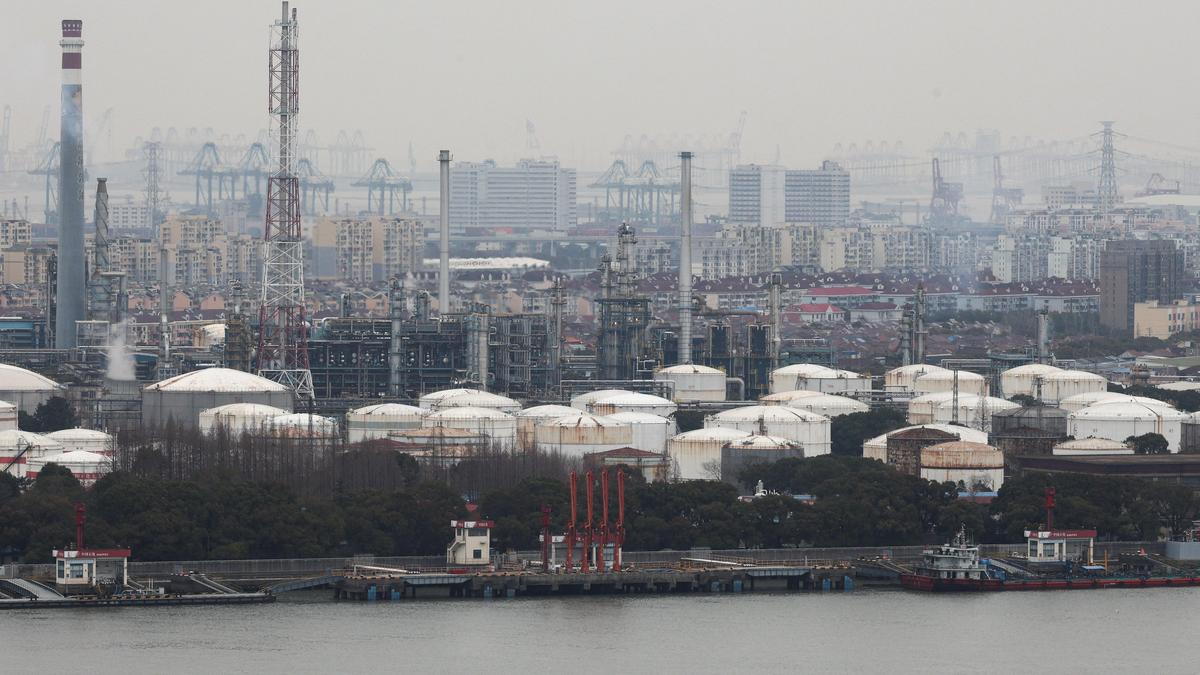
Oil storage tanks and facilities of a Sinopec plant in Shanghai, China. Photo for representational purpose
| Photo Credit: Reuters

As the Israel-US war on Iran has meandered on, India has faced the shortage of liquified petroleum gas (LPG) and experienced a social panic over the possible shortage of petrol and diesel. One does not see similar news from China despite its bigger economy, larger consumer market and role as a supplier to global markets, raising the question of how China escaped the early consequences and how, and in what ways it may be affected in the future. The answer to that question lies in what China has done in the past two decades and how its geography, its position as the world’s largest polluter, its stringent actions against the local air pollution challenges and its concerns over status have combined to protect it from the current crisis.

How did it tackle the Malacca dilemma?

About 15 years ago, China’s concerns over its dependence on the Malacca strait for trade and energy transits, and the near permanent American presence in the vicinity were real. The country sought to address this by building the capacity to create strategic petroleum reserves (SPR) and used long-term contracts to fill those up. Today China has nearly 120 days of SPR storage and it may be tapping into some of that. Data suggests that a combination of China’s oil reserves and diversification may allow it to bypass imports from the Strait of Hormuz for several months.

China’s second approach to reducing the dependence on the Malacca strait was to build pipelines to import oil and gas from Central Asia and Russia. If the straits were a geopolitical challenge, its stable relations with its Central Asian neighbours made the geography an opportunity.

Now almost 20 per cent of China’s crude oil imports happen through these pipelines, including an estimated 900,000 barrels per day from Russia. Consider that against the failed attempts to establish the Iran-Pakistan-India (IPI) and the Turkmenistan-Afghanistan-Pakistan- India (TAPI) pipelines, which have been stalled for a combination of reasons. On the other hand, China’s national oil companies like Sinopec, CNPC and CNOOC, have traditionally had deeper pockets and China has been an active negotiator in conflict zones like Sudan or Angola and their proactive strategies have also helped it create a good diversification in its imports sources.

What are China’s climate and energy strategies?

For its part, China joined hands with India, South Africa, and Brazil, to protect their carbon space, forming the BASIC bloc during the early days of global climate change negotiations.

However, it also used its status as the world’s largest polluter and managed to get the US-China Ten-Year Framework Cooperation on Energy and Environment, in June 2008, before it agreed to any commitments under the United Nations Framework Convention on Climate Change (UNFCCC). This cooperation and the subsequent knowledge and technology transfer led to the success of the Paris Climate Accord and allowed China to create a foundation for its industrial surge in sectors like solar panels, wind and tidal energy, energy efficiency and management, carbon storage and sequestration, electric mobility including cars and buses.

Along with this, China has also faced a significant criticism for its role as the world’s largest coal consumer. China has also worked to undertake energy transition plans and address the air pollution challenge that Beijing and other cities have faced via time-bound targets declared in its numerous white papers, task forces and bureaucratic restructuring initiatives.

How did EVs help lower oil demand?

China’s role as a large middle-class economy also matters. China is also the largest consumer of electric vehicles. And in 2025 nearly half of the cars sold in China were electric vehicles. Its preferential policies favour EV via tax concessions, mandates and preferential lottery chances and its scaling capabilities and larger size of consumer markets have contributed to their popularity. This has allowed China to significantly reduce its imports in 2025 and this number is bound to grow in the coming years.

Is economic slowdown a factor?

Lastly, China is indeed facing a serious economic slowdown which means its overall energy consumption is lower. It has set a modest target of growth at 4.5% for 2026. Its construction sector has nearly stalled and it means that sectors such as cement, iron and steel and others are not doing well too. China’s role as the world’s factory is changing gradually compared to how it was a decade ago, and it has been a good thing for its energy demand.

To sum it up, a combination of opportunities, proactive strategies and strategic and status concerns have helped China to stay afloat stronger in the current crisis.

(Avinash Godbole is a Professor and Associate Academic Dean, JSLH, JGU. Views expressed are personal)

Published – April 06, 2026 08:30 am IST



Source link

World Tags:China, crude oil, electric vehicles, energy supply, Malacca dilemma

Post navigation

Previous Post: Access Denied
Next Post: Access Denied

Related Posts

  • Malaysian PM, Japanese Ministers set to visit New Delhi next week
    Malaysian PM, Japanese Ministers set to visit New Delhi next week World
  • Decoding Qantas’ Ghost Flights Scandal, Which Led To  Million Penalty
    Decoding Qantas’ Ghost Flights Scandal, Which Led To $66 Million Penalty World
  • Access Denied World
  • Access Denied World
  • UK Minister For Local Government
    UK Minister For Local Government World
  • Access Denied World

More Related Articles

Covid Still Kills 1,700 A Week Around World: WHO Covid Still Kills 1,700 A Week Around World: WHO World
Stellantis, Striking US Auto Workers Reach Tentative Deal After 44 Days Stellantis, Striking US Auto Workers Reach Tentative Deal After 44 Days World
Access Denied World
Biden leads condemnation after Trump wounded at rally shooting Biden leads condemnation after Trump wounded at rally shooting World
India On Critical Mineral Deal With US India On Critical Mineral Deal With US World
Access Denied World
SiteLock

Archives

  • April 2026
  • March 2026
  • February 2026
  • January 2026
  • December 2025
  • November 2025
  • October 2025
  • September 2025
  • August 2025
  • July 2025
  • June 2025
  • May 2025
  • April 2025
  • March 2025
  • February 2025
  • January 2025
  • December 2024
  • November 2024
  • October 2024
  • September 2024
  • August 2024
  • July 2024
  • June 2024
  • May 2024
  • April 2024
  • March 2024
  • February 2024
  • January 2024
  • December 2023
  • November 2023
  • October 2023
  • September 2023
  • August 2023
  • July 2023
  • June 2023
  • May 2023
  • April 2023
  • March 2023
  • February 2023
  • January 2023
  • December 2022
  • November 2022
  • October 2022
  • September 2022
  • August 2022
  • July 2022
  • June 2022
  • May 2022

Categories

  • Business
  • Nation
  • Science
  • Sports
  • World

Recent Posts

  • Access Denied
  • Access Denied
  • Access Denied
  • Why did Iran war not affect China’s energy security so far?
  • Access Denied

Recent Comments

  1. Williamsking on UP Teacher Who Asked Students To Slap Muslim Classmate
  2. Jamesamuse on UP Teacher Who Asked Students To Slap Muslim Classmate
  3. Scottlon on UP Teacher Who Asked Students To Slap Muslim Classmate
  4. Jimmiecef on UP Teacher Who Asked Students To Slap Muslim Classmate
  5. Robertrap on UP Teacher Who Asked Students To Slap Muslim Classmate
  • IND vs NZ ODI series: India never began well, youngsters need to emulate Kohli’s mindset, says Gavaskar
    IND vs NZ ODI series: India never began well, youngsters need to emulate Kohli’s mindset, says Gavaskar Sports
  • Maharashtra hit backs to reduce Kerala to 35 for 3
    Maharashtra hit backs to reduce Kerala to 35 for 3 Sports
  • Access Denied World
  • Access Denied
    Access Denied Nation
  • Arvind Kejriwal Unwell In Jail, Has Lost 4.5 Kg In Weight: Sources
    Arvind Kejriwal Unwell In Jail, Has Lost 4.5 Kg In Weight: Sources Nation
  • Access Denied
    Access Denied Nation
  • AI gobbling up memory chips essential to gadget makers
    AI gobbling up memory chips essential to gadget makers Business
  • RBI appoints two new executive directors
    RBI appoints two new executive directors Business

Editor-in-Chief:
Mohammad Ariff,
MSW, MAJMC, BSW, DTL, CTS, CNM, CCR, CAL, RSL, ASOC.
editor@artifex.news

Associate Editors:
1. Zenellis R. Tuba,
zenelis@artifex.news
2. Haris Daniyel
daniyel@artifex.news

Photograher:
Rohan Das
rohan@artifex.news

Artifex.News offers Online Paid Internships to college students from India and Abroad. Interns will get a PRESS CARD and other online offers.
Send your CV (Subjectline: Paid Internship) to internship@artifex.news

Links:
Associate Journalism
About Us
Privacy Policy

News Links:
Breaking News
World
Nation
Sports
Business
Entertainment
Lifestyle

Registered Office:
72/A, Elliot Road, Kolkata - 700016
Tel: 033-22277777, 033-22172217
Email: office@artifex.news

Editorial Office / News Desk:
No. 13, Mezzanine Floor, Esplanade Metro Rail Station,
12 J. L. Nehru Road, Kolkata - 700069.
(Entry from Gate No. 5)
Tel: 033-46011099, 033-46046046
Email: editor@artifex.news

Copyright © 2023 Artifex.News Newsportal designed by Artifex Infotech.