




Iran is expected to have around 500 kg of uranium enriched to 60%. U-235 is the isotope of uranium conventionally used in nuclear weapons and nuclear reactors. Enrichment is the process of increasing the quantity of U-235 in the uranium mass. The rest will be U-238, which is not a good fissile material.
Whereas a nuclear reactor producing electric power needs uranium to be enriched only up to 20%, a nuclear weapon generally needs 90%. So the question is: if Iran has uranium enriched to 60%, what time and resources lie between this point and Iran possessing an a-bomb?
Bomb-grade uranium
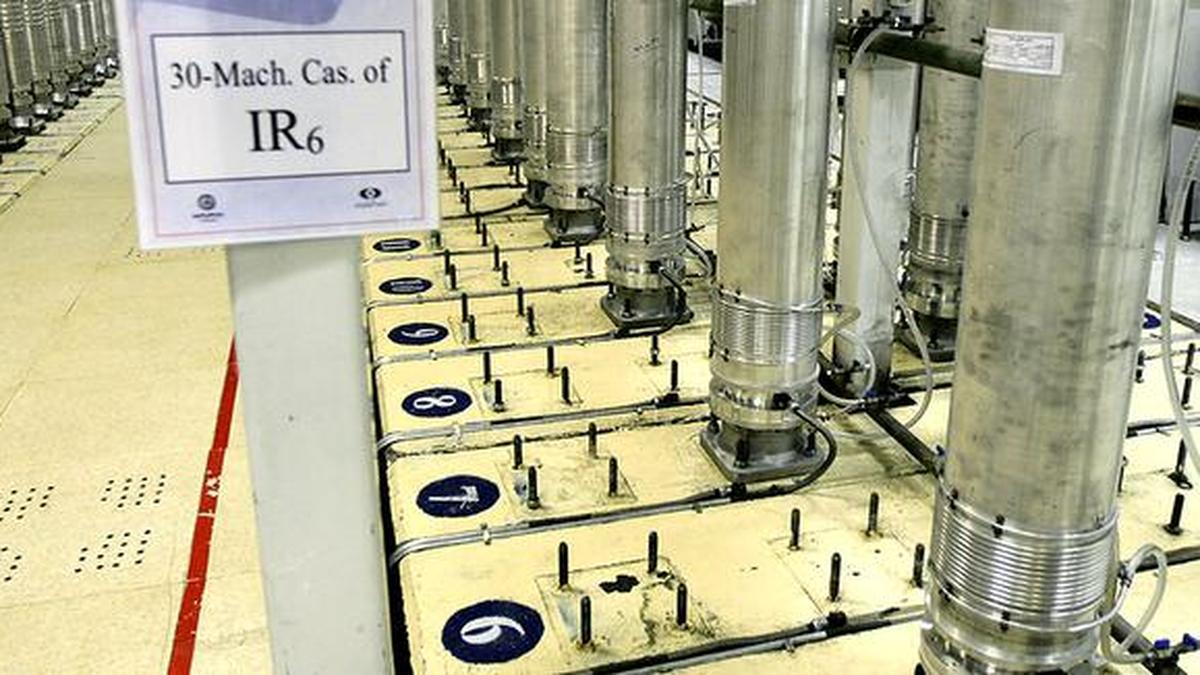
Iran has been enriching uranium using devices called centrifuges. It’s common practice to set up a group of centrifuges such that each one receives the uranium enriched by a previous unit and enriches it further. These setups are called cascades.
More centrifuges are required to enrich a kilogram of uranium from, say, 1% to 20% than it is to enrich it from 60% to 90% in the same amount of time. This is why uranium enriched to 60% has already completed 85% of the total enrichment effort required to turn it into weapons-grade material.
The International Atomic Energy Agency (IAEA) has estimated that Iran could produce 25 kg for one bomb in under 10 days. Theodore Postol, professor emeritus of science, technology, and international security at the Massachusetts Institute of Technology (MIT), suggested in an interview to Prof. Glenn Diesen on YouTube that a cascade of 174 centrifuges would take a “few weeks” but also that if the country has more centrifuges hidden away, it could be done in less than a week.
Both in June 2025 and in the ongoing war, the U.S. and Israel have attacked Natanz and Isfahan — two cities in Iran that were known to host facilities required to enrich uranium and build a nuclear weapon. However, it is not clear how many centrifuges were destroyed. Details of damages to other equipment have also been muddled.
From gas to metal to weapon
Once Iran has enriched uranium to 90%, it needs to convert the gas into a metal. The gas is in the form of uranium hexafluoride (UF6). This process is generally expected to take a few weeks, although a more modern technology called a moving-bed furnace is known to be able to complete this process in around six hours. Iran may already possess the technology; if it doesn’t, setting up a facility to metallise the gas could take a few months. The other equipment required include a cyclone separator, steel containers, and induction furnaces — plus a space the size of a “large closet”, in Prof. Postol’s words.
In ideal conditions, personnel handle the fissile material through gloveboxes, which are also filled with argon and maintained at a negative pressure (such that a leak causes air to flow into the box). The facility may also be expected to have high-grade filters, potassium hydroxide towers (to scrub toxic gases from exhaust streams), and powerful water scrubbers since personnel will be working around hydrogen fluoride gas, which is highly toxic.

The next step is to weaponise the uranium. While the IAEA has estimated this process could take up to two years, Prof. Postol argued that if Iran is ready with the necessary equipment and processes, it could weaponise uranium “within weeks” or even under a week.
To this end, again in ideal conditions, skilled personnel will need CNC machine tools, two-axis lathes, vacuum furnaces, and isostatic presses. According to Prof. Postol, these and other requisite operations would be “doable in a tunnel with just a few hundreds of square meters of floor space”.
Matter of weeks
Say Iran has enough centrifuges to enrich 25 kg of uranium from 60% to 90% in two weeks. If it has also mastered the weaponisation technology — it was expected to have as part of its Amad Plan — and already pre-stashed the required equipment, it could have a bomb ready in three to five weeks.
Alternatively, if Iran’s position is like that of a new nuclear power, it could take more than a year.
Iran has yet another option: it can skip enrichment beyond 60% and use it directly to build a nuclear warhead. It will just take more of the fissile material: around 40 kg has been shown to suffice for a weapon with a kilotonne yield.
Bomb design
Prof. Postol also said in his conversation that Iran could deliver the bomb without having to test it first if it uses the gun-type design. This comes with a caveat.
The gun-type design is the simplest design for an a-bomb. U-235 emits neutrons as it undergoes radioactive decay. Other U-235 atoms can absorb these neutrons and undergo nuclear fission. So the gun-type design brings together two sub-critical pieces of uranium to form one supercritical mass. This is the minimum amount of enriched uranium required such that, once nuclear fission begins, it proceeds at an increasing rate until the mass destroys itself.
Also read: Hiroshima and Nagasaki: 80 years after the bombing – a visual story
For the bomb, nuclear fission should begin only after the mass is supercritical, not before. The gun-type design uses a conventional explosive to blow one subcritical mass towards the other, joining them within milliseconds, creating a supercritical mass, and setting off the increasingly destructive chain reaction.
The caveat: the gun-type design is not very efficient. According to the International Panel on Fissile Materials, the mass of 90% enriched uranium required to have a yield of around 20 kilotonnes (kt) is around 50-60 kg. Using the more efficient implosion-type design for the same yield will require 15-18 kg. As the name indicates, this design causes one ‘shell’ of subcritical uranium to collapse on another.
Delivering the bomb to enemy territory is a separate challenge. Peer-reviewed research has found that figuring out how to miniaturise a bomb to fit on a missile could take years. The Shahab-3 missile can carry a payload of up to 1 tonne and travel more than 1,000 km. However, it’s not known if Iran has successfully mated a sufficiently small nuclear warhead with the missile.
One possibility here is for Iran to load the bomb on a ship, move it closer to enemy territory, and threaten to detonate it.
Nuclear havoc
Now, say the U.S. and Israel destroyed all the important facilities at Iran’s Natanz, Fordow, and Isfahan facilities, although this is highly uncertain, if not unlikely. Both technical experts and current events suggest Iran possesses or could quickly establish clandestine facilities to assemble a warhead.
This is not least because centrifuge cascades are not hard to hide underground. There were also signs after the June 2025 conflict that Iran had moved its stockpile and other resources into secure tunnels. The country also has a history of responding to military attacks by ratcheting up its nuclear programme in undeclared locations.
Importantly, as Prof. Postol said, if Israel strikes Iran with a nuclear weapon, there is no difference between whether Iran responds in a matter of months or days. The point is that it’s a nuclear-capable state and given enough time it could wreak nuclear havoc in return. Which means Iran could also put together a much smaller, more secretive, effort to build a bomb over months rather than weeks.
Finally, Iran could also build a ‘dirty bomb’, where a conventional explosive is used to disperse radioactive uranium across a large area. While uranium is not usually preferred for such a bomb, a successful detonation could still cause mass panic and social unrest.
mukunth.v@thehindu.co.in
Published – April 03, 2026 07:15 am IST